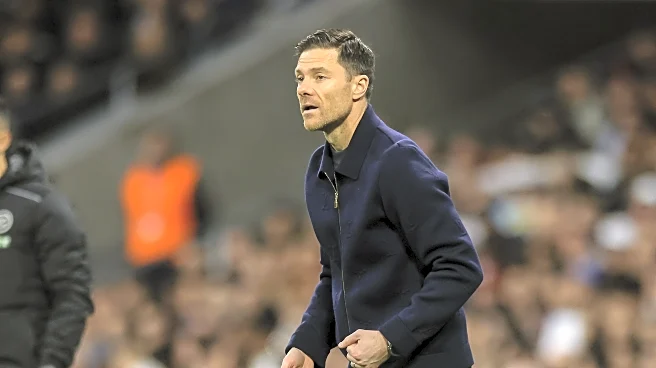

It has been just over eight years since Xabi Alonso hung up his boots, calling it quits on a legendary career that saw him win two UEFA Champions League titles, two UEFA European Championships, one FIFA
World Cup, and four league titles. Alonso started off coaching Real Madrid’s U14s before heading back to boyhood club Real Sociedad, where he coached their B team from 2019 to 2022 and guided them back to the second tier for the first time in six decades. This would earn him his first-ever top-flight coaching gig, with Bayer Leverkusen hiring him as their new manager in October 2022.
Alonso took charge of a Leverkusen side that had suffered its worst start to a season since 1979, leading them from an early relegation battle to a sixth-place finish, as well as guiding them to their first European semifinal in 21 years. The 2023/24 season, however, was beyond their wildest expectations, with Leverkusen breaking Benfica’s 59-year record for the longest run of matches without defeat (51) and winning their first-ever Bundesliga title. And whilst they would lose to Atalanta in the UEFA Europa League Final, they nevertheless beat Kaiserslautern in the DFB-Pokal Final to secure a domestic double.
Having ended Leverkusen’s 31-year trophy drought, all signs pointed to Alonso riding off into the sunset and returning to Anfield, filling the void of a Liverpool team that had lost various important coaching figures like Jürgen Klopp, Pep Lijnders, and Vítor Matos. Instead, he decided to remain put at Leverkusen, leading them to a DFL-Supercup title and a respectable second-placed finish. The homecoming that Alonso wanted wasn’t in Merseyside, but Madrid, and eventually, he got his wish. All things considered, it seemed like a match made in heaven; Alonso had already played for European giants like Real Madrid, Liverpool, and Bayern Munich. He had already performed, and won, on the biggest stage in sport – the 2010 FIFA World Cup Final with Spain. He was a young manager with fresh ideas, with a proven track record, and with the credibility needed to impose his tactics on the team. But there was one blemish on his résumé: he hadn’t worked with any superstars before. It may have seemed like a slam dunk, but for experienced coaches like Glenn Crooks, it was clear there was going to be a teething period.
“I’m a massive fan of Alonso, and I think he’s a highly intelligent person, but what remains to be seen is if he can blend what he wants to do and how he wants to coach a team that includes high-end superstars and get his message across to them,” stated Crooks. “Phil Jackson was only able to build a dynasty with the Chicago Bulls when he got the stars like Michael Jordan to buy in and sacrifice and get the rest of the team to follow, and Alonso’s going to have to do the same. But he clearly sees what it takes to win, and where to put individuals into their best spots for the team to produce. This is what has made him successful at Leverkusen in particular, and we’ll see what happens the rest of the way at Madrid.”
After replacing Carlo Ancelotti as Real Madrid’s manager ahead of the 2025 FIFA Club World Cup, Alonso led Real to the semifinals, where they were demolished 4-0 by newly crowned UEFA Champions League winners Paris Saint-Germain. Real enjoyed a flawless start to the campaign, winning seven in a row before falling to a 5-2 humiliation at Atlético Madrid. Six straight wins followed before a torrid spell that saw them lose at Liverpool and draw at Elche and Rayo Vallecano, after which Alonso admitted the difficulty of managing a squad of superstars.
”You have to get the best out of the players and make them feel as good as possible. It’s a process that has its ups and downs, but you have to know how to navigate it well. It’s essential at Real Madrid and at any team – it’s as important as footballing ideas, tactics and fitness work. It’s a very demanding job… moments when you have to react, and we’re in one of those moments right now. I’m certainly not the first Real Madrid coach who has had to deal with these situations… These moments are nothing new. We’re demanding and self-critical. We’re not happy with our recent performances.”
Real’s crisis deepened after drawing at Girona and losing to Celta de Vigo and Manchester City, but they nevertheless managed to close out the year with three straight victories against Alavés, Talavera and Sevilla, before opening 2026 with a 5-1 thrashing of Real Betis. However, it’s clear that this has been only a temporary reprieve: Alonso is well aware that if he cannot turn things around in the immediate future, he might very well receive his marching orders before he completes his debut season as a LaLiga manager. Real currently sit four points behind league leaders Barcelona, whilst they also sit seventh in the UEFA Champions League, six points behind league leaders Arsenal. The performances and the results simply haven’t been good enough, and Alonso knows that more than anyone.
Whilst Alonso has clearly made an impact on Real’s younger players like Arda Güler, Franco Mastantuono, Dean Huijsen and Álvaro Carreras, it seems that he’s still coming to grips with collaborating with Real’s veteran leaders. This reached a boiling point during El Clásico when Vinícius Jr., following his petulant reaction to being subbed off, decided to exclude Alonso from his apology letter. Apart from that win vs. Barcelona, Real haven’t yet managed to win a match against one of the top sides in Europe, and if that is to change, Alonso will need the complete buy-in of his entire squad. Although he’s managed to get the best out of Mbappé, it’s clear he hasn’t yet been able to unlock Vinícius’s full potential as a world-class attacking star.
“Vinícius is one of the best players in the world,” stated Bristol City’s Brazilian fullback Neto Borges. “He isn’t just playing well, but he’s training well and taking care of himself and doing all the things off the pitch that are necessary to succeed. He works very hard, and his numbers don’t lie; the difference he makes on the field is absurd. Even if his numbers aren’t like previous seasons, he is still an elite player, and he still has the potential to be even better, to continue doing what he does best: scoring goals, assisting, dribbling, and enchanting everyone with his football skills.”
As Alonso has come to realize, a leopard can’t change its spots. Throughout Real’s illustrious history, it hasn’t been the detail-oriented coaches who’ve had success – instead, it’s been the man managers like Vicente del Bosque, Zinedine Zidane, and Ancelotti, who’ve been able to stroke everyone’s ego and keep every single player hungry and motivated. If there is a dressing room falling-out, it has typically been the coach who has paid the price, with the president shielding his superstar players from suffering consequences. Whilst Florentino Pérez has clearly shown his confidence in Alonso achieving success, he also won’t hesitate to pull the trigger and make a coaching change if things don’t change sooner rather than later.
Real Madrid isn’t in the business of undergoing tactical evolutions – it’s in the business of winning, and right now, those wins aren’t as frequent as they need to be. Alonso will have a major test ahead of him as his team heads to Saudi Arabia to compete in the Supercopa de España. If they can beat Atlético Madrid, they will face Barcelona in the final. If they can’t, then Alonso may very well be dismissed from his post before returning to Spain.