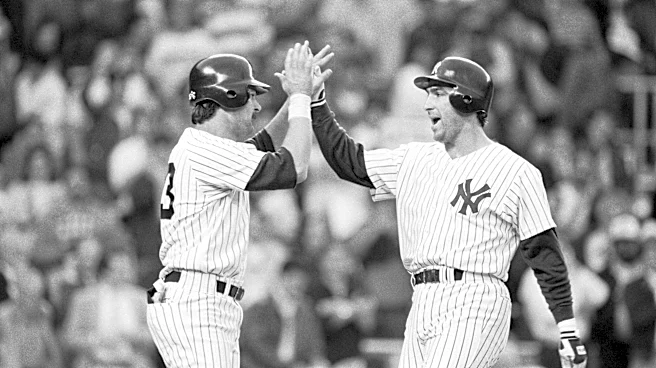



There is no worse time to hit free agency than while major league owners are colluding to hold down player salaries. And that’s awful luck. Because normally, there is no better time to hit free agency than after the best season of your life. For Jack Clark, who enjoyed a Hall of Very Good career, that confluence of circumstances is how he ended up in the Bronx.
Clark had a monstrous 1987 season with St. Louis, leading the majors in walks, on-base percentage and OPS+. Despite the larger environment
working against him, he parlayed that outstanding season into a two-year free agent deal that brought him to New York. He had a productive, though controversial 1988 campaign in New York before the Yankees dealt him to San Diego.
Name: Jack Clark
Born: November 10, 1955 (New Brighton, PA)
Yankees Tenure: 1988
Clark debuted with the San Francisco Giants in 1975 as a 19-year-old and spent nearly a decade on the West Coast. During that time, he made a pair of All-Star games and earned MVP votes in three seasons.
Prior to the 1985 season though, the Giants dealt him to St. Louis. Great timing for Clark. One thing he’d never done was play in the playoffs. Thanks in no small part to Clark, who earned his third All-Star game nod and won his first Silver Slugger while manning first base, the Cards won 101 games and the NL East.
Clark hit .381 for the Cards in the NLCS, which they won in six games over the Los Angeles Dodgers. And it was Clark who propelled St. Louis to the World Series. He came to the plate in the top of the ninth in Game 6 with two runners on, the Cards trailing 5-4.
Clark’s three-run home run won the game and the pennant for St. Louis, sending them to the World Series against Kansas City. Unfortunately for Clark, his Cardinals came up on the losing end of a seven-game series. Worse, he was on the wrong end of a couple of controversial plays in the ninth inning of Game 6, with St. Louis needing three outs to win it all. Jorge Orta, leading off the inning, hit a grounder to Clark, who shoveled the ball to pitcher Todd Worrell, covering first base. In a time before instant replay, if an umpire missed a call, there was no recourse.
Shortly after, Clark and Cards catcher Darrell Porter let a ball fall between them in foul territory (Porter later said he’d called Clark off). Eventually, two runs scored and the Royals evened the series, before blowing the Cards’ doors off in an 11-0 Game 7 rout to win the World Series.
Injury cost Clark the bulk of the ’86 season but he bounced back in a big way in 1987. Amid a baseball-wide offensive explosion, Clark put together the best season of his career. He set career marks in walks, on-base percentage, slugging percentage, and OPS+, won his second Silver Slugger and finished third in NL MVP voting. It was his 10th consecutive season (he went on to have 14 such) with an OPS+ of at least 116, a testament to his consistent offensive excellence.
That offseason, unable to get a deal done with St. Louis, Clark inked a two-year pact with the Yankees for $3 million, with another $1 million in incentives. Clark’s deal broke a spending freeze amid what we now know was a collusion-riddled era. Gene Orza, associate counsel for the MLBPA, threw cold water on the idea that Clark’s signing meant there was no collusion happening.
“Collusion is price-fixing, not location-fixing,” he said. ”Collusion takes different shapes. Why aren’t a lot of clubs interested in Jack Clark? Why aren’t they fighting to get him? Sure, Jack Clark moved. But he moved at a price that was fixed. Clubs are making offers, but they’re all the same offer. The Basic Agreement between the clubs and the players is based on the premise that there will be competition for a player’s services. The numbers aren’t competitive; they’re orchestrated.”
With the move to the American League, Clark found himself a designated hitter for the first time. But that summer, the Yankees dealt for Ken Phelps from Seattle. When Clark walked into the Yankee dugout in late July and saw his name penciled in to left field for the first time in over a decade, he lost his temper, yelling “What kind of —- is this?!” in front of a crowd that included sports writers.
Eventually, Clark made it clear he wanted to be traded, preferably back to the National League. Yankee owner George Steinbrenner publicly agreed in September to move Clark after the season ended, which is exactly what happened. The Yanks dealt Clark to San Diego a little over a month later.
In his lone season in the Bronx, Clark hit 27 bombs, drove in 93, and walked 113 times. The dingers and free passes led the Yankees, while only Dave Winfield drove in more runs. Clark was good for a 113 OPS+ and 2.8 rWAR, but the decline in numbers across all he board from his career year in ‘87 combined with his somewhat-surly nature to cast him as a bit of a disappointment in the minds of fans of that era.
Clark continued to rake in San Diego, where he played through the 1990 season. He then signed with Boston, where he played for two seasons. His 1992 campaign was awful, possibly influenced by ongoing bankruptcy proceedings. He signed with Montreal before the ’93 season but ultimately retired.
Shortly after retirement, Clark’s financial problems were solved. Years earlier, in November 1990, arbitrators ruled that the owners had colluded to suppress free agent salaries in 1985, 1986, and 1987. Among those affected was Jack Clark. After settlement negotiations, Clark received $4.4 million. The settlement, along with liquidating assets, allowed Clark to pay all of his debts.
After retirement, Clark ended up back in the majors, as the hitting coach for the Dodgers from 2001-03. He also dabbled in broadcasting, working for the Cardinals in 2009 and 2010.
Jack Clark was not a Yankee for long. And in a world without the 1980s collusion scandal, maybe he never ends up a Yankee. But in this world, he had a heck of a career, coming oh so close to becoming a World Champion whilst a Cardinal. Happy 71st birthday, Jack Clark.
See more of the “Yankees Birthday of the Day” series here.