
Earlier this week, entrenched in the hype on social media surrounding ESPN’s new Nick Saban docuseries, I stumbled upon one of his best speeches from his time as head coach at Alabama.
“And they ran through our ass like shit through a tin horn,” said Saban, recalling when his 2011 national championship team at Bama conceded 302 yards rushing to Georgia Southern.
“They all took a week off, this wasn’t important, so it’s not important to anybody
else,” he added, mocking his players.
This was a week the ‘Cats could have taken off.
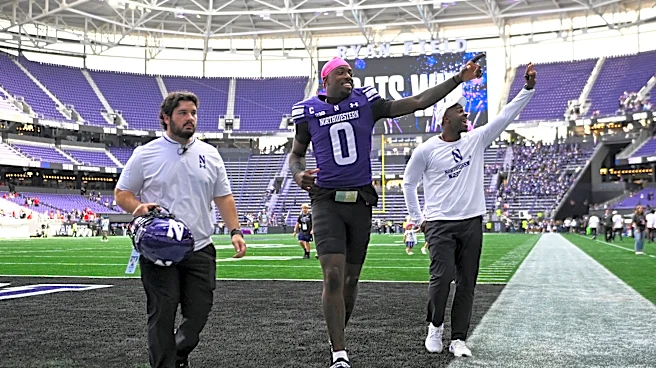
NU entered its second game at the New Ryan Field as 34.5-point favorites, after flexing its strength the week prior with a 34-13 victory over Penn State. Making the trip from Muncie, Indiana, to Evanston, Illinois, NU’s opponent, the Ball State Cardinals, were 1-4 on the year and tied for last in the Mid-American Conference. To put things simply: this was a game Northwestern was supposed to win… by a lot.
Yet, amid these circumstances, David Braun and his staff, for the most part, did not let their Wildcats become fazed. Northwestern took care of business and moved on to the next.
Here are three takeaways from NU’s 45-14 victory over the Cardinals:
1. Northwestern is explosive?
Yes, that’s right. With Chip Kelly tucked behind the play sheets, barking calls into a headset, Northwestern has become one of the most explosive offenses in college football.
On Saturday, the ‘Cats had 15 explosive gains of 15 or more yards, with nine coming through the air and six coming on the ground. Three of such plays were turned in for touchdowns: Chiles’ 19-yard passing touchdown to Griffin Wilde in the first quarter, Caleb Komalafe’s 14-yard touchdown rush in the second quarter and Alex Honig’s 32-yard touchdown reception in the third quarter.
Now having posted double-digit explosive plays in each of its first five games, NU is ranked amongst the most explosive offenses in the country.
Two great statistics that can be used to measure offensive explosiveness are explosive pass rate and explosive run rate, which measure, respectively, the percentage of an offense’s passing and rushing plays that gain big yardage (with a yardage threshold that is typically a gain of 15+ yards, but is not defined in the graphs shown below).
Through Week 6, the ‘Cats have graded out metrically as the nation’s most explosive passing offense, while being right up there with Indiana, Louisville, Texas Tech and Auburn for the crown of most explosive rushing offense.
And, though there is no website that tracks historical offensive explosive rate, it’s no hidden truth that the ‘Cats have had a more traditional, rugged offensive identity in recent history. Since the Ryan Fieldhouse training facility opened in April 2018, NU has not averaged over 25 points per game in a single season. The state-of-the-art indoor turf facility had never seen a high-flying offense until this year.
However, the explosiveness is not just offensive. This ‘Cats defense also deserves credit for being punchy.
Northwestern racked up nine tackles for loss and two sacks against Ball State, while Robert Fitzgerald took an interception into the end zone for a touchdown in the second quarter.
The ‘Cats have turned over a new leaf in the takeaway department this season and are currently averaging 1.8 takeaways per game, which is good for No. 18 in the country. And havoc-makers are everywhere… six different Wildcats have takeaways: Fitzgerald, Braden Turner, Ore Adeyi, Brayden Brus, Damon Walters and Michael Kilbane.
Taken together with the offense’s control of the football (see next section about Aidan Chiles not having a turnover yet this season), NUFB is ranked No. 7 in the nation in turnover margin (+1.3 per game)… that’s pretty unbelievable.
NUFB 2026 is high voltage.
2. Aidan Chiles: A breath of fresh air
For years and years, NUFB quarterbacks have been turnover prone.
Fresh in the memory of ‘Cats fans is Preston Stone’s painful 12 interceptions and two fumbles lost last season. However, in reality, turnover issues at the quarterback position have haunted the ‘Cats for decades. The Steve Schnur and Tim Hughes-led 1994 team threw 19 interceptions. The Gavin Hoffman-led 1998 team threw 18. In 2007, C.J. Bachér led the Big Ten with 19. Even Clayton Thorson, one of NU’s best quarterbacks in recent history, had a turnover problem, throwing 12 INTs in 2017 and 15 in 2018.
In fact, NU’s lowest single-season interceptions thrown mark since 1990 came from the 1995 team that finished No. 8 in the AP Poll. Schnur improved his INT issues from ‘94 and threw five while Chris Hamdorf added one, for a good — but not great — final tally of six on the season.
Aidan Chiles so far this year? Zero turnovers. Zero interceptions, zero fumbles lost.
On Saturday, Chiles added to the historically efficient season he’s having in Evanston, completing 73.9% of his 23 passes for 272 yards and three touchdowns, while, once again, committing zero turnovers.
Against Ball State, Chiles continued to firmly assert himself as one of the Big Ten’s best game managers, showing a calm presence in the pocket and heightened poise under duress. Perhaps most impressive against the Cardinals, and all season long, was that Chiles has been so efficient while maintaining his mobility in the pocket.
On plays like this, Chiles has done a good job of keeping calm while rolling outside the ticks and making the right decision. On this play, the 6-foot-4 signal-caller was able to find Hayden Eligon II downfield to move the chains, but on other occasions he has been smart about knowing when to take off himself or when to just eat a sack. While nobody likes sacks, and Chiles has taken eight of them this year, some of them have been situationally necessary in order to avoid a risky, high-turnover probability play.
Following Chiles’ solid 2025 campaign — where he committed just six turnovers — myself and others were still not sold that Chiles had shaken the fundamental inconsistencies that caused his turnover problem in the year prior, when he threw 11 interceptions and lost four fumbles.
The man has proven me wrong, and, for once, it now feels like Northwestern has found “a rock” to take care of the rock.
3. Concern about the passing defense
While it’s hard to have a bad takeaway for the ‘Cats after a 45-14 win, I was slightly concerned from what I saw from the passing defense.
A 1-4 Ball State team that had averaged 174.2 yards through the air through its first five games had 270 passing yards against Northwestern and three big gains of 20 or more yards. Against a team of the Cardinals’ stature, that should not be happening.
Despite nabbing two sacks against the Cardinals, Northwestern’s pass rush was not phenomenal against the Cardinals and has been a bit weak all season long. The ‘Cats rank tied for 96th in Division I in sacks per game (1.5), a number that has actually gone down from 2025, when NU averaged 1.8 per game.
Additionally, NU is also still hurting at the cornerback position with the continued absences of starters Braden Turner and Josh Fussell. Adeyi and Montae Pate, who have filled in for the injured ‘Cats on the depth chart, were in coverage on Ball State’s two biggest passing gains on Saturday and have repeatedly been attacked through the air by opposing defenses in the past few weeks.
As a result, though NUFB’s defense — and more specifically its passing defense — grades out well per many analytical definitions, one place it struggles is in passing success rate allowed, a statistic that measures how often opposing offenses accomplish its goal on passing downs based on a play’s situational down and distance. The ‘Cats have a passing success rate allowed of 40.8% that ranks No. 76 in Division I and 11th in the Big Ten, according to statrankings.com (a website that tracks pretty much every advanced analytic for college football).
As the success rate statistic shows, teams have had decent success getting the yardage they need against NU’s defense on passing downs, which has shown up on third downs, where teams oftentimes opt to pass. The ‘Cats currently rank No. 73 nationally with a 39.66% third down conversion percentage allowed according to teamrankings.com — that number has to go down if Northwestern wants to be serious about getting some big wins in the back half of its season.