



There’s this great moment in the (vastly superior) 1971 version of Willy Wonka and the Chocolate Factory where, immediately after purchasing some chocolate next door, Charlie Bucket overhears from the hubbub of a crowd surrounding a newsstand that one of the claimed golden tickets has been proven a fraud.
Musically, it’s perfection. The moment of revelation is met with a marvelously-timed reverberating bell-like tone that hangs in the air as Charlie turns to walk away, which turns into the mischievous
trilling of woodwinds (that some part of my subconscious swears John Williams repurposed in the Harry Potter score) and sharp, heart-pumping piccolo-esque runs that pick up just as Charlie opens his final Wonka bar, before being replaced by the building of triumphant horns and strings as he discovers the last golden ticket.
It’s the first real sense of magic in the downtrodden opening of a film that still manages more wonder than a series of successors made with unquestionably superior technology, and it conveys it primarily through sound.
It sets the tone, so to speak, for the rest of the film.
I must confess that the usage of that phrase in the context of sport baffled me as a child. For whatever reason, my introduction to that word was initially musical, melodic, symphonic. It didn’t make sense to me in the context of the Spurs, which I expressed to my grandmother as we watched David Robinson run amok on the last iteration of the Charles Barkley Suns (the first time I can recall sitting down and watching an entire playoff series with her).
“Well, you must not be listening very well,” she said matter-of-factly. “Every sport has its sounds. Listen closely the next time he (The Admiral) scores.”
Not even a full thirty seconds later, Robinson was able to establish position against Barkley, and with a nifty change of direction, went right over him and off the glass for his final (and 40th) points of the night.
And even through the speakers of the television set my grandparents had purchased in the early-80s, the eruption from the crowd was cacophonous.
“You see? Sometimes they make music with the basketball. And sometimes they play the crowd.”
“Like an instrument?”
“Mhmm, if it’s a good crowd.”
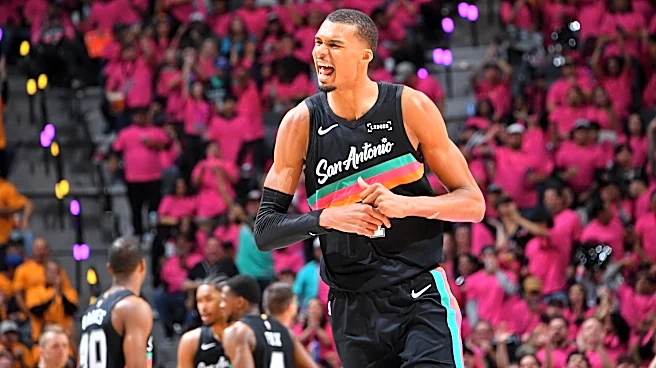
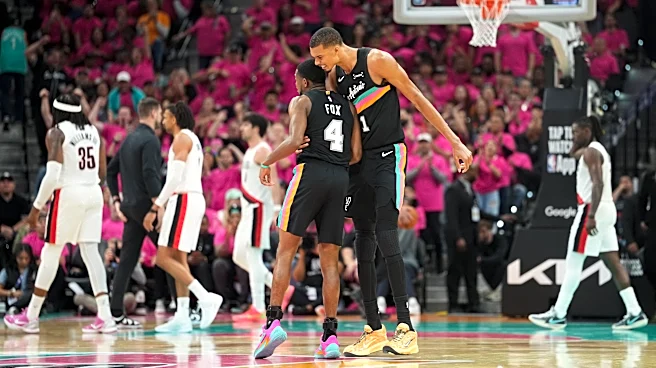
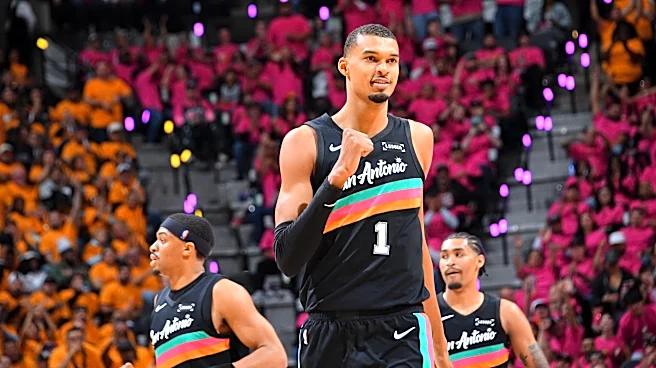
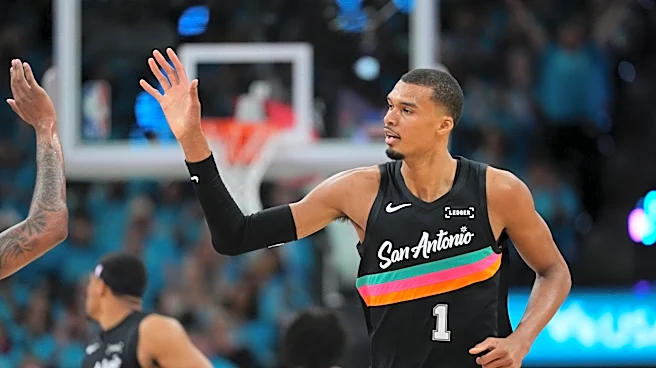
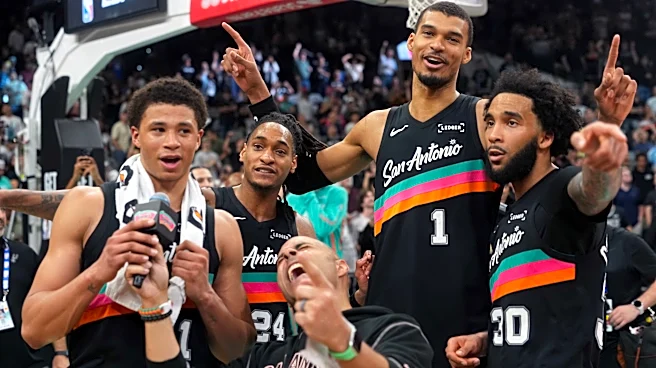
Well, last night featured a very, very good crowd. And Victor Wembanyama played them like an orchestral conductor while he and his teammates set the tone of the series.
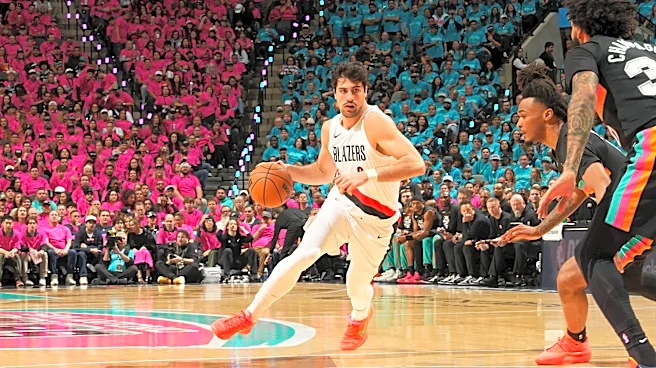
Not that San Antonio playoff crowds haven’t always been good, but the extended absence seemed to make it take on a life of its own. The years of feeling like Charlie Bucket, after decades of taking the postseason for granted, added to the fever pitch of pseudo-hallucinogenic pinks, and oranges, and blues.
Seemingly every fan was Fiesta-clad, determined to make the most of the moment, mirroring the spirited young team on the court. For the first time in a long time, Spurs fans and players were just happy to be there.
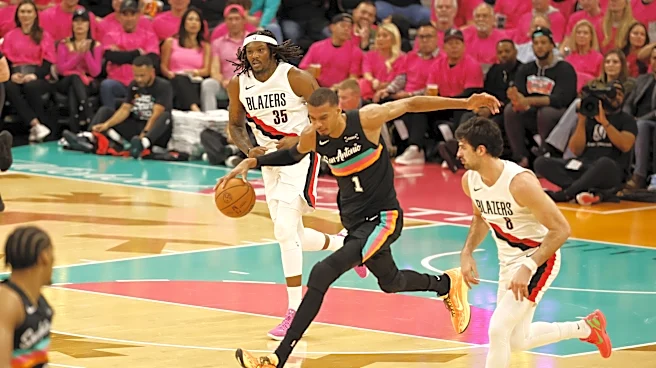
Not that that interfered with their sense of determination at all. As play began, the Trailblazers immediately announced their intention to kick the Spurs in the teeth (figuratively, and somewhat literally).
Benefiting from a friendly whistle in the first quarter (and most of the first half) Portland players immediately got physical while staging some impressive melodramas of their own. It felt a bit like watching a younger sibling punch an older sibling in the face and then run to a parent before the offense could be repaid in full.
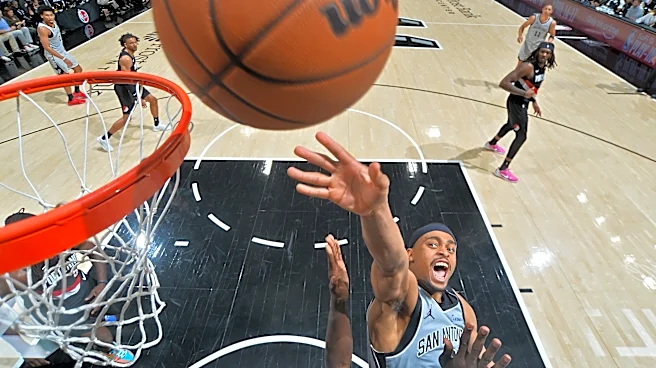
Whatever the intended effect, it resulted in the exact opposite, as the Spurs woke up and Victor Wembanyama began to attack the Blazers defense with vengeance, raining three-pointers and dunks down on the opposition like a Titan awoken from a thousand-year slumber.
At one point in the second half he missed a dunk with such force that it felt like he was attempting to tear at the very fabric of the universe, as if trying to silence all Portland crowds both present and future in perpetuity.
Wemby took the predictable shots to the still-healing ribs, refused to be pulled, and when the dust had settled, had unseated the most fundamental Spur who ever lived from his long-standing perch atop the San Antonio playoff debut leader-board.
All the while, his teammates took advantage of every inch of space that he gave them, setting the franchise record for most threes made in a half and finally beginning to capitalize on all of Portland’s contact as the officials abandoned their Mr. Magoo act and rewarded them for their perseverance at the free-throw line.
All the while the crowd made themselves known, ooing and aahing and chanting and booing in equal measure with the unity and harmony of a Gregorian cantorum. It was Beethoven for the sporting obsessed. Bach for the San Antonio faithful. Vivaldi for a long silver-and-black winter that had finally turned to spring.
One of the reasons I consider the 1971 version of Roald Dahl’s beloved children’s tale to be superior to the versions that followed, is that it earns its joy. There’s a darkness in the book that lends itself to black comedy of the highest order, but that film leans away from the comedy and into the bleakness of the situation.
Very much of film its time, it almost effortlessly evokes the financial difficulties of the 1970’s — the stagflation, the loss of faith in institutions and in people. It juxtaposes the enthusiasms of a child against the knowing fear of the grown-ups in his life.
The mother who has lost optimism for her own life, but lives for the joy of her son. The grandfather desperately trying to preserve the miraculous idealism of childhood in his only grandchild. The very adult hope that exists in the atrophy of faith permeates the landscape of both the bodily able and the bedridden.
All the music of the moment that Charlie finds his golden ticket means less without all of these things first.
I’ve got another confession to make (insert Foo Fighters joke here): I’ve never written about a playoff game.
San Antonio’s series against Denver took place during my rookie year at PTR, and I was (understandably) pretty far down the line of writers with seniority. My only postseason-adjacent bit of writing was back in 2022, when the Spurs made (and immediately flamed out of) the Play-in.
I’ve been waiting for this moment for a while now, like the rest of you. And after years writing in the postseason-less trenches, I can see that even I took it for granted. I am not old enough to remember the times before David Robinson arrived. I understand now, more than ever, what that 1999 title meant to Spurs fans.
I felt like one of those bedridden grandparents the year the Wemby was on the table, unwilling to engage with hope for fear of the alternative.
And then I felt like Grandpa Joe climbing out of bed when the lottery went San Antonio’s way.
Last night I felt like Charlie Bucket entering the factory. I’ve got a golden ticket. We all have a golden ticket. His name is Victor Wembanyama.
And I don’t know what’s going to happen in the factory, but I’m prepared to see wonder after wonder.
I can hear the music, and the music is euphoric. And I think we’ve all earned that.
Takeaways
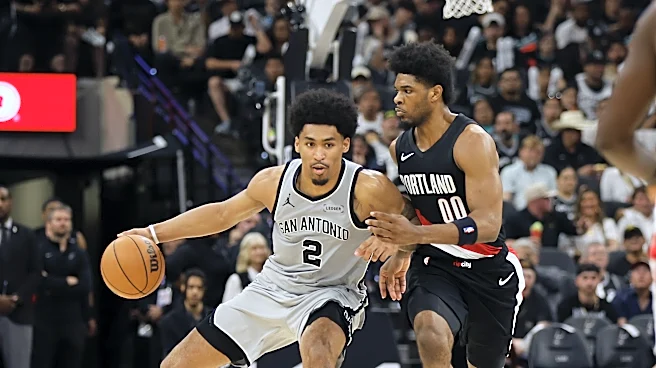
- I have to admit, Stephon Castle and Dylan Harper looked a little shaky in the first half. They combined for five turnovers, and the penetration and long-distance shooting just was not there. They picked it up in the 2nd half, but boy am I glad that none of us run San Antonio’s front office, because it was largely De’Aaron Fox steadying the ship, and he spent most of the game picking his spots carefully (yet aggressively), finding the open man, and feeding the rampaging monster that was Victor Wembanyama. I’m gonna go out on a limb here and recommend that we keep that guy around for a little while longer. He seems good at basketball.
- Having been one of those who covered the 2022 play-in game, I was 0% surprised to see Devin Vassell completely unshaken and rising to the moment from the onset of the game. It’s a detail that’s been a bit neglected since, but it was Vassell (not Dejounte Murray) who led the team in scoring (and pretty much every other way) in that contest, and he came in clutch one several occasions as the Trailblazers did their level best to close the gap. The Spurs were able to keep them at arm’s length for most of the game, but it would have been a very different game without Vassell doing yeoman’s work on both ends.
- Julian Champagnie continued his Danny Green impersonation so convincingly, that I’m starting to suspect a body-swapping scenario. The box score isn’t going to do justice to how often he helped keep the perimeter from collapsing against a Portland team that refused to give up the ghost and were looking to take advantage of any and every opening. Both of his threes were well-timed, but it’s always amusing to see teams really do their best to scheme him out of San Antonio’s offense because of how much they (justifiably) fear giving him an open shot. I don’t know how well they’re going to be able to keep that up, though, because he is just incredibly slippery off-ball, to the point that they lost track of him on a number of occasions. If Castle had been in a less jittery headspace, I’m reasonably certain he would have capitalized more on those lapses.
- Boy howdy did Luke Kornet look *healthy* last night. I recognize that Portland’s big-man rotation is less than stellar, but Kornet was almost as much trouble as Wemby on the defensive end, and he kept finding space to throw it down on the other end. With all of the collected youth, it’s easy to forget that San Antonio’s does have vets with title-winning experience, and Kornet did exactly what he was brought here to do against the Trailblazers. If they get more of that version of Kornet, this is going to be a quick series.
Playing You Out – The Theme Song of the Evening:
Best of You by Foo Fighters