
While the offensive line did a pretty bang-up job against the Packers, who boast a solid defense and front-seven, and didn’t have a single sack recorded against them, it felt like pass protection was a bit
all over the place. Some plays you had the perfect pocket for Bo Nix to step up into and deliver a strike, while others he was running for his life.
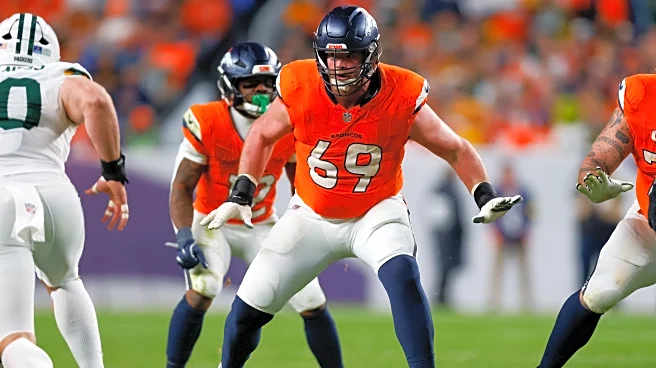
Now, we’ll determine if that was his fault or the offensive line’s fault, and we’ll also take a look at what went wrong when it went wrong. And I think the best way to do that is by taking a look at an offensive tackle, particularly Mike McGlinchey.
It’s been a little bit since we focused on him, and it felt like he was due for his next film review. Let’s see how one of the best offensive tackles in the league did on Sunday.
Stat crunch
The Broncos had 63 offensive snaps that weren’t kneel downs. 27 of them were designed run plays and 36 of them were designed pass plays. This was one of their more balanced games when it comes to play calling.
Mike McGlinchey would play all 63 of those snaps, and twice he would line up on the left side of the line in the on-ball TE position in their heavy sets.
McGlinchey finished the game with zero blown blocks, zero TFLs given up, four pressures, zero QB hits, and zero sacks. (I consider blown blocks as a block where the lineman gets beat immediately).
He had one false start penalty.
McGlinchey scored six “Bad” blocks, four “Meh” blocks, nine “alright” blocks, and 44 “Good” blocks. With the subtraction of points due to his penalty, this is good for a score of 52.25 points out of a possible 63, or 82.9%.
In run protection he had an unadjusted score of 80.6% and in pass protection he had an unadjusted score of 86.1%.
In general
This was not McGlinchey’s best game on the year. In fact, it might have been his worst when it comes to pass protection. Statistically this is the most amount of pressures I’ve seen him give up in a single game. The false start, while not a regular occurrence, is not something we haven’t seen before. He now has four of those on the year. And he did have that block on the first drive where he got shed by Micah Parsons, who forced the fumble.
McGlinchey is an interesting blocker, and for a big chunk of his plays, you can predict the success of his block from just the initial contact alone.
In run protection, when McGlinchey is the one hitting first and getting his hands in the proper spot off the jump, he rarely loses that rep. However if he doesn’t have the needed leverage on first contact, it can be really hard for him to get it back. In pass protection it’s a similar idea. If he’s able to fend off the first rush move, then he’s stout. The big issue I saw on Sunday is that when he loses, it’s typically due to him getting compressed into the pocket, which is usually a result of losing the pad-level battle. And when he does get compressed, it usually starts at the point of initial contact, and not something that results from a secondary rush move by the defender. You’ll see what I mean when we take a look at a couple of these reps.
Another interesting note to make is that when Parsons lined up over him, Denver was chipping him or leaving an extra blocker most of the time. But when he was lined up over Garett Bolles there was a lot more one-on-one blocking. Maybe this suggests that Denver trusts Bolles more in pass protection, which they should. McGlinchey isn’t bad, but Bolles is just better.
And while the bad reps were fairly poor, he was good the majority of the game. With how often the Broncos run their Inside Zone concepts, McGlinchey is almost always able to wall off his defender. He is athletic on the boundary when they ran Pin and Pull to his side. And he finished well on much of his run fits.
The specifics
Run play – Inside Zone – Bad block

Here is the play that nearly derailed the game before it could really get started.
Mike McGlinchey is lining up against Micah Parsons, who while mostly known for his pass rushing ability, is quite astute in run protection. Off the get he already has the leverage game won as Parsons is inside of him, so all McGlinchey has to do is get his head on the near shoulder and work Parsons inside. He actually does a good job with that at the beginning, made evident by Parsons hopping on one foot a couple of times.
But as the block goes on, McGlinchey gets too tall in his pads, allowing Parsons to get his eyes on the ball carrier, and he then sheds the block. He’s able to do this because McGlinchey wasn’t able to fully close out the block and left too much space between him and Parsons.
I might be grading based off the result of the play here, as I probably would’ve just given him a “Meh”, but since Parsons was able to force the fumble I gave it a “Bad”. I think I’ll stick with that, but I wanted to still give McGlinchey some credit here and some insight as to why I didn’t consider this a blown block.
Run play – Inside Zone Lead – Good block

The biggest aspect of McGlinchey’s game that this clip demonstrates is his patience.
He’s working to his left while looking back to make sure Crum’s guy doesn’t spike inside on him. He then flicks his eyes to the playside to see if the DT over Meinerz spikes to the B gap. After clearing both gaps at the line of scrimmage he then works up to the linebacker and puts a great block on him.
He gets a great fit initially on the backer, turning him to the outside to open up a rushing lane, and when the backer tries to work across his face, McGlinchey is quick to flip his hips and maintain his hand leverage. It’s crisp and a lot harder to execute than it may look.
Pass play – Drop back – Bad block

Here is an example of one of the pressures he gives up do to him getting compressed in the pocket.
This block is doomed from the moment the DE makes contact with him. It’s all about that initial moment of hand fighting. It looks like McGlinchey just slightly missed with his hands, hitting too high up on the shoulder pads and you can also see that he lands his hands out too wide. Since he wasn’t able to get his hands to the DE’s chest plate, this makes it even easier for the DE to work that hand swipe, which puts McGlinchey on his heels.
McGlinchey is then having to play on his heels, and that’s fighting a losing battle and he’s unable to regain his base, allowing for the DE to force him back into Nix’s lap. Better initial hand fighting and playing with his but a little more behind him would’ve helped this block.
Run play – QB Sneak – Good block

On a QB Sneak most of the action takes place between the offensive guards and the center, but McGlinchey does a great job of getting into the fray. He’s lined up on the left side of Bolles and his job is simply to prevent anyone from coming through the C gap.
He’s firing off at the snap and takes a great angle that would cut off any attack to that C gap, and when the edge defender declares, McGlinchey just buries the guy. The smaller-bodied defender stands no chance against this down block. And the bonus is that McGlinchey runs the guy over the back end of the pile, tripping him and getting the defender to the ground. It’s always good when you land on top of your guy.
Final thoughts
The film shows what we know about him. He is almost always a solid B to B+ player that occasionally has those A- to A games. It’s almost a luxury that he can have what feels like a bad game for him, but it’s just a B-. Most teams can’t say that about their tackles.
I might be making a weird analogy, but Denver’s offensive tackles feel like their cornerbacks. There’s one who is just the best in the league at what he does, but the guy on the other side of the field would be the best player at that position if he was on another team. And that guy is almost always reliable and serves as a great tandem player.