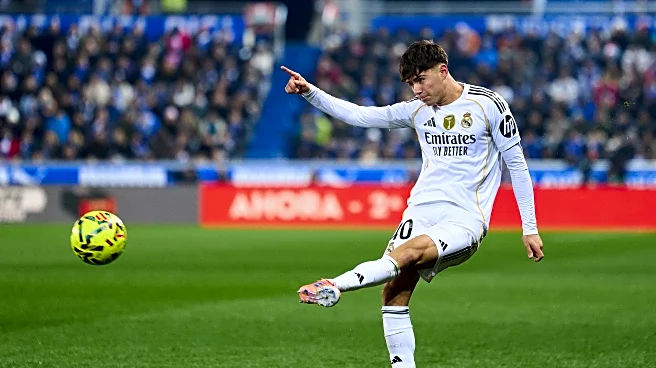




Víctor Valdepeñas’ first appearance with Real Madrid’s senior team should have been remembered solely as a milestone moment — the realization of a dream shared by every academy player who wears white. Instead, the hours that followed his debut became unexpectedly turbulent, placing the young defender at the center of a conversation he shouldn’t have been a part of.
According to a report from Marca, Real Madrid head coach Xabi Alonso took it upon himself to immediately defuse the situation.
The controversy
stemmed from Alonso’s post-match analysis following Madrid’s draw with Alavés. While reviewing the game, the coach publicly praised Valdepeñas’ overall performance, highlighting his composure and solidity across the match. However, Alonso also pointed out that Madrid conceded on the only play in which the young defender made a mistake, saying: “We conceded on the only play where Valdepeñas made a mistake, because in all the others they were very solid.”
From a purely footballing standpoint, the comment was measured and analytical. Yet because it was delivered publicly — and because it concerned a debutant experiencing his first night under the brightest lights — the remark was interpreted by some as an unnecessary exposure of a youth player.
But that wasn’t Alonso’s intention, whose words were intended to praise the young left-back and highlight that he only made one mistake.
Marca reports that Alonso later recognized that, while his assessment was honest (though it’s debatable whether Valdepeñas actually made a mistake on that particular play, as Managing Madrid’s Kiyan Sobhani notes in the video below); the timing and setting were not ideal. Rather than letting the narrative spiral, the coach chose to address the issue directly.
After his press conference, Alonso reportedly sought out Valdepeñas in the locker room and spoke with him face-to-face. In that private conversation, the coach clarified his intentions, acknowledged that his words had unintentionally placed the player in an uncomfortable position, and offered an apology. The message was clear: the comment was never meant to single him out or diminish what had otherwise been an impressive debut.