
The unofficial start of trade season is upon us. Starting Monday morning, all but 17 of the NBA’s 540 players will be eligible to be dealt. The 82 players signed in the earlier part of the summer will be added
to the pool of players GMs can move around the board. (The remaining 17 free agents signed later in the summer become eligible on January 15.)
Reports of impending trades could come even earlier. Last year, Shams Charania tweeted out news of the trade of Dennis Schroder and a future second rounder for three other future seconds at 4:36 p.m. nearly eight hours before the deadline. At that point, the Nets wanted to improve their chances for a top pick, the same situation they find themselves So don’t be surprised if there’s early word.
Moreover, according to various reports, the Nets have been trolling the NBA for salary dumps, trading players for even more draft assets beyond the 13 first rounders, two first round swaps and 19 second rounders already on the big board at HSS Training Center. With their $15.3 million in cap space left over from the summer, they could be involved in dumps or as a facilitator in other, multi-team deals.
As Shams noted last week, they have flexibility … and little competition.
The Nets have $15 million in cap space and can create more, which has led to increased trade talks about using their room to absorb salary while receiving assets, sources said. The Nets, Pistons ($14.1 million trade exception) and Utah Jazz ($18.4 million trade exception) are the only teams with significant room that can take in larger deals and not be impacted by the apron.
Cap space offers more flexibility than trade exceptions.
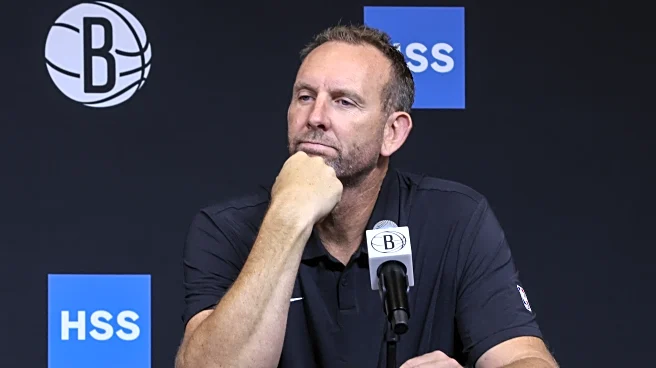
Since then, Jake Fischer of The SteinLine and Brian Lewis of the Post have confirmed the aggressive stance Sean Marks & co. are taking. Wrote Fischer:
My best read on Brooklyn at the moment is that it has mostly abandoned its ambitions for jumping straight back into the star market in the wake of the Kevin Durant/James Harden/Kyrie Irving Era. It was two summers ago that the Nets, who once viewed Mikal Bridges as their in-house No. 2 with the ability to help attract a true alpha to Barclays Center, dealt Bridges to the Knicks. I’m told Brooklyn has since set its sights on the upper reaches of the forthcoming draft in hopes of adding a potential rookie superstar to the five first-round selections it made this past June.
As for Lewis, he reported this weekend that despite a fan debate between the pro- and anti-tank corps, there appears no indication of any change of mind by ownership or the front office on the original plan to get as high a pick as possible in the May lottery, noting Joe Tsai’s comment back in September, “We have one pick in 2026 and we hope to get a good pick, so you can predict what kind of strategy we’ll use for this season.” Lewis wrote:
Teams are leery about trading away huge quantities of first-round picks for stars on the wrong side of 30, and instead hoarding draft assets. That’s still very much what the Nets plan to use their league-high $15.3 million in cap space for, to absorb yet more salary dumps in order to garner other team’s draft picks.
League sources have consistently told The Post that Brooklyn’s plans remain the same.
And while there’s been a lot of speculation about who the Nets might move, with the leading candidates being Michael Porter Jr. and Nic Claxton, Lewis hints at a specific scenario that had some currency in the summer: a deal with Boston. In it, the Nets would take on Anfernee Simons expiring $27.7 million contract in return for trade assets. Simons, 26, averaged better than 20 points a game over his last four years in Portland, but has had reduced role in Boston this season after being sent to the Celtics by the Blazers for Jrue Holiday in the off-season, itself a salary dump.
Brooklyn’s reported asking price to take on Simons and help Boston avoid CBA sanctions — a first round pick — was deemed too steep for Brad Stevens. In addition, Boston has made subsequent moves that made their situation less onerous.
Then, there’s the issue of Cam Thomas whose recurring hamstring issue won’t be re-evaluated for another week. His situation is tricky. Having exercised his $6.0 million qualifying offer, Thomas would have to approve any trade and lose his Bird Rights with his new team. He appears to have already made one contract mistake with the QO, turning down a one-year, $9.5 million contract and a two-year, $30 million deal with the second year a team option. Would he be willing to take another chance, stick around and try his hand at unrestricted free agency in the summer?
Jordi Fernandez seemed to hint that when Thomas does return this season, his role will be different, considering how well the team has played in his absence.
“That’s a good question,” Fernandez said when asked about Thomas’ role. “The context is different [now]. Before Cam got hurt, obviously, his superpower was the ability he had to score. At the same time, we always want to see playmaking efficiency and improvement on defense. So all those things were important at the time. Now, he’s been out, the team continues to get better and play in a [good] way… The skillset, he’s very unique and very good at what he does. But at the same time, now the group is taking positive steps.
“For the most part, I’m very happy with the whole group. And now when he comes back, it’s going to be on me to figure out how we introduce him into the group, and thinking that the most important thing, it’s always the group.”
Hardly a ringing endorsement.
During the summer, the Nets used $40 million in cap space plus $1.1 million in cash to acquire two first round picks, one in 2025, another in 2032, a second rounder also in 2032 while also taking on the contracts of MPJ, Haywood Highsmith, Terance Mann and Kobe Bufkin (who they later waived.)
It seems quite obvious they are not done.