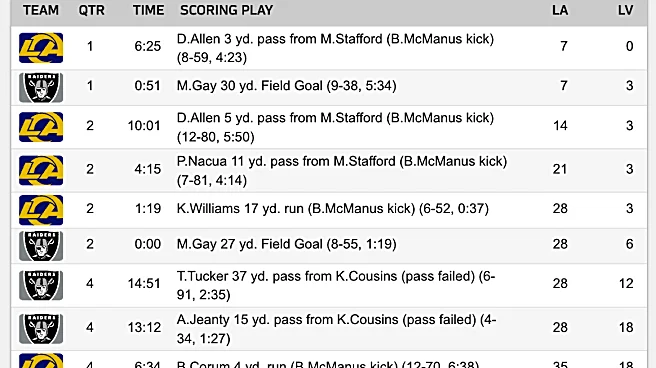



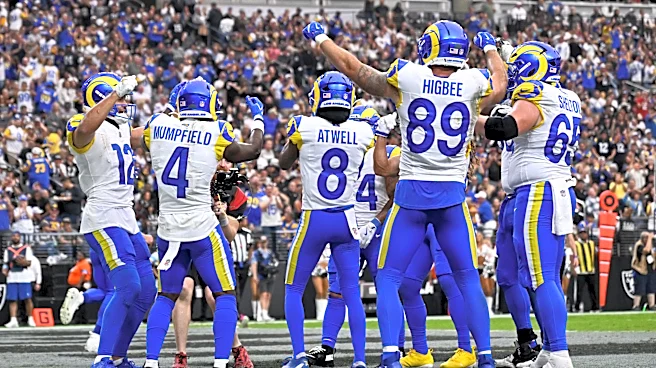
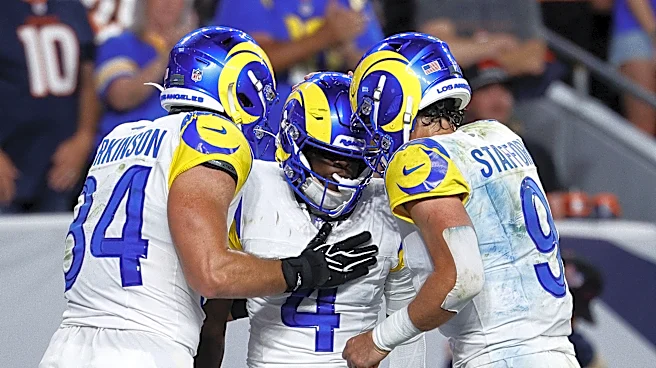
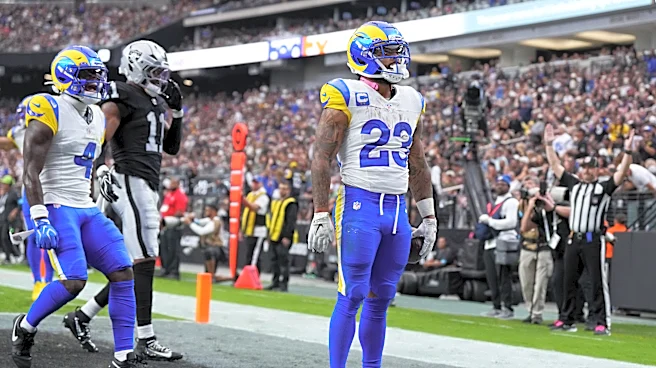

The Los Angeles Rams entered Week 7 against the Las Vegas Raiders with several key injuries, including wide receiver Davante Adams. Additionally, Los Angeles hadn’t logged 100 or more rushing yards as a team
in its previous two contests. However, none of that mattered with the Rams cruising to a 35-21 victory while setting a season high with 199 rushing yards and 5.2 ypc, including three kneel-downs from quarterback Matthew Stafford.How did that happen? L.A. leaned heavily on 13 personnel (one running
back, three tight ends), and Las Vegas simply had no answer for it.
According to Sumer Sports, the Rams were in 13 personnel for 50 percent of their offensive snaps, which is 41.17 percent higher than the NFL average. While Stafford didn’t exactly torch the Raiders through the air with just 195 passing yards, he completed six of nine passes (66.7 percent) for 51 yards, a 0.02 EPA per pass and 66.7 percent success rate with three tight ends on the field.
That being said, it was the rushing attack that really did the Raiders’ defense in.
Los Angeles had 25 rushes for 111 yards (4.4 ypc), a 64 percent success rate and 0.24 EPA per rush out of 13 personnel. Vegas’ defensive coordinator Rob Leonard tried to counter with more base personnel on 61.8 percent of his play calls, up exactly 40 percent from the season average, but that didn’t matter. Leonard’s crew allowed 0.125 EPA per play (run and pass) on 33 plays with seven front seven defenders against the Rams’ three-tight end looks.
But to really answer the question of how it happened, we have to turn on the film to find out.
We’ll start with a few passes because the Rams actually had more success throwing the ball out of 13 personnel earlier in the game and then leaned on the rushing attack to close it out. Also, the Raiders have been getting killed by the play design above, as the New England Patriots and Buffalo Bills had success with it. So Los Angeles copied it, and the result was the same: an easy first down.
Pretty much every time the Raiders face 12 or 13 personnel, Leonard has an off-ball linebacker on the line of scrimmage. Typically, it’s Quay Walker, but in this instance, it’s Tommy Eichenberg.
Meanwhile, the Rams run a play-action fake where the outside tight end has a corner route to occupy Darien Porter (the corner at the top of the screen), who is responsible for the deep third of the field. That’s another key tendency at play here; Leonard leans heavily on Cover 3 behind this front.
So, when Eichenberg steps down to play the run and sees the tight end release upfield, by the time he recognizes it’s a pass, there’s no chance for him to get in the flat with enough time to disrupt the pass to Puka Nacua. On top of that, with Porter pulled out of the play, Nacua is wide open for an easy catch and run to move the sticks and put the ball in the red zone.
In other words, Sean McVay was able to manipulate the defense to get the look he wanted by leaning on Leonard’s tendacies and following the blueprint that the Patriots and Bills used.
To be honest, there isn’t too much to break down on this one.
The Raiders are in man coverage, which gets confirmed by the tight end’s (No. 87, Davis Allen) pre-snap motion, where Treydan Stukes mirrors his movement step for step. Post-snap, it’s play action, and Stukes sees Allen bluff a block on Jeremy Chinn, so the rookie takes his eyes to the backfield. He quickly realizes he’s been duped and it’s a pass, but it’s too late. Allen is wide open in the end zone for an easy pitch-and-catch to put six points on the board.
That’s the result of knowing what coverage is coming, allowing a veteran play caller and quarterback to pick on a young defensive back.
This time, it’s third and two, and Las Vegas does a decent job of not falling for the run fake despite the down and distance. However, that doesn’t matter when it comes to the end result.
The Raiders are playing Cover 2 where, at the bottom of the screen, Porter is the end man on the line of scrimmage and Eichenberg takes a couple of steps toward the line when the tight end motions across the formation to get into a two-by-two set. Post-snap, the outside tight end (No. 89, Tyler Higbee) has a vertical release to run an intermediate route, and the other tight end works across the formation to help in pass protection.
So, Eichenberg gets hands on Higbee to disrupt the timing of the route a bit and pass Higbee off to Jeremy Chinn. With no one threatening his area, Porter starts working for depth but doesn’t get deep enough to tighten the throwing window to Higbee.
But the bigger problem is that Chinn gets manipulated by the tight end’s eyes/head fake, anticipating a dig or drag route across the field. So, the safety tries to cheat toward the middle of the field and jump the in-breaking route, leaving his area open while Higbee breaks toward the sideline and climbs the ladder on the out route for a 15-yard gain.
Also, it doesn’t help that the pass rush doesn’t come close to getting pressure, giving Stafford a clean pocket to throw from.
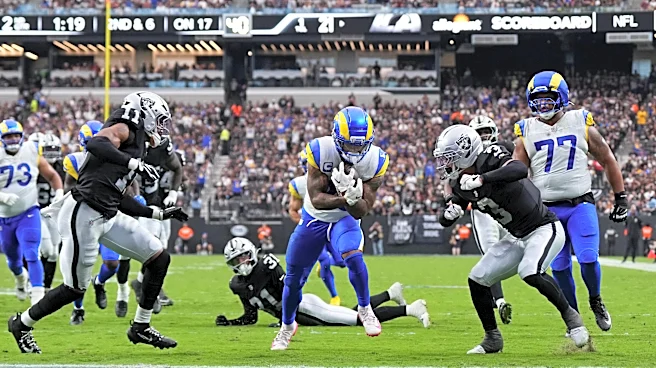
Moving on to the running game, Los Angeles primarily stayed on or slightly ahead of schedule with a bunch of four- or five-yard runs out of 13 personnel. That on its own isn’t a huge deal, but the problem was the Rams also had a few chunk runs that really broke the Raiders’ backs, like the one above.
LA comes out in a three-tight end formation but run iso by motioning the outside tight end into the backfield, where he settles in the B-gap like an offset I-formation fullback.
The problem is the linebackers respond to that action by sliding over to the weak side despite the offense not changing the strength and all of the weak side gaps being accounted for. Notice how the weak-side defensive tackle (JJ Pegues in a 3-technique) slants into the A-gap, while Maxx Crosby tries to work across the left tackle’s face (B-gap), and the corner blitzes off the edge (C-gap).
The linebackers shifting ends up being very costly for the Raiders. Allen, the motioning tight end/fullback, goes to iso block Dean. Meanwhile, Walker is an unblocked defender and has an opportunity to shoot the B-gap to the inside of Allen’s block, but Walker is a step late because of that shift.
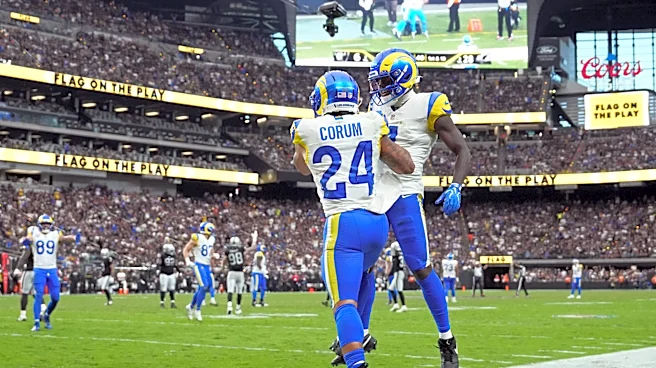
To make matters worse, with Hibgee executing a fold block inside of the right tackle, the Rams get a double team on Dean to kick him out of the rushing lane. On top of that, Patrick Johnson can’t cross the right tackle’s face to make the play, and Eric Stokes sees the tight end work inside but doesn’t follow him to get involved in the run fit and clog the lane. So, running back Blake Corum gets nine yards.
Here, the tight end motion does flip the strength of the formation and the linebacker’s shift appropriately. However, that doesn’t matter at all.
The Rams run duo and get a good combo block from the right guard and right tackle, where those two push Tonka Hemingway backward and inside before the guard peels off to get a hat on Dean. Also, Crosby gets displaced by a couple of yards against the two tight ends before Higbee comes off to get a piece of Walker.
Adding to the issues, Stokes can’t get off the wide receiver’s block to cross the receiver’s face and make the tackle, while Chinn takes a bad angle by coming too far downhill and failing to keep the running back on his inside shoulder. That allows Corum to get outside and rip off a 17-yard run.
We’ll end with the best example of how LA was able to get those four- to five-yard runs and close out the game.
The Raiders do a decent job of plugging up the front-side gaps, where there isn’t much room to run. However, every defender is taking on their block square instead of getting on an edge, meaning none of them are in a position to escape and make the tackle. So, Corum just puts his head down and picks up five yards to keep the offense on schedule.
Moving forward, the biggest problem for Las Vegas’ defense is that opponents have figured out the unit can’t stop 12 or 13 personnel runs or runs against tight formations. The Bills had a lot of success with it the week before, and the Rams followed suit. In other words, the Raiders can expect to see more of this for the rest of the season until they make an adjustment.