




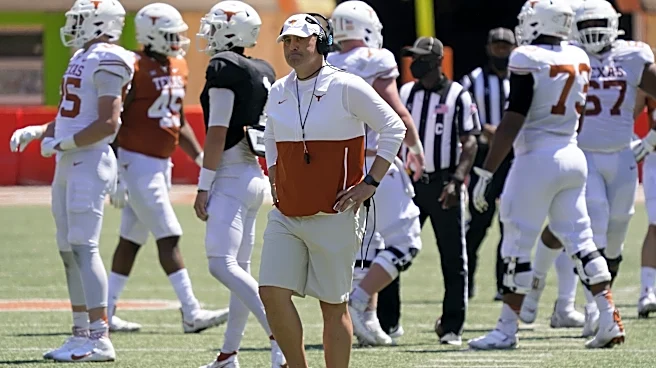
When the call came from Steve Sarkisian last December, the Muschamp family was ready to roll back to Austin.
“I’ll go tomorrow,” Carol Muschamp told her husband.
“There’s only one Texas,” Jackson Muschamp told his father. “You’ve got to do this.”
So Will Muschamp once again became the defensive coordinator for the Texas Longhorns, returning to the Forty Acres almost 15 years to the day after walking away from his title as the head coach in waiting under Mack Brown and taking on the difficult challenge
of replacing Urban Meyer as the head coach for the Florida Gators.
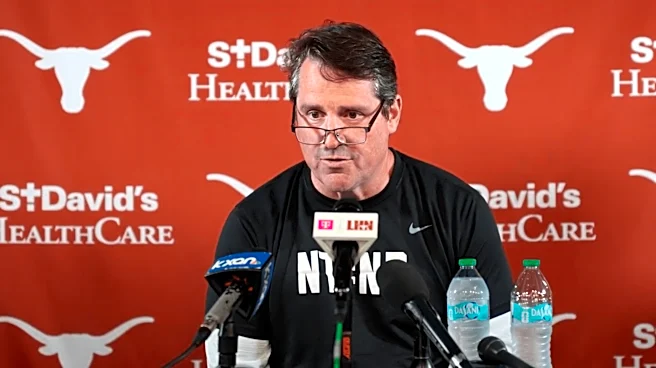
With glasses perched on the end of his nose, streaks of gray in his hair, and a few more wrinkles in his forehead, Muschamp was adamant that he’d aged better than some of the reporters in the recruiting lunge at the Moncrief-Neuhaus Athletic Center on Thursday — “Kirk Bohls, guy’s been rode hard and put up wet” — but he’s certainly not the same coach he was when he left Texas.
“What do you know now that you didn’t know when you walked out of here?”
“How much time you got?” Muschamp responded.
The long answer would certainly take more time than the allotted 20 minutes before the breakout session with Muschamp’s defensive assistants, but the short answer was “a lot.”
“Being a coach, you live and learn and you get better as you go,” Muschamp said.
Some of those lessons were hard earned with a 56-51 record over nine seasons as a head coach. Getting fired by Florida and South Carolina robbed Muschamp of some of that youthful ambition that led him to leave Texas the first time, too impatient to wait for Brown to finally retire.
So when Muschamp was asked whether he wants to be a head coach again, his answer was quickly and resoundingly to the negative, evidence of the wisdom he’s gained over the last 15 years as his failures as a head coach forced on him a recognition of his weaknesses.
For Sarkisian, though, Muschamp’s game-management experience gained as a head coach was enough for the Texas head coach to call his new coordinator the head coach of the defense, affording Muschamp a level of freedom and responsibility Sarkisian was unwilling to grant his former defensive coordinator Pete Kwiatkowski, unceremoniously dumped for the fiery, peppery brunet.
Originally a top choice when Sarkisian left Alabama to take over the Texas program, Muschamp opted to take a lower-profile role as a defensive analyst under fellow Nick Saban disciple Kirby Smart at Georgia to spend more time with his family.
With both sons now in college, Muschamp was ready to return to calling defenses himself for the first time in more than a decade working for a like-minded head coach who also worked under Saban.
After Kwiatkowski was fired, co-defensive coordinator Johnny Nansen called the defense for the Citrus Bowl. On Thursday, Muschamp recalled his first impression of Sarkisian’s program observing a bowl practice of a team that missed the playoff, had opt outs, and was approaching a portal window.
“In my mind, I mentally prepared myself for a bad practice, and it was awesome. It was a great practice. It was competitive,” Muschamp said.
When practice was over, Muschamp called his wife and told her that they’d made the right decision.
“That speaks a lot to Coach Sark and the staff and the guys they recruited and the development and the culture that they have here,” Muschamp said.
Around the Texas practice facility this spring, it’s been a reunion. Brown was at practice on Thursday. The Acho brothers and Jackson Jeffcoat have been around. Ben Wells is working on the support staff. Blake Gideon is one of his assistants again after leading Muschamp’s secondary in Austin.
“It’s been a wonderful experience,” Muschamp said. “Every day has been great.”
In the 15 years since the last time Muschamp was the defensive coordinator for the Longhorns, his defensive philosophy has remained consistent.
“I don’t know that philosophically, that a lot changes — we want to defend the middle of the field, we want to play tight coverage, we want to force the quarterback to throw into tight areas, obviously, stopping the run, creating it to be a one-dimensional game,” Muschamp said.
Muschamp’s reliance on press man coverage with his cornerbacks stands in contrast to the more conservative Kwiatkowski, who preferred a more bend-but-don’t-break approach with softer zone coverage.
“We believe in denying the ball, making the quarterbacks throw the ball in some tight spots, but we’re going to be multiple in what we do. You’ve got to give some, some different looks. You can’t live in it, but we certainly believe in getting our hands on people,” Muschamp said.
He’s still got that trademark intensity, too, wearing an “NT = NP” shirt on Thursday, which stands for “no thud equals no play.”
“Some guys, they don’t want to thud at practice. I call it a turn down. If you turn down too much, you won’t get on the bus to go to the game. You’ll be watching it from home. So if you don’t thud, you won’t play. That’s what this means. It’s very important to me,” Muschamp said.
What has changed is how opposing offenses approach the game.
“When I was here before you know tempo was kind of the fad — everybody wanted to go fast, play fast. No one ever motioned, no one ever shifted. They just wanted to go fast, get the call in, go as fast you want to go. Now people are falling back to more of a motion-shift,” Muschamp said.
So Muschamp appreciates the extensive use of motions and shifts by Sarkisian because it prepares his defense for game situations.
The athleticism of the student managers who run routes against the defense? Not so much, prompting Muschamp to call for combine-style tryouts.
“We’re trying to match routes against some really bad athletes,” Muschamp said.
The further synergy between Muschamp and Sarkisian helps, though, as the Texas head coach models his practices the way Saban did, giving the defense plenty of live reps.
But are there any concerns about all the time that has passed since Muschamp has called defenses?
“At the end of the day, it’s like riding a bike,” he said. “You don’t forget.”