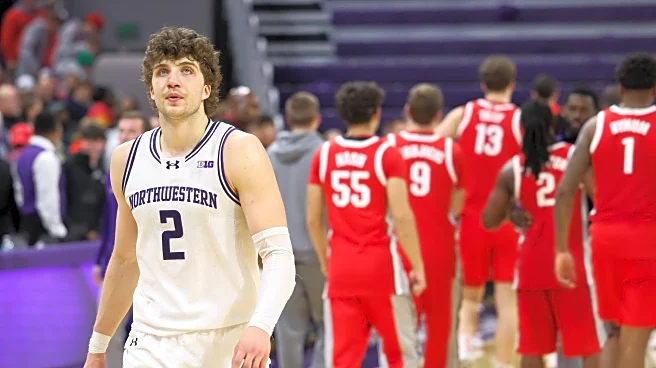

It hasn’t been quite the start to Big Ten play that Head Coach Chris Collins would’ve liked to see from his Wildcats, as Northwestern dropped both of its first two games in conference play on the road
in Wisconsin and at home against Ohio State. What should Wildcat fans take away from these games (other than frustration at the refs in the Ohio State game)?
In dire need of consistent bench production:
Across any level, from high school all the way to the professional leagues, a hallmark of a good basketball team is depth. Yes, top end talent that can reliably produce will help raise a team’s ceiling, but the floor of a basketball team is determined by how many rotational players can consistently provide meaningful minutes.
So far, the Wildcats haven’t been able to rely on their bench as much as they would like. Northwestern is averaging 81.1 points a night so far this season — almost 60% of that total comes from Nick Martinelli (21.1), Arrinten Page (15.4) and Jayden Reid (11.8).
When so much of the production comes from three players, they need to step up every night. This leads to games like the one against Wisconsin where Martinelli, Page and Reid couldn’t get it going for long stretches of the first half while the bench only contributed eight points, leading to NU being down 23 at halftime.
Or, you get a game similar to Saturday’s against Ohio State when Martinelli has a season-high, but K.J. Windham’s eight points are all you get from the bench for the entire game. The Buckeyes had 10 more points from its non-starters in a contest it ultimately won by four.
Northwestern will not be able to out-talent its way to in-conference wins. Windham’s performance on Saturday and Jordan Clayton’s Wednesday outing were promising individual displays, but Collins will need more from his rotational players if he hopes to turn this losing run around.
Shooting disparities prove costly:
Northwestern is technically ninth in the B1G when it comes to three point shooting, but it reaches this figure on the least amount of attempts in the conference and thus registers the fewest three point makes per game in the conference. To put it simply, threes are worth more than twos. When you’re taking less threes, there is less opportunity for shooting variance to go your way.
Take the game against Wisconsin for example. The Badgers are a worse shooting team than Northwestern percentage wise, but they nearly double the Wildcats in attempts per game. When a team takes that many attempts, 9-of-21 (43%) shooting runs from beyond the arc are a lot more plausible.
Of the eight players on the roster who have attempted at least ten threes this season, half of them are shooting below 30%. All in all, the ’Cats’ shooting percentage is likely bolstered by Martinelli shooting 71% (!) on 17 attempts to start the year, a figure that is almost certain to fall as the season goes on.
Considering how good Northwestern is from inside the arc, the solution isn’t as easy as just shooting more threes for the sake of shooting threes. You still need to make sure that the shots you generate are of a good quality. Maybe the answer lies in taking advantage of Martinelli’s scoring gravity inside the arc to free up shooters on the outside. Maybe it’s pushing the pace in transition and finding open looks before the defense can set itself.
The solution is nowhere near as simple as “just shoot better,” but something has to give and there’s a lot for Collins to think about.
Arrinten Page is what this team needs:
Amidst a rough stretch of games for Northwestern, the Wildcats and their fans can find solace in the quality of Page’s performances this season. In an increased role compared to last season at Cincinnati, the transfer has improved on all of his counting stats compared.
Page has emerged as the number two option behind Martinelli and has put up big performances against quality opponents. He had an efficient 13 points and 9 rebounds against the Buckeyes, and led the team with 20 points in a close loss against Virginia.
The 6 -foot-11 big man’s rebounding has been especially valuable this season, leading the team with 7.1 and being one of two Wildcats to average more than five per night. Page has also shown an ability to stretch the floor from midrange and accounts for a third of the team’s blocks total.
Even during a rough stretch of games for the team as a whole, Page’s high-end play on both ends of the floor has been a bright spot for the Wildcats.