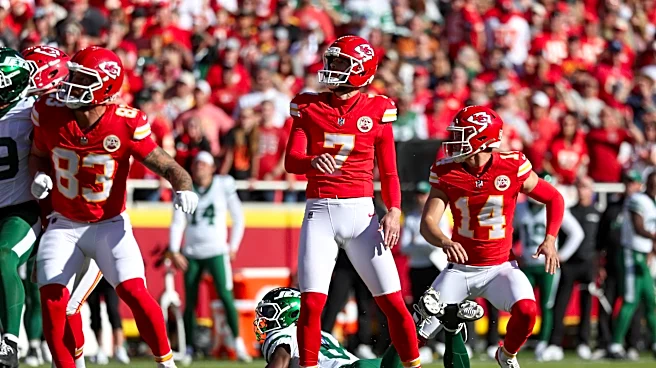




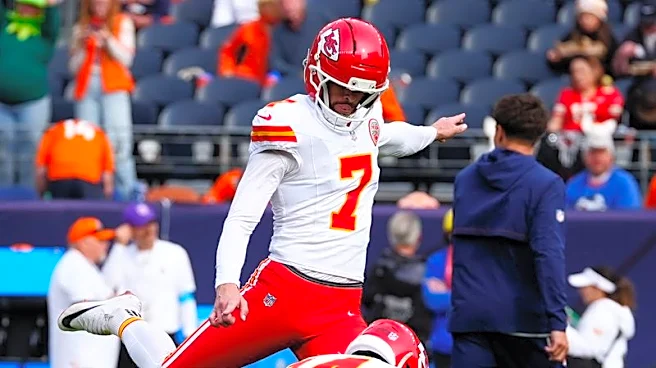
Kansas City Chiefs head coach Andy Reid made it clear Wednesday that he isn’t ready to give up on Harrison Butker.
“I’m gonna stick with Butker this week. And we’ll go from there,” Reid told reporters during his weekly press conference.
For a growing number of Chiefs fans, that wasn’t the answer they wanted to hear.
Butker’s struggles have become increasingly difficult to overlook. The veteran kicker has missed seven of his 19 field-goal attempts this season, converting just 63.2% of his opportunities.
Combined with his five misses in 2025, the concerns surrounding one of the most reliable kickers in franchise history are understandable.
But while the frustration is justified, the calls for Kansas City to move on from Butker might be premature.
There’s a difference between a player losing his ability and a player losing his rhythm. And right now, there’s reason to believe Butker is dealing with more of the latter.
Consider Golden State Warriors superstar Stephen Curry, widely regarded as the greatest shooter in NBA history.
During the 2021-22 NBA season, Curry experienced one of the most difficult shooting stretches of his career. In January 2022, he connected on just 29.9% of his 3-point attempts, a remarkable decline for someone whose career had been defined by extraordinary shooting accuracy.
Curry hadn’t suddenly forgotten how to shoot.
Instead, he eventually identified a subtle mechanical issue involving his balance and foot positioning during his shooting motion. What seemed like a minor adjustment was enough to affect something he had executed thousands of times successfully throughout his career.
Curry worked through those struggles and ultimately helped lead Golden State to an NBA championship that season, earning Finals MVP honors along the way.
The comparison isn’t perfect. Basketball players have dozens of opportunities to find their shooting touch during a game, while an NFL kicker might get only two or three chances to make a difference.
But the underlying principle remains the same: Even elite athletes can experience stretches when the mechanics behind something they’ve mastered become inconsistent.
And that’s where Butker’s situation becomes interesting.
The misses tell an interesting story
A closer examination of Butker’s missed kicks over the past two seasons reveals something worth considering.
Several of his misses haven’t come from kicks falling short of the uprights. Instead, they’ve sailed wide right, including misses against the Philadelphia Eagles, New York Giants and Baltimore Ravens in 2025.
This season, four of his seven missed field goals have been classified as wide right.
That distinction matters.
A kicker consistently struggling to generate enough distance might raise questions about declining leg strength. But kicks that travel the necessary distance while missing their target suggest mechanical inconsistencies.
That doesn’t mean Butker’s power is beyond question. He came up short on a 58-yard attempt against the Seattle Seahawks this season. But Chiefs special teams coordinator Dave Toub suggested the miss was partly because Butker focused too heavily on accuracy rather than driving through the football.
Reid has also acknowledged inconsistencies in Butker’s technique.
Foot placement, approach angle, timing and contact point can all influence where a football travels. Even a small change in one of those areas can significantly affect the result.
Much like a basketball player overthinking his shooting motion, a kicker attempting to correct his mechanics can sometimes make the problem worse.
The question isn’t whether Butker is struggling. The numbers make that obvious.
It’s whether those struggles represent a permanent decline or a correctable problem.
Why Justin Tucker isn’t necessarily the answer
The Chiefs have another option waiting on their practice squad in Justin Tucker, and there’s a legitimate reason to believe he could provide an upgrade.
When Kansas City brought Tucker in for a workout in late October, the former Ravens kicker connected on all 30 of his attempts, including seven from beyond 50 yards and one from 60.
According to Toub, 60% of those kicks traveled through a six-foot-wide area in the center of the uprights. He described the performance as “off-the-charts good,” explaining why Kansas City decided to sign Tucker.
Those numbers are difficult to ignore, especially considering Butker’s recent struggles.
But there’s a difference between making kicks in a workout and delivering when the games count.
Tucker also struggled with accuracy in his final season in Baltimore, converting just 22 of 30 field-goal attempts in 2024, including 6 of 11 from 50 yards or longer.
He also hasn’t appeared in a regular-season game since that season. His absence followed allegations of sexual misconduct and a subsequent 10-game NFL suspension.
None of that means Tucker couldn’t rediscover the form that once made him one of the greatest kickers in NFL history. His workout certainly suggests that possibility.
But if we’re willing to believe Tucker corrected the accuracy problems that plagued his final season in Baltimore, shouldn’t we at least consider whether Butker can do the same?
There’s another detail worth considering. After Tucker joined the Chiefs, Butker went 10-for-10 during a windy practice session, with gusts reaching 28 mph.
Both kickers have demonstrated they can still make kicks in practice. The question is which one can consistently translate that success to Sundays.
Patience doesn’t mean ignoring the problem
There is a legitimate argument that the Chiefs have already been patient enough.
Butker’s difficulties extend beyond this season, and his long-distance accuracy has become particularly concerning. After converting five of eight attempts from 50 yards or longer in 2025, he’s made just two of eight this season.
For a team with championship aspirations, that simply isn’t good enough.
But Reid’s decision to stick with Butker for another week doesn’t mean he’s ignoring those numbers. It means he’s giving his veteran another opportunity to correct the problem before making a significant change.
Butker has helped Kansas City win three Super Bowls, delivering crucial postseason kicks when the pressure was at its highest. That history shouldn’t guarantee him a job indefinitely, but it shouldn’t be dismissed, either.
Reid has spent decades coaching professional football players. He’s seen talented players struggle, make adjustments and return to form. He’s also seen situations where those struggles become permanent.
The challenge is recognizing the difference.
Curry’s shooting slump didn’t end his career as an elite shooter. It meant something that had become almost automatic needed correction.
Butker might be facing a similar challenge.
Reid isn’t wrong for believing the kicker who helped Kansas City win three Super Bowls can still find his way back. But that belief comes with a responsibility to recognize when patience is no longer producing results.
For now, the Chiefs don’t necessarily need to find another shooter.
They need the one they already have to start making his shots again.