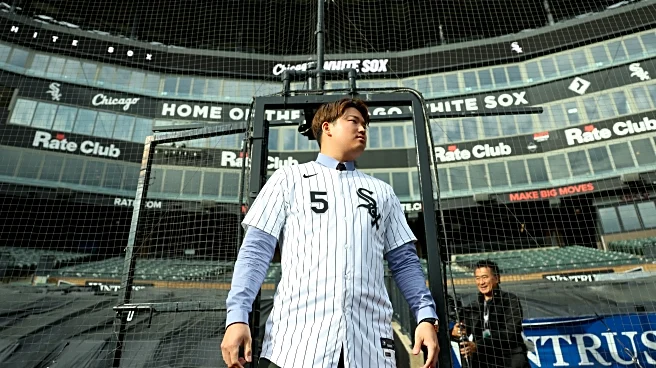




Some say Pope Leo XIV blessed the White Sox with a miracle when Japanese phenom Munetaka Murakami signed with Chicago, but this underperforming team needs more than a miracle to crawl back to a winning record.
Murakami’s standout power and accolades bring hope to a team that struggled to put the ball over the fence in 2025. Chicago’s .373 slugging percentage and .675 OPS ranked third-worst among all 30 teams and well below league averages (.404 and .719). Across the pond, Murakami was a slugging machine
in his 69 games, delivering a .659 slugging percentage and 1.051 OPS.
Based on the power Murakami produced from a season shortened by an oblique injury, would his performance have helped the Sox win more than 60 games?
To understand Murakami’s impact on the Sox last season, I calculated the expected number of wins for the Sox with him on the team in place of Andrew Vaughn. I did this by swapping Murakami’s performance on the Yakult Swallows with Vaughn’s while on the Sox. I used Vaughn as the replacement player for several reasons. First, Murakami is expected to be the Opening Day first baseman in 2026, and he would’ve easily gotten the starting job at first in 2025 had he been with the Sox. Second, Vaughn played more games at first base than anyone else on the team. With Murakami slotted as the starting first baseman in the depth chart, it’s logical to assume he would’ve played a similar proportion of games at first.

Finally, Vaughn was not instrumental to the Sox. With his .189/.218/.314 slash line and a .217 batting average on balls in play (BABIP), Vaughn had fans tearing their hair out each time he came to the plate. Even if Vaughn got the starts out of the gate in 2025 due to tenure, anyone would’ve replaced him with Murakami by mid-April had the two been teammates.
The first step in this analysis was measuring Vaughn’s contribution to the Sox by calculating his runs per plate appearance (RPA). I only used Vaughn’s stats while in Chicago, and tied his performance to the team by calibrating Vaughn’s OPS against the team’s average OPS. This allowed me to replace him with Murakami.
AV’s RPA = AV’s PAs x (Total Sox Rs / Total Sox PAs) x (AV’s OPS / Sox Avg OPS), thus
AV’s RPA = 193 x (647 / 5,987) x (.531 / .719) = 29.69
Next, I calculated Murakami’s RPA, which required translating Murakami’s NPB performance to MLB. NPB and MLB aren’t equivalent in terms of difficulty; baseball analysts have observed that the NPB’s competition level is comparable to Triple-A. Japanese hitters have struggled adjusting to MLB-caliber pitching, which has resulted in 22% lower on-base percentages and 25% lower slugging percentages on average, when moving from Japan to the U.S. I used an estimated rate of decline from Jordan Rosenblum’s FanGraphs article, where he measured the decline in wrC+ and OPS among Japanese players transitioning from NPB to MLB since 2000.
To accommodate the difference between NPB and MLB, I lowered Murakami’s OBP and SLG by 22% and 25%, as exhibited by the 0.22 and 0.25 multipliers in the table below. I also added a regression towards the mean MLB on-base and slugging percentages for the 2025 season. Because Murakami’s translated MLB stats still don’t capture his true MLB potential, I regressed his stats by 10% towards the Sox’s mean performance, which factors in Murakami’s performance against the few games he played and provides a conservative estimate of his hypothetical impact on the Sox.

With a fair estimate of his MLB performance, I calculated Murakami’s RPA to be 24.33, nearly five runs lower than Vaughn’s RPA.
The final step was calculating the expected number of wins for the Sox with Vaughn and Murakami in the lineup using Pythagorean winning percentage. I did this by projecting the number of runs scored using either player’s RPA, and I assumed Sox pitchers allowed the same number of runs with either player in the lineup. The results were surprising.

Yes, the Sox were projected to win one more game and score more runs with Vaughn in the lineup than Murakami.
The analysis didn’t factor in potential performance improvements due to player development, and should be interpreted as Murakami’s expected run production in a vacuum.
Digging into this analysis, there are several key takeaways.
Murakami alone can’t transform the Sox. Although obvious to any baseball fan, emotions can make it easy to forget that one signing on its own doesn’t turn a franchise around when emotions take over. It’s also unlikely that Murakami will wallop more than 30 home runs and slug better than .550 in his first MLB season. Given the historical challenges Japanese players have faced when adjusting to more difficult pitching, Murakami’s NPB stats shouldn’t be taken at face value. Sox fans should be excited that he picked Chicago to call home for the next two years, but inflated expectations of his debut season will only crush morale for fans of a team that’s finally digging itself out of the trenches. For Murakami to adapt to MLB pitching, the Sox coaching staff must be able to develop his swing and improve his swing decisions.
Also remember, the Sox didn’t play to their potential — that’s why in the table above their win pace was 71 even with the disappointing Vaughn in the lineup. Chicago fell 10 games short of its expected win total, and the reason is that math can’t account for human factors of the game. The Pythagorean expectation doesn’t account for an unstable bullpen, a godawful offense in the season’s first half, the lineup enduring rookie pains at least once during the season or Luis Robert Jr. not being able to handle carrying the team (indicated by his sub-.200 batting average from April-June). Ultimately, with a 15-36 record in one-run games, the Sox couldn’t make the big outs or get the big hits when needed.
As Chris Getz and company point toward 81 wins, they must remember that there’s a difference between building a team that can win and a team that does win. The Sox are the former, and they need more than just Murakami’s bat in the lineup to become the latter.