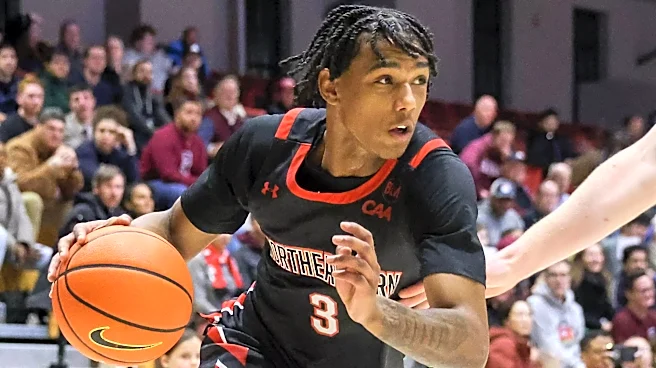







This is the third edition of Going Portaling, Inside NU’s Northwestern MBB transfer analysis column. The previous two articles have covered Jack Karasinski and Luke McEldon. This one will cover LA Pratt, the graduate transfer guard making the directional jump from Northeastern to Northwestern.
Pratt is a true point guard at 6-foot-5 who ran Northeastern’s offense on the ball and racked up excellent assist rates. He scored 17 points per game and provided 3.3 assists and 2.3 steals per game for the Huskies
in 2025-26, but played in just three games before going down with a season-ending foot injury. In his junior year, Pratt scored 11.2 points, grabbed 3.6 rebounds, dished out 2.5 assists and nabbed 1.4 steals across 31 minutes a game in his first year in Boston after a pair of seasons at Elon.
When this move was announced, my initial reaction was quite reserved.
I definitely still have concerns, mostly about how he recovers from the foot injury, but my excitement has steadily risen. Albeit in a tiny three-game sample size, Pratt’s scoring, passing and defending numbers were all way up. The peripherals backed it, with Pratt earning a 1.4 adjusted RAPM (regularized adjusted plus-minus) on Hoop Explorer after posting an atrocious -4.3 RAPM in 2024-25.
Recruiting Pratt to the Power 5 level is a gamble by Chris Collins that Pratt will be the player he was for three games in 2025-26; the 24-25 version was simply not a very good basketball player. However, Collins got a sneak peek at the best of Pratt when Northwestern and Northeastern played for dominance of the North in late December of 24-25, in what ended up being one of Pratt’s best games of his junior season. He posted 18 points, seven assists and four rebounds despite a 25-point loss. All film in this column is pulled from that game.
Looking past the numbers, the biggest reason I’m higher on Pratt now than I was when the move was announced is a deeper analysis into what feels like a seamless fit in this Jake West-led backcourt.
All stats sourced from College Basketball Reference and Hoop Explorer unless otherwise noted. All film pulled from Big Ten Plus.
Scoring
Pratt is a score-first point guard despite the aforementioned assist rates, so that’s where we’ll start. What stands out instantly when watching Pratt is the burst. The now-graduate student can get downhill from any position, and multiple times seemed to take Northwestern’s very good defenders by surprise. The other thing that impresses is the length he has from the point guard position and his ability to actually use it. A few of the finishes, specifically the right-hand on the left side and the weird flip/baby hook runner through the lane over Brooks Barnhizer, stand out. Those are really tough shots to avoid getting blocked, but Pratt’s size/length/speed combo allows him to score anyway.
This game was one of Pratt’s best in terms of efficiency. He shot 8-for-12 from the floor, and all four misses were from three, where he went 2-for-6. It was one of just two games for Pratt at Northeastern where he scored 15 or more points and missed four or fewer shots, and it was the most 2-pointers he made (six) without a miss.
That said, Pratt had major problems with overall efficiency in 24-25. His strength was finishing at the rim, where he made 65.7% of his shots, a spectacular rate for a guard. However, he shot just 29% from three and a stunningly poor 19.6% from the midrange, which checked out in the 0th percentile. In fact, it was the ninth-worst mark for the 1072 players who played at least half of their team’s offensive possessions and took a midrange shot at least 10% of their time in the 24-25 season. One wouldn’t be able to tell by watching the scoring reel from the Northwestern game, where he drained a few middies, but it was a major problem in his game.
In the acknowledged small sample size of 25-26, the efficiency from three and the midrange didn’t improve. The major difference between the two seasons, and the reason for hope for improvement, is that he cut down on taking jumpers overall. As a junior, Pratt took 42% of his shots at the rim, 44% from three and the remaining 14% from midrange. In 25-26, the rim rate jumped all the way to a shining 60% (where he still made 62.5% of his shots) and the midrange fell to 12.5% while the three-point rate took a much-needed hit, dropping to 27.5%. If Pratt can translate that rim rate to the next level and over a full season of work, he will be able to maintain a strong level of efficiency even if the jump shot doesn’t regularly fall. As a result, his free-throw rate almost tripled year-over-year, rising from an abhorrent 9.8% to a still-below-average but at least respectable 27.5%. He made 10 of his 11 free throws across the three games in 25-26 as well, after shooting 72% from the line the year prior.
Passing
Pratt is an excellent passer with solid ball retention, though he struggled in the Northwestern game, turning the ball over four times. He has good vision, the ability to pass on the move and can make passes with both hands. Pratt maintained a solid 16.2% assist rate in 24-25; that number catapulted above 25% in his three-game sample as a senior. That rate would have been in the top 200 nationally over a full season. His turnover percentage stayed identical across the two seasons, even with the major jump in assist percentage.
The one negative from a passing perspective when watching film is Pratt’s tendency to leave his feet to make a pass. Once or twice a game, he will get caught in the air and toss an ill-advised pass, often resulting in a turnover. On the flip side, when Pratt does jump, he gives himself even more height to see his teammates, and with his already bigger 6-foot-5 frame, it’s nearly impossible to swallow him up in the lane and prevent a drive-and-kick. That becomes a valuable trait when you consider how easily Pratt gets two feet in the paint and contends with the trees.
Defense
Pratt’s defense graded out poorly in 24-25, with a -2.1 RAPM on the defensive end that landed him in the 11th percentile. His 110.3 luck-adjusted defensive box rating also grades out below average. Watching him on defense, it’s tough to see exactly what grades out so poorly. He moves well laterally, was rarely disengaged from the play and had quick hands. His one pitfall was a few unwise post doubles that turned into open Northwestern shots, but it wasn’t clear whether that was his own volition or a coaching strategy against the Wildcats that just didn’t work. Either way, Northwestern loves the post double, so I imagine that will remain a part of his game, but maybe slightly more disciplined. The one negative clip in the reel shows Pratt getting fully removed from the play by Matt Nicholson (side note: I would do anything to have a screener like Big Matt again in the program). At times on both ends, Pratt shows a lack of physicality, which is confusing for a guy who tends to be larger than his matchup. He shied away from contact a few times, and in this clip, lets himself get caught up by Nicholson far too easily.
Like everything else, Pratt’s defensive metrics saw a huge positive bump in his Triple Dipper sample of games as a senior. His RAPM improved to a 2.5 (which would have been a top-200 mark season-long), and his defensive box rating dropped six points to a 104.5. The most notable jump came in his steal rate, which went from an already very good 2.6 to an elite 4.2. If Pratt can be that disruptive and turnover-driven for Northwestern, that can push them to continue to improve in the possession battle, something they struggled mightily with last season.
Fit
As I mentioned in my introduction, the fit is what excites me most about Pratt. If his 25-26 numbers hold, he will be a very good player; even if he looks closer to his 24-25 version, the situation should be much better for him for one reason: Jake West. Pratt is the perfect alternative to West as a backup point guard and as a guy who can share the floor with West for extended periods. To explain why, I’m going to show you two screenshots from Hoop Explorer. The first is West last year, the second is Pratt from 24-25.
Basic way to read these charts: height of bar = frequency of action; color of bar = scoring efficiency within action with darkest green being best and darkest red being worst


West had an awesome rookie year with Northwestern and could be the focal point of the team this season. Looking at his play style, the main weak spots in his game for a point guard profile (no need for West to have a post-up, pick-and-pop or inside-out game) are attacking the rim and scoring in transition. And wouldn’t you know it, those are Pratt’s biggest strengths.
Even if Northwestern gets the inferior junior version of Pratt, he fits the team well as a West sub who can play 10-14 minutes a night and give a bigger, more downhill look to the offense. If Northwestern gets the improved skillset that Pratt showcased for a troika of games in 25-26, Pratt should play closer to 25 minutes a game and perhaps even start alongside West. He can run the point when West needs a breather, but he can also be used to move West off the ball and allow him to utilize his off-ball shooting strengths. Northwestern did this a lot in 23-24, with Ryan Langborg and Barnhizer starting an offensive play while Boo Buie started in the corner and could be used to get a three or a floater with an off-ball screen. In an ideal world, Pratt would give the Northwestern offense the same versatility to use its possibly best player in West in a multiplicity of ways while continuing to turn this roster bigger and more physical.