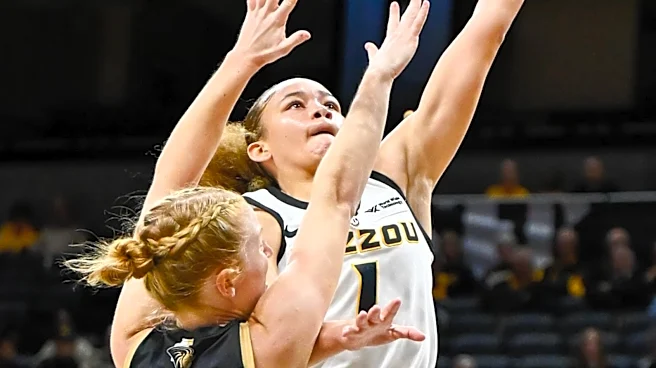


Mizzou women’s basketball showed how dangerous its offense can be during Sunday’s 72-64 loss to Kansas State at T-Mobile Center. The Tigers also showed how quickly that offense can disappear, struggling to find consistent scoring throughout four quarters against the Wildcats.
Mizzou’s offensive production fluctuated throughout the afternoon, with two particularly costly stretches in the first and third quarters. The Tigers scored just 11 points in the opening period before recovering with 21 in the second.
After taking an eight-point advantage into halftime, Mizzou managed only 12 points in the third quarter, allowing Kansas State to erase the deficit and take a 47-44 lead into the final 10 minutes.
The Tigers finished with 64 points on 20-of-68 shooting (29.4%), including 5-of-20 from beyond the arc. Their shooting struggles were especially noticeable during the third quarter, when Mizzou connected on just two of its 16 field-goal attempts. Eight trips to the free-throw line helped the Tigers reach 12 points in the period, but they could not generate enough offense from the field to maintain their halftime advantage.
The contrast between Mizzou’s first-half quarters illustrated the team’s offensive potential and inconsistency. After shooting 22% in the first quarter, the Tigers responded by making 50% of their shots in the second. They also turned a 17-11 deficit into a 32-24 halftime lead, fueled by improved defensive pressure and an 8-0 run to close the half.
Sophomore guard Neveah Caffey was a consistent scoring option, finishing with a career-high 22 points and six rebounds. Caffey went 5-of-14 from the field but made 11 of her 12 free-throw attempts, accounting for more than half of Mizzou’s free-throw production. Senior Grace Slaughter added 13 points and 12 rebounds for her double-double, while fifth-year guard Tanyuel Welch contributed 12 points.
However, the Tigers struggled to find additional scoring options when their leading contributors were unable to generate offense. Sophomore McKenzie Mathurin finished with nine points but shot 2-of-12 from the field. Mizzou’s 20 total field goals also highlighted the difficulty it had finding efficient possessions against Kansas State’s defense.
The offensive struggles extended beyond shooting percentages. Kansas State outscored Mizzou 38-24 in the paint and held a 21-15 advantage in fast-break points. The Wildcats also finished with 15 assists compared to the Tigers’ 11, creating more opportunities through ball movement and transition offense.
Mizzou’s 90.5% shooting at the free-throw line (19-of-21) provided a bright spot, but the Tigers’ inability to consistently convert field-goal opportunities proved costly. The second-quarter surge demonstrated what the offense can accomplish when shots fall, but the first- and third-quarter performances showed the difficulty of sustaining that production against a quality opponent.