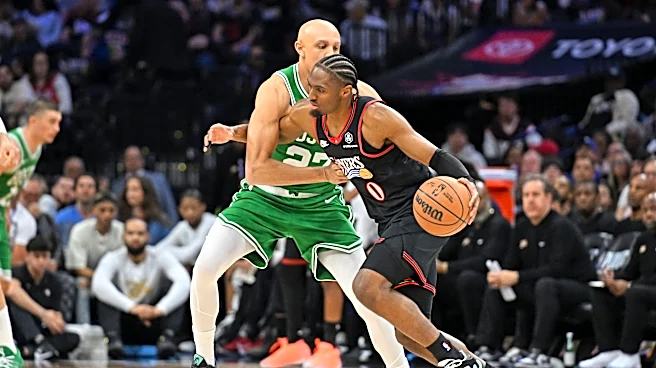




The Boston Celtics delivered a commanding 128–96 road victory over the Philadelphia 76ers, moving them just one win away from advancing to the second round.
The Celtics received widespread contributions in this game, highlighted by the scoring heroics of Payton Pritchard. The Oregon product built on the clutch shots he hit in Game 3, pouring in 32 points in just 34 minutes. Jayson Tatum also brought snacks to the party as he finished with 30 points, seven rebounds, and 11 assists in another well-rounded
effort.
One performance that may slip under the radar amid the headline-grabbing stat lines was that of Jordan Walsh, whose impact has been felt every second he’s been on the court.
During the regular season, Walsh offered a glimpse of his defensive potential in two matchups against the 76ers, suggesting he could be a viable option to contain star guard Tyrese Maxey. The third-year wing proved particularly effective in those minutes, holding Maxey to just 1-of-10 shooting from the field when matched up with him directly.
Before Game 4, Walsh was asked to evaluate the team’s defensive effort against Maxey to that point. “I actually think we’ve done a great job,” Walsh said. He went on to break down what it takes to defend a player of that caliber, noting that it requires “a lot of effort — a lot of technical things have to know but most of all just playing as hard as possible.”
He also emphasized the importance of defensive discipline and awareness, explaining that, “everything is about balance: when to be aggressive, when to back off, when to pick up high, when to pick up low.”
And in just 12 minutes of play last night, he was able to showcase all of the effort and those technical details.
Here, Walsh plays incredible defense forcing a shot clock violation and a great reaction out of Jayson Tatum.
Walsh told reporters before the playoffs began that part of his success against Maxey came from “taking away tendencies and then knowing the small things that get under his skin.” One of those tendencies, he noted, was favoring his right hand. “Like if he wants to go right and do a step back, just don’t let him do that. Make him do something else.”
In Game 3 I noticed Celtic defenders sitting on Maxey’s right hand a ton and this play starts with that. After going left and using the screen, Maxey snakes the screen to get back to his right hand. Even though Walsh gets hit by the screen, his length and pursuit help him get back in front of Maxey forcing the pick up and pass. When Maxey gets the ball back up against Walsh and the clock, great isolation defense ensues.
One of the most critical aspects of Walsh’s defensive assignment in pick-and-roll situations is his ability to stay attached. In this instance, he uses his massive wingspan to deploy a savvy technique called “grabbing the shorts.” He executes it subtly enough to avoid the officials’ notice, then immediately showcases his relentless pursuit once again, ultimately forcing a pass.
On the next possession, Walsh again forces Maxey to his left, battling over the screen and ultimately drawing an offensive foul on Joel Embiid.
Embiid ends up scoring on this play, but Walsh’s pursuit in this game really jumped off the screen. Play begins just as you’d expect with Walsh forcing Maxey left. He then goes under both screen attempts ending up right in Maxey’s face.
He also provided on the offensive end crashing the glass and knocking down a three.
In his limited minutes, Walsh has nonetheless managed to leave a clear imprint on the game through relentless pursuit, an attention to detail that doesn’t always show up in the box score and just flat-out energy. His ability to disrupt rhythm, navigate screens, and take away comfort areas from a dynamic scorer like Maxey underscores why he continues to earn trust in key defensive assignments. If he sustains this level of focus and execution, Walsh could carve out a more prominent role as a situational stopper for the Celtics moving forward.