
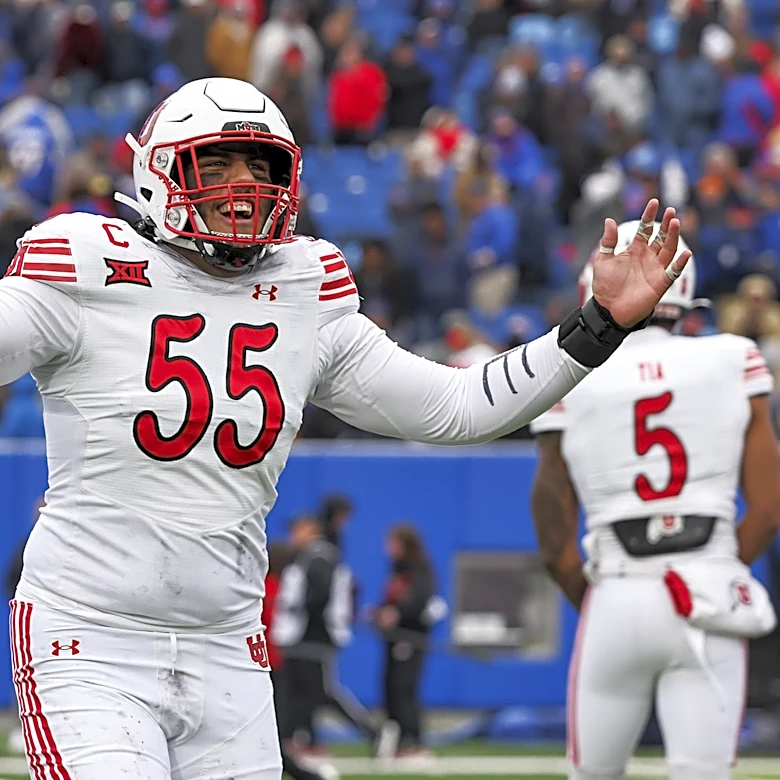
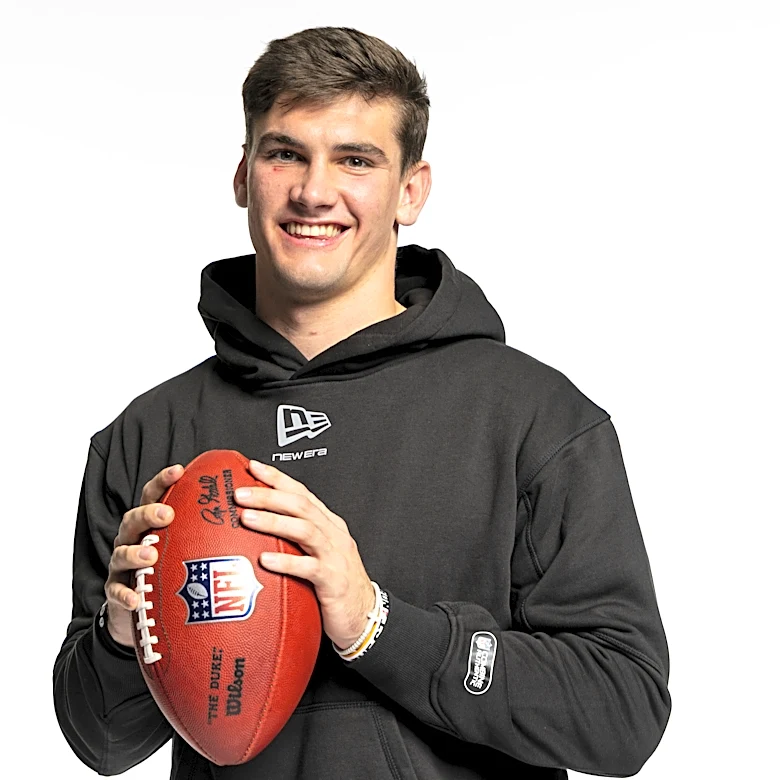
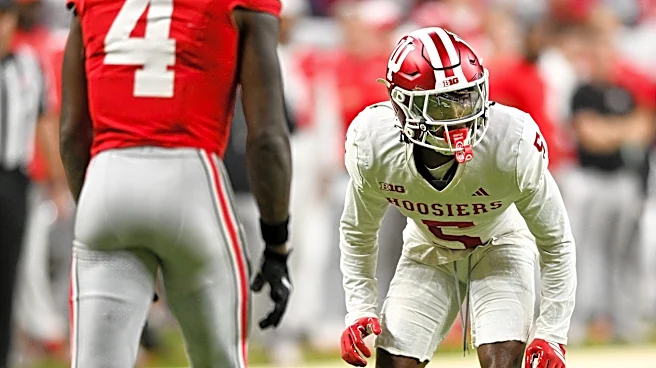
Next up in the series of draft position round-ups is Safety.
Safeties
Center
Aside from free agent addition Nick Cross, the Commanders’ line-up at safety strikes this author as a remainders’ bin collection of JAGs and unproven players.
If the prospect visit schedule is any indication, however, safety might not be a major priority for the team in the draft. Incoming defensive Coordinator Daronte Jones has spoken highly of the players he inherited, even highlighting the versatility
Quan Martin, after a shocking performance in 2025.
Whether that was coach speak or a genuine appraisal, it won’t be a surprise if Adam Peters takes advantage of a deep safety draft class to give his new DC more weapons in his arsenal and build the talent pipeline to man a “position agnostic” secondary.
Based on his previous experience in Brian Flores’ hyper-aggressive, exotic scheme, we might expect Jones’ wish list to include versatile secondary players with plus athleticism and the ability to make plays in all phases on defense. Lucky for him, this draft class is loaded with prospects who fit the spec.
To identify safety prospects who might appeal to the Commanders, I screened the draft class using the same advanced stats as in the previous round-ups. But the diversity of roles under the “safety” umbrella required some extra attention to the coverage metrics. The following section goes through the rationale in depth, and might be too much detail for many readers. The key takeaway is that coverage metrics differ between nickel backs and other safeties. Coverage assignment must be taken into account to avoid reaching incorrect conclusions about coverage performance.
Advanced Performance Metrics for Safeties
The diversity of coverage assignments within the safety position group makes interpretation of the advanced performance metrics more complicated than any other role on defense. To simplify things, I broke the vast continuum of varied safety roles into three subtypes, based on where players lined up the most.
As the name implies, Box Safeties lined up more often in the box than in the slot or deep. Nickel Safeties lined up the most in the slot. And Free Safeties took the most snaps lined up deep. These distinctions became fairly arbitrary in many cases, because a lot of safeties split time nearly equally between two, and sometimes three assignments. But it was necessary to make sense of the coverage metrics.
Metrics were generated for 214 draft-eligible safeties who played a minimum of 200 defensive snaps in 2025. Nearly all were FBS players. A few players with consensus ranks were added from lower divisions, as well as one player who missed most of the season due to injury.
Rate of Yardage Allowed – Yards/Coverage Snap
I have been using Rate of Yardage Allowed (Y/Cov Snap) as the primary coverage performance throughout all of my articles this offseason. The rationale and details are explained in the Free Agent CBs round-up. It is essential the flip-side of Yards/Route Run, which is used to measure receiving productivity, and provides the best overall metric for coverage defenders’ performance at containing receiving yardage.
There is a large difference in Y/Cov Snap values between the three subtypes of safeties, which reflects the differences in coverage assignments. It is essential to keep these differences in mind to avoid reaching wrong conclusions about an individual safety’s coverage numbers.
Nickel Safeties (n = 36) spend the most time in primary coverage. Consequently, they have the most targets attributed to them and allow higher rates of yardage in coverage than the other types of safeties. They are the odd men out of the position group, with Y/Cov Snap figures closer to CBs than other safeties. They are also the least common subtype.
Box and Free Safeties have comparatively similar Y/Cov Snap figures. Box Safeties (n = 80) had the next highest Rate of Yardage Allowed in coverage, since they are next most likely to be identified as the primary cover man. Free Safeties (n = 98) spend the most time supporting primary defenders, who take the blame for receptions. They also benefit from the inverse correlation between reception rate and ADOT, which drives down receiving productivity in the deep part of the field, where they live. As a result of this combination of factors, they have the lowest Y/Cov Snap figures. Any differences in coverage ability between the safety subtypes, at the group level, is likely to be swamped by the effects of differences in coverage assignments.
The following table provides Y/Cov Snap benchmarks for the safety draft class as a whole, and also broken down by subtype:

Run Stop Rate
Run Stop Rate is a PFF Signature Stat, which is an improvement over tackle counts and tackles for loss for quantifying run defense performance (see link for details). It is the percentage of running downs on which a defender made a tackle resulting in a failure for the offense.
Run Stop Rate does a good job of differentiating defenders whose tackles make an impact against the run from those who tend to arrive late, such as former Commander LB Cody Barton. But it does have one limitation for use with safeties. It does not capture saves, which can be game saving plays on the back end of the defense. Nevertheless, it identifies safeties who excel at getting to the ballcarrier early, which is the primary aim in run defense.
Surprisingly, there were no major differences between the three safety subtypes, which means we can keep it simple and group all safeties together:

Pressure Rate
Blitzing the quarterback is a minor part of most safeties’ roles. But it has elevated importance in the hyper-aggressive defensive scheme which we are expecting Daronte Jones to bring to Washington. So I included it as a secondary consideration.
Evaluating pass rush performance was vexed, because less than a third of draft eligible safeties blitzed enough to provide large enough samples to generate meaningful statistics. To get the numbers up, I set a low minimum of 15 pass rush attempts. That might be pushing things too far, but if I set it much higher, there wouldn’t be many players to talk about.
Pressure Rate is the percentage of pass rush attempts on which a defender generated a sack, QB hit or QB hurry. It provides a robust measure of pass rush performance, since it measures all of the ways in which the pass rush can influence the offensive play. That becomes particularly important at the safety position, where numbers of rush attempts are low.
The following benchmarks are derived from 59 safeties with 15 or more rush attempts. The numbers were too small to break it down further by safety subtypes.

The Pressure Rate leader was Kody Jones, from powerhouse Kennesaw State (where my sister has a faculty position). He is an outlier, with 12 pressures generated on just 19 blitzes. The next highest qualifying figure was 43.8% from a player with 16 blitz attempts. UNLV’s Jaheem Joseph had the highest pressure rate among safeties with > 20 attempts, which might be a better place to set the high end of expectations for the position.
With the Seventh Overall Pick

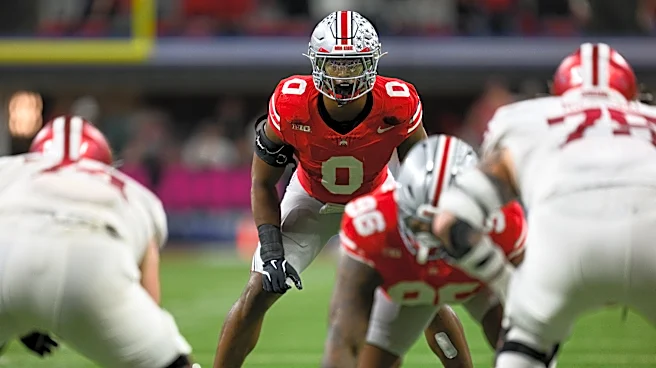
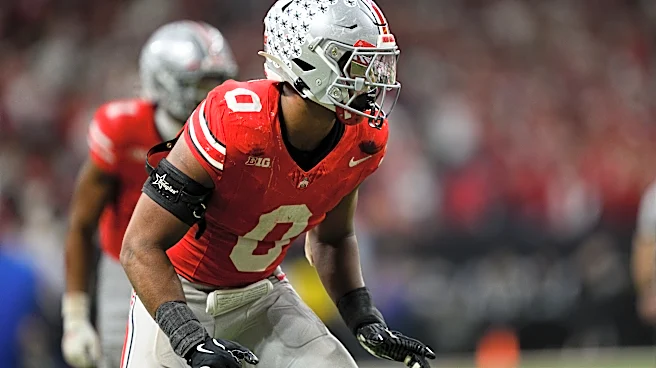
Caleb Downs, Junior, Ohio State
6-0 | 206 lbs | Arms 30.25” | Age 21
2025 Stats: 14 games | 68 Comb Tkl | 35 Stops | 2 FF | 1 Sack | 2 INT | 2 PD
Run Stop Rate: 7.2% (Rk 9)
Y/Cov Snp: 0.47
Pressure Rate: 20.8% (24 Att)
Consensus Rank: 9
Commanders Meetings: Combine
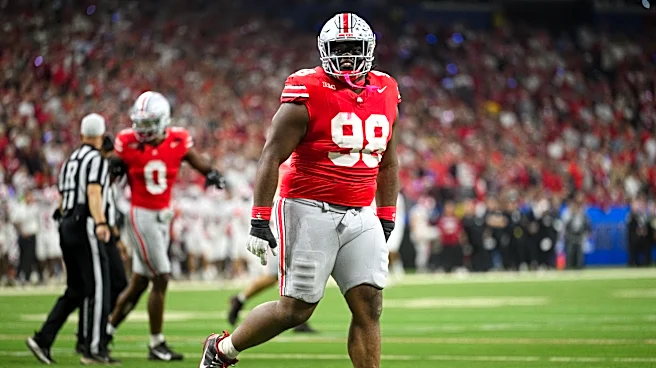
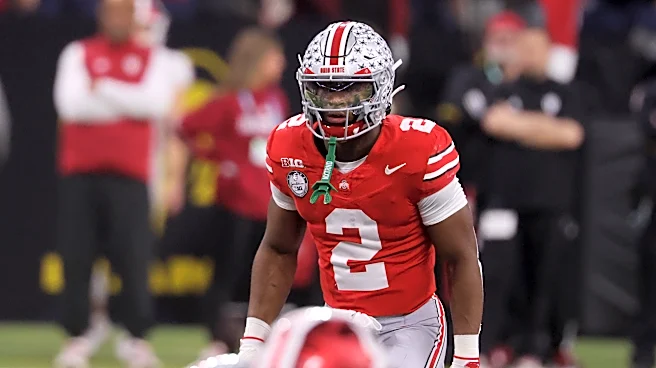
Downs would have to be in the mix for the Commanders at the 7th overall pick. Several outlets and analysts rate him as the top overall prospect or the top defensive prospect in the draft.
The reason he is rated so highly is that he is a versatile defender, with quality production playing in the box, in the slot, at deep safety and rushing the passer. That comes packaged with an alpha dog mentality to set the tone on defense, and elite instincts to anticipate offensive plays. He looks like a perfect fit for the Commanders, whom Daronte Jones could move around the backfield to create problems for offenses.
Downs is not the biggest or fastest safety in this roundup, but he plays with advance recognition to diagnose and break on plays, while avoiding misdirection. He split time almost equally between box and free safety alignments (37.9% vs 37.7% of snaps), with around 23% of snaps covering the slot.
Downs is an elite run defender. His Run Stop Rate ranked 9th out of 213 draft-eligible safeties, and was 2nd highest among consensus-ranked prospects. The player ahead of him is listed last in this round-up.
His Rate of Yardage Allowed in coverage places him right around the 75th percentile for Box Safeties. He has also been a consistent ball producer, with 2 INTs per year for the Buckeyes, plus 12 pass breakups and 3 forced fumbles in 3 seasons.
Downs’ was used fairly frequently as blitzer, but his Pressure Rate and sack output were a little below average. It is an aspect of his game that he may need to develop if he lands with the Commanders.
Downs looks like a Day 1 starter in Washington, with potential to be an impact player. He would be an instant upgrade over every safety who was one the roster when the league year started.
Rest of Round 1
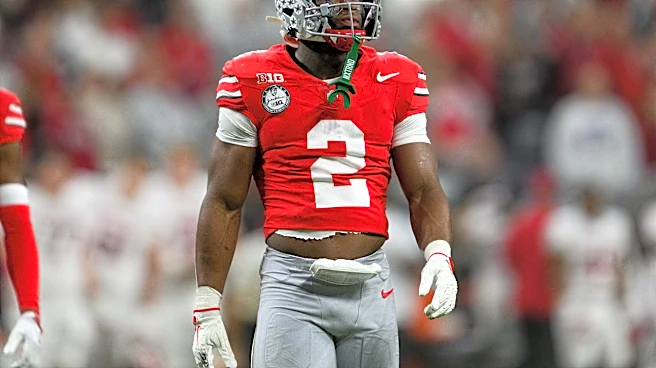
Dillon Thieneman, Junior, Oregon
6-0 | 201 lbs | 4.35 sec 40 | RAS 9.71 | Age 21
2025 Stats: 15 games | 96 Comb Tkl | 30 Stops | 1 Sack | 2 INT | 5 PD
Run Stop Rate: 4.9% (Rk 32)
Y/Cov Snp: 0.33 (Rk 26)
Consensus Rank: 18
Commanders Meetings: None
If the Commanders trade back in the first round to gain more picks, Thieneman becomes a consideration. He is a smart, super-athletic speedster. With the Ducks, he directed coverages on the field, while playing more than half his snaps in the box, with around 1/3 of snaps at FS and 15% covering the slot.
Like Downs, Thieneman plays with high end recognition, allowing him to anticipate plays in the run and passing game. His instincts shine brightest in zone coverage, but he is functional in man. His Run Stop Rate and Rate of Yardage allowed in coverage are both right around 85th percentile for the safety class as a whole. His Y/Cov Snap is just below the 90th percentile for Box Safeties; and he has been a consistent ball producer, with 8 INTs, 14 PBUs and 2 FF in three seasons with Oregon and Purdue.
He was used sparingly on blitzes, generating pressure on 80% of 4 pass rush attempts with 1 sack.
Thieneman fits the mold as an interchangeable chess piece for Daronte Jones to move where he’s needed in the Commanders’ secondary. He was one of the biggest risers in the draft process, and shot into irst round consideration when his Combine numbers confirmed what everyone saw on tape.
Emmanuel McNeil-Warren, Senior, Toledo
6-3.5 | 201 lbs | 4.52 sec 40 | RAS 9.00 | Age 22
2025 Stats: 13 games | 77 Comb Tkl | 18 Stops | 0.5 Sack | 3 FF | 2 INT | I INT TD | 5 PD
Run Stop Rate: 3.6%
Y/Cov Snp: 0.34 (Rk 28)
Consensus Rank: 26
Commanders Meetings: None
Another player AP might consider if he trades even further back is Emmanuel McNeil-Warren. The former Toledo Rocket is a big safety, who played mainly in the box, with about half as many snaps deep and only a smattering of plays in the slot. McNeil-Warren is best playing as an enforcer in the box and robber in underneath coverage.
Despite the heavy hitting playstyle, he was just slightly above average in Run Stop Rate. He was more impactful in coverage, with a Rate of Yardage Allowed at the 87th percentile for Box Safeties. Where he really excels is making plays on the ball and generating turnovers, with 5 INTs, 8 FFs and 13 PDs in the last three seasons. Speed constraints might limit his ability to cover the slot and play deep coverage at the NFL level.
McNeil-Warren might not be the all-purpose weapon that Daronte Jones is looking for. But he can be an impactful defender in the hands of a defensive coordinator who knows how to use him, which might actually be more to the point.
Day 2

Keionte Scott, Senior, Miami FL
5-11 | 193 lbs | 4.33 sec 40 | RAS 8.97 | Age 24
2025 Stats: 14 games | 64 Comb Tkl | 36 Stops | 2 FF | 5 Sacks | 2 INT | 2 INT TD | 5 PD
Run Stop Rate: 6.9% (Rk 12)
Y/Cov Snp: 0.85
Pressure Rate: 23.0% (87 Att)
Consensus Rank: 59
Commanders Meetings: Top 30 Visit
The Commanders had Scott in for a Top 30 Visit, so you know they are interested. And what’s not to like about a twitchy nickel back who can blow up the run and rush the passer?
Scott gets labelled as a nickel corner, but something twigged when I saw his Run Stop Rate, which is out of range for a CB. Sure enough, the 30% of snaps when he wasn’t covering the slot were mainly spent in the box, so I included him with the safeties. And that might be a big part of his appeal to the Commanders. He brings versatility to cover the slot like a CB and slide inside to defend the box like a linebacker.
Scott’s Run Stop Rate places him at the 94th percentile for safeties, and out of range for slot corners. He made 13 TFL loss in 2025, included in his 36 total defensive stops, along with 2 forced fumbles.
His Rate of Yardage Allowed in coverage was right on average for Nickel Safeties. But he was very good at containing receivers after the catch, with 0 TDs allowed in 56 targets, and making plays on the ball to generate turnovers.
Another facet of Scott’s game which should appeal to the Commanders is the pass rush. He had the most blitz attempts among consensus-ranked safeties and generated an average Pressure Rate. But with volume attempts comes volume production, including 5 sacks and 20 total QB pressures, per PFF.
Keionte Scott is exactly the type of defensive chess piece to suit a varied, attacking defense. His consensus rank is a little higher than the Commanders’ current third round pick, but well within the wiggle range. He is an older prospect, but brings the type of locker-room leadership that is likely to earn him a Commander tag.
Bud Clark, 6th Yr Senior, TCU
6-1 | 188 lbs | 31.5” arms| 4.41 sec 40 | RAS 8.88 | Age 24
2025 Stats: 11 games | 56 Comb Tkl | 13 Stops | 1 Sack | 4 INT | 7 PD
Run Stop Rate: 2.5%
Y/Cov Snp: 0.64
Consensus Rank: 89
Commanders Meetings: Senior Bowl
Switching gears to another Nickel Safety who looks more like a slot corner. In fact, Clark took the most snaps in the slot (313), but played a fair amount in the box (250) and at free safety (160).
He is a versatile coverage safety, who excels playing single high or manned up on slot receivers. His Rate of Yardage Allowed in coverage was around the 80th percentile for Nickel Safeties. He is one of the most consistent ball producers in the safety class, with 15 INTs and 21 PDs over the past four seasons.
Clark is a willing run defender and wrap-up tackler, but lacks ideal size to take down RBs and bigger receivers. His Run Stop Rate was below average for the safety class. He also generated pressure on 100% of four blitz attempts, with one sack.
Clark offers coverage talent that is currently lacking on the back end of the Commanders’ secondary. He is an older prospect, who might be an option in the third round, or if AP acquires a later pick.
Zakee Wheatley, 5th Yr Senior, Penn State
6-3 | 203 lbs | 31” arms | 4.62 sec 40 | RAS 7.66 | Age 24
2025 Stats: 12 games | 74 Comb Tkl | 23 Stops | 1 INT | 1 PD
Run Stop Rate: 4.5%
Y/Cov Snp: 0.11 (Rk 2)
Pressure Rate: 23.5% (17 Att)
Consensus Rank: 91
Commanders Meetings: None
Wheatley is a bigger, athletic safety who aligned predominantly at Free Safety and in the box for the Nittany Lions.
Despite the slow 40 time, he is a rangy cover safety and achieved the lowest Rate of Yardage Allowed among consensus-ranked safeties in the draft class. He has a large tackle radius and physical presence in run support and achieved a Run Stop Rate around the 80th percentile for the safety class.
Wheatley could be a good depth addition with upside to develop as a starter, if the Commanders acquire a pick toward the end of Day 2 or early Day 3.
Day 3

V.J. Payne, Senior, Kansas State
6-3 | 206 lbs | 33.75” arms | 4.4 sec 40 | RAS 9.74 | Age 22
2025 Stats: 12 games | 59 Comb Tkl | 16 Stops | 2 FF | 1 INT | 3 PD
Run Stop Rate: 3.0%
Y/Cov Snp: 0.42
Consensus Rank: 153
Commanders Meetings: None
Payne is an athletic Box Safety, with the length and athleticism that teams covet at the position. What might appeal to Daronte Jones is his versatility to take on multiple assignments in the secondary, from underneath coverage in the box to man coverage on tight ends, and playing deep split safety.
Counter to expectations for a box safety, his coverage is ahead of his run defense at this point in his development. His Rate of Yardage Allowed in coverage was above the 75th percentile for box safeties and around the 82nd percentile for the safety class as a whole. In comparison, his Run Stop Rate was below average in the safety class.
Payne’s coverage skills could provide a route to earn playing as a depth addition to Daronte Jones’ secondary. He has the quick recognition and physical tools to improve as a run defender with coaching at the next level.
Michael Taaffe, 5th Year Senior, Texas
6-0 | 190 lbs | 29.25” arms | 4.50 sec 40 | RAS 7.82 | Age 23
2025 Stats: 10 games | 70 Comb Tkl | 21 Stops | 1 Sack | 2 INT | 1 PD
Run Stop Rate: 4.0%
Y/Cov Snp: 0.29 (Rk 21)
Consensus Rank: 181
Commanders Meetings: Combine
Taaffe is a former walk on who worked his way onto the Longhorns’ starting roster. He plays will good awareness and ball skills to make plays underneath. He aligned predominantly at FS for Texas, but might lack the range to play over the top at the next level.
Despite speed and size limitations, his Rate of Yardage Allowed in coverage was around the 80th percentile for Free Safeties, and he had consistent ball production (7 INT, 13 PD past 3 years). His Run Stop Rate was above average for the safety class.
Taaffe was a core special teamer, with good tackle production. He could be an immediate contributor on teams and depth addition to the secondary. But there might be better options behind him in the consensus rankings.
Jalen Huskey, Senior, Maryland
6-1 | 196 lbs | 30.9” arms | 4.55 sec 40 | RAS 7.03 | Age 22
2025 Stats: 12 games | 72 Comb Tkl | 20 Stops | 4 INT | 3 PD
Run Stop Rate: 3.9%
Y/Cov Snp: 0.23 (Rk 9)
Consensus Rank: 199
Commanders Meetings: East-West Shrine, Combine
Huskey is a split-field Free Safety, with strong awareness and ball skills to offset average athleticism.
His Rate of Yardage Allowed in coverage was above the 90th percentile for Free Safeties. He was a consistent producer, with 11 INT and 10 PD in the past 3 seasons. His Run Stop Rate was just above average.
Average testing numbers will likely drop him to the later rounds, where his above-average playing ability makes him a potential steal.
Bishop Fitzgerald, Senior, USC
5-11 | 201 lbs | 31.25” arms | 4.55 sec 40 | RAS 6.47 | Age 22
2025 Stats: 10 games | 51 Comb Tkl | 13 Stops | 1 Sack | 5 INT | 1 INT TD | 3 PD
Run Stop Rate: 2.5%
Y/Cov Snp: 0.54
Consensus Rank: 231
Commanders Meetings: East-West Shrine
Fitzgerald is a compact, ballhawking Free Safety. His background as a dual-threat high school QB shows in knowledge of route concepts to make up for mediocre athleticism.
His Rate of Yardage Allowed in coverage was just above average for Free Safeties, but he has been an interception machine throughout his college career, with 10 takeaways and a pick-6 in three seasons, along with 14 PDs.
He could be an intriguing depth addition in the 7th round or after the draft.
Cole Wisniewski, 5th Yr Senior, Texas Tech
6-3 | 219 lbs | 30.5” arms | Age 23
2025 Stats: 14 games | 78 Comb Tkl | 27 Stops | 2 FF | 1 Sack | 0 INT | 6 PD
Run Stop Rate: 5.7% (Rk 25)
Y/Cov Snp: 0.33 (Rk 25)
Consensus Rank: 240
Commanders Meetings: East-West Shrine
After an outstanding, 8-INT season for North Dakota State, Wisniewski transferred to play his final year at Free Safety with the Red Raiders. He is a big safety to provide a physical presence in run support with surprisingly good coverage ability.
He was a dominant run defender, with a Run Stop Rate at the 88th percentile for the position. His Rate of Yardage Allowed in coverage was above the 75th percentile for Free Safeties. He logged 1 sack in 6 blitzes.
Wisniewski is an under the radar prospect who could be a late round sleeper or value UDFA signing. He was a core special teamer with tackle production in Fargo, providing a possible route to early roster entry.
Late Rounds/UDFA

DeShon Singleton Jr, Senior, Nebraska
6-3 | 205 lbs | 32.9” arms | 4.57 sec 40 | RAS 7.92 | Age 23
2025 Stats: 12 games | 70 Comb Tkl | 1 Sack | 25 Stops | 2 INT | 4 PD
Run Stop Rate: 4.7%
Y/Cov Snp: 0.37 (Rk 31)
Pressure Rate: 40% (Rk 3, 15 Att)
Consensus Rank: 287
Commanders Meetings: None
Singleton is a big, athletic, and highly productive box safety who has generated interest from multiple teams, with some talk about converting him to linebacker.
He is a raw prospect, who excels in run support and zone coverage against tight ends, with the tools to develop into a more complete safety. He wasn’t used much on blitzes in Nebraska, but was effective in limited reps. His 40% Pressure Rate was the third highest among safeties with 15+ blitz attempts.
He was a four-year contributor on special teams, which provides a route to gain playing time early in his career, and sets a reasonable floor for him. He might be a consideration in the seventh round or as an UDFA after the draft.
Skyler Thomas, Senior, Oregon State
6-2 | 210 lbs | 32.13” arms | 4.60 sec 40 | RAS 7.79
2025 Stats: 12 games | 78 Comb Tkl | 21 Stops | 1 INT | 4 PD
Run Stop Rate: 6.5% (Rk 14)
Y/Cov Snp: 0.29 (Rk 20)
Pressure Rate: 31.3% (16 Att)
Consensus Rank: 383
Commanders Meetings: None
Thomas is a big Box Safety with great length and good athleticism. He is one of the best run defenders in the safety class with a Run Stop Rate at the 93rd percentile.
What comes as more of a surprise from a safety his size is that his Rate of Yardage Allowed would be good for a Free Safety. It is outstanding for a Box Safety, sitting above the 90th percentile of his peers. He was also a consistent ball producer throughout his last three seasons in Corvalis.
Thomas also achieved a 31.3% Pressure Rate on blitzes, which puts him at the 75th percentile of qualifying safeties.
Thomas profiles as a do it all safety that Daronte Jones could move around the backfield. It is a mystery how a player with his measurables and productivity has flown under the media radar. The one blemish on his profile is an ACL tear in 2023, which did not hold him back the following season. He will be a great depth addition to some team in the later rounds or after the draft. Could it be the Commanders?
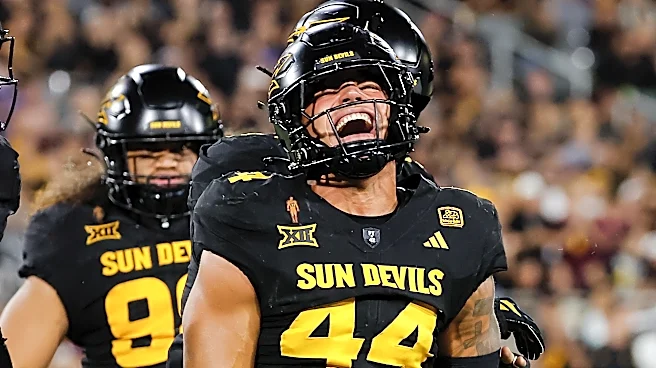
Myles “Ghost” Rowser, Senior, Arizona State
6-0 | 194 lbs | 4.64 sec 40 | RAS 1.24 | Age 21
2025 Stats: 13 games | 84 Comb Tkl | 35 Stops | 0 INT | 3 PD
Run Stop Rate: 6.1% (Rk 21)
Y/Cov Snp: 0.59
Pressure Rate: 23.5% (17 Att)
Consensus Rank: 447
Commanders Meetings: East-West Shrine
Rowser earned the nickname “Ghost” for his quite personality. On the field, he is a physical, high energy player, and a big hitter who sets the tone in the middle of the field.
Rowser plays faster than his testing numbers, which is a good thing for a player with 1.24 RAS. Rowser lined up predominantly in the box. But despite the poor testing numbers, he has the versatility to play free safety – where he stood out at the Shrine Bowl – and cover the slot.
Rowser is a quality run defender, with a Run Stop Rate in the top 10% of the safety class. His Rate of Yardage Allowed in coverage was above average for box safeties. His Pressure Rate on 17 blitzes was around average for the safety class.
He could be a fit to Daronte Jones’ position-agnositic backfield, but would probably be best used in the box, where he can defend the run and occasionally rush the passer.
Xavion Alford, Senior, Arizona State
5-9 | 202 lbs | 31.13” arms | 4.55 sec 40 | RAS 7.02 | Age 23 to 24 (?)
2024 Stats: 14 games | 85 Comb Tkl | 9 Stops | 2 INT | 5 PD
2024 Run Stop Rate: 1.4%
2024 Y/Cov Snp: 0.21 (2025 equiv. Rk 7)
Consensus Rank: 644
Commanders Meetings: None
Alford could be one of the steals of the draft, or as an UDFA, if he is fully recovered from the back surgery which cut his 2025 season short. His recent Pro Day performance, where he put up 16 reps on the bench and a 37.5” vertical, suggests that might be the case. His 2024 stats are used here.
Alford is a rangy deep safety, with the speed and coverage skills to play single high. At ASU, he aligned primarily at FS, with significant time in the box and around 8% of snaps in the slot. He is not much of a force against the run, but gives very little yardage away in coverage. His Rate of Yardage Allowed in coverage in 2024 would have ranked in the top 10% of this year’s free safety class.
If his medicals check out, he could be a sleeper on Day 3 of the draft or a steal as a UDFA signing.
Fred Perry, Senior, West Virginia
5-9 | 202 lbs | 31.13” arms | Age 22 to 23 (?)
2025 Stats: 12 games | 78 Comb Tkl | 35 Stops | 2 FF | 2 Sacks | 0 INT | 3 PD
Run Stop Rate: 11.3% (Rk 1)
Y/Cov Snp: 0.48
Pressure Rate: 25.0% (52 Att)
Consensus Rank: Unranked
Commanders Meetings: None
Perry is outside the prototypical size range for NFL safeties, which will make it an uphill fight to land on an NFL roster. But the former Mountaineer has toughness and playing ability to make it worth a shot.
Perry is an aggressive, hard hitting safety, who played all over the backfield in three seasons at Jackson State and one year at West Virginia. In 2025, he played 242 snaps in the slot to 150 in the box and 101 at free safety. His 0.48 Rate of Yardage Allowed in coverage also placed him in the top 10% of Nickel Safeties.
He is an exceptional run defender. His 11.3% Run Stop Rate, against Big 12 competition, was an outlier in the safety class, with the next closest player trailing at 8.3%.
Perry had the 6th most pass rush attempts in safety class and achieved an above average Pressure Rate, with 2 sacks.
He is a player the Commanders could deploy all over the secondary, on rushing and passing downs. Could he be the next Antoine Winfield Jr, Budda Baker, or Kyshoen Jarrett? I don’t know, but I will be pounding the table for the Commanders to offer him a UDFA tender if he isn’t snapped up in the draft.