




There was no John Poulakidas player preview here at MavsMoneyball. That is understandable given the undrafted rookie’s whereabouts at the time. Back in October, he was preparing to play 27 minutes per night for the Clippers’ G-League affiliate, having been waived by Los Angeles in camp two weeks earlier. He didn’t become a Maverick until early March, shortly after Ryan Nembhard’s two-way contract was upgraded to a standard deal. He made his NBA debut that same night, played in 13 games over the next
six weeks, and ended the season with eight made threes and a career-high 28 points in the same finale where Nembhard broke Jason Kidd’s franchise rookie assist record.
Two undrafted guys on the same squad, both having memorable nights on the last day of a 26-win season.
Who is this guy?
John Poulakidas is a 6-foot-6 lefty shooter from Naperville, Illinois, who finished his college career as the second-leading three-point shooter in Yale history. He shot 40.2 percent from deep across 110 games for the Bulldogs, made 243 career threes, and finished 10th on Yale’s all-time scoring list at 1,362 points. The most efficient way to describe him is also the most accurate one: he’s a shooter, and he has been a shooter for a long time.
The college résumé has texture beyond the percentages. As a junior in the 2024 NCAA Tournament, Poulakidas hit the game-winning jumper in Yale’s 78-76 first-round upset of fourth-seeded Auburn, finishing with 28 points on six made threes. He returned for a senior year, led the Ivy League in scoring at 19.4 points per game, earned First Team All-Ivy honors, and was named MVP of the Ivy League Tournament after a 25-point championship game against Cornell. He went undrafted in 2025 and signed an Exhibit 10 deal with the Clippers before getting waived in camp.
Season retrospective
Most of his year was spent with the San Diego Clippers, the L.A. Clippers’ G-League affiliate. Across 24 regular-season games there, Poulakidas averaged 14.7 points and shot 47.3 percent from three on more than seven attempts per game (96-of-203), the seventh-highest three-point mark in the G League among qualified players. After joining Dallas in March, he played 14 minutes in his NBA debut that night, a 117-90 loss to Charlotte.
His March was a typical two-way distribution. Most of his time went to the Texas Legends. At the NBA level, the appearances were short and scattered: 18 minutes for three points against the Pelicans, 28 minutes for 11 points against the Bucks, single-digit cameos in between. Somewhere in there, Mark Followill landed on “Pull-a-three-dis.” The long-time announcer’s nicknames don’t always work. This one did — the kind of corny that earns its smile during garbage time.
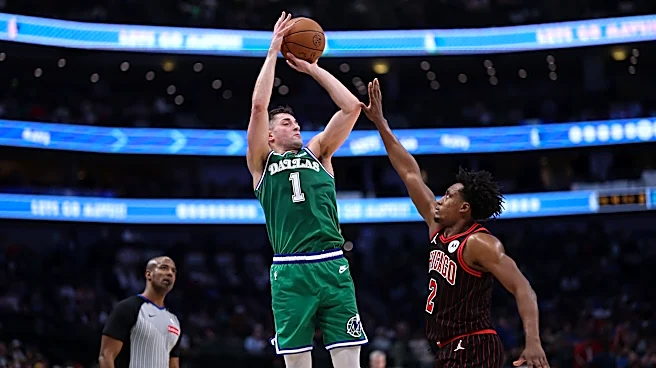
April rebooted the workload. Cooper Flagg’s ankle was managing him out of the rotation. Dallas had nothing to play for. The bench got long. On April 8 against the Suns, Poulakidas put up 23 points on five made threes in 29 minutes off the bench, his career high at the time. Four days later, in the season finale against Chicago, he played 36 minutes and finished with 28 points on 8-of-16 from three.
Outlook
Most rebuilds come with built-in upside. Bad year, high pick, talent infusion later. Dallas doesn’t get that. The team’s first-round picks are mostly gone for the next four years, which means there’s no benefit to being terrible. This year the losses helped the Tankathon premise. For the next four years, losing will do this franchise no good at all. The Mavericks have to rebuild without the usual rebuilding rewards, and that puts a different kind of pressure on every roster spot. The cheap value has to be developed in-house, in the places other teams aren’t looking.
A player like Poulakidas is exactly the kind of low-cost flier that math rewards. He shot 40.3 percent from three across his 13 NBA games. He shot 47.3 percent from three across his G-League work in San Diego. He shot 40.2 percent from three across four years at Yale. The shooting profile has been consistent at every level he’s played. He’s 23, which fits the Flagg-era timeline cleanly, and cheap perimeter shooting that takes pressure off a focal point is one of the more useful things a rebuilding roster can have—especially one that can’t draft its way out of holes.
The roster math complicates the path. We can pencil a draft pick that will likely get plenty of minutes if not a solid starter role. Perhaps that will be alongside Kyrie Irving, who will slated to return from his knee injury next season. Klay Thompson is potentially still here at least to start of the campaign. Max Christie is locked in. Flagg eats wing wherever he wants them. Poulakidas is not breaking up that group. The question is whether the back-of-bench shooter who made 31 of 77 threes in a lost season is the kind of guy you keep on a real contract instead of the kind of guy you let walk because the slot is needed for someone else.
Two-way contracts exist for cases like this. They’re cheap experiments at the back of the roster, low-risk fliers on undrafted prospects, and most of them produce nothing memorable. Poulakidas’s two-way produced 13 NBA games, two career nights, and a back-of-the-bench question that has more substance than back-of-the-bench questions usually do.
He didn’t earn what Nembhard earned. The sample is too small and the context too soft. But he earned a look, and he earned a question. On a roster that can’t draft its way out of holes, the question itself is an asset.
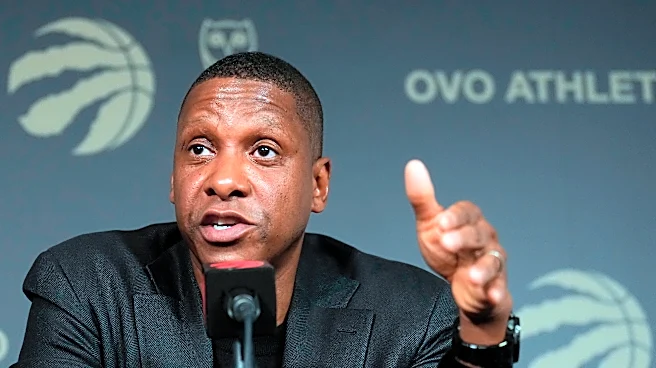
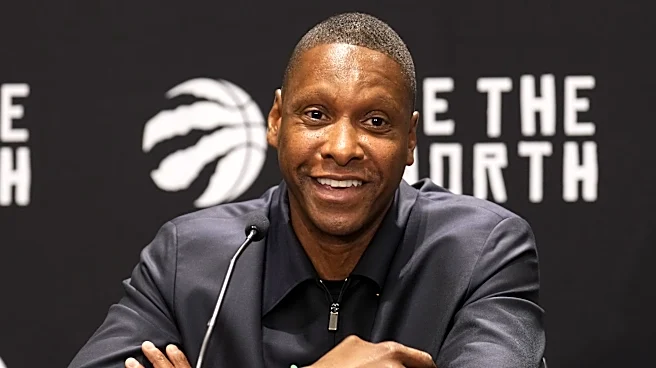
The new Ujiri front office now decides on the answer.