


Baseball history is full of great players. It is also full of players whose stories become intertwined with legends so large that they never quite stand on their own.
Ernie Shore just happens to be one of those players.
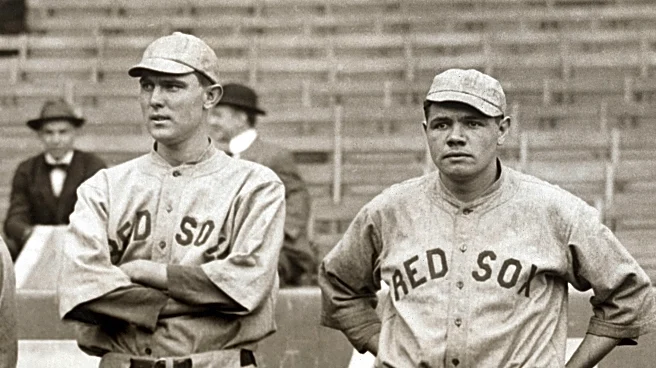
The former Yankee celebrates his birthday today, and while his career deserves recognition on its own, it is nearly impossible to tell his story without telling it alongside the one and only Babe Ruth. At almost every turn of Shore’s baseball life, Ruth was there.
Ernest Grady Shore
Born: March 24, 1891 (East Bend, NC) Died: September 24, 1980 (Winston-Salem, NC) Yankees Tenure: 1919-20
Shore’s journey to the major leagues began far from the spotlight that would eventually follow him. Born in North Carolina in 1891, he developed a country-strong frame on his family’s farm and an arm that caught the attention of professional scouts early. He graduated from Guilford College in 1914 and even returned during the offseason to serve as a math professor, but his professional path had already begun to take shape before that.
In 1912, the New York Giants brought Shore in on trial, a reminder of just how different the game looked at the time. Shore made his professional debut on June 20 as a reliever, but when the Giants attempted to option him, he refused and returned to college. He was later required to pay a fine to be reinstated before continuing his professional career.
Like many players of his era, his path back to the majors ran through the minor leagues, where he refined his command and established himself as a dependable arm rather than a headline-grabbing prospect. That reliability made him valuable. By the time he reached the Baltimore Orioles of the International League, Shore had developed into one of the more promising pitchers in high-level minor league baseball. Baltimore was one of the premier pipelines to the majors, and it just so happened that another young player was coming through that same system.
George Herman Ruth.
In 1914, both Shore and Ruth were part of the deal that sent them from a financially struggling Baltimore franchise to the Boston Red Sox. It was the first time their careers crossed, and it would not be the last. The two even roomed together early in their Boston days, until Shore reportedly requested a different roommate due to their vastly different lifestyles and habits.

In Boston, Shore quickly proved he belonged. While Ruth was still being used primarily as a pitcher, Shore emerged as one of the most reliable arms on a loaded Red Sox staff. From 1914 through 1917, he compiled a 58–33 record with a 2.12 ERA and played a key role in helping Boston capture World Series titles in 1915 and 1916. He was not flashy, but he was effective, the kind of pitcher teams relied on to win games consistently.
Ruth, meanwhile, was becoming something else entirely. Even then, the contrast was clear. Shore was steady and dependable. Ruth was becoming a phenomenon. Much like their personalities, they were two very different types of players.
That contrast reached its peak on June 23, 1917, in one of the strangest and most famous games in baseball history. Ruth started that day and immediately walked the first batter. What followed felt more like chaos than competition. After arguing the strike zone, Ruth was ejected and, in a moment that only adds to the legend, reportedly punched the umpire on his way out.
Shore entered the game in relief, despite having pitched just a few days earlier. The runner Ruth had allowed on base was caught stealing, and from that moment on, Shore was perfect. He retired the next 26 batters in order, recording 27 consecutive outs without allowing another baserunner.
For years, the game was considered a perfect game. Today, it is officially recognized as the first combined no-hitter in Major League Baseball history, credited to both Ruth and Shore, further cementing their connection in baseball history.
But that designation has always felt a little incomplete. Shore did everything a pitcher could possibly do. He faced 26 batters and retired all 26. His performance alone met every standard of perfection. The only thing separating him from a perfect game was the fact that Babe Ruth had already walked a batter.
In a single afternoon, Shore’s greatest achievement became inseparable from Ruth’s most chaotic moment. That was not a one-time occurrence. It was the pattern of his career.
Shore continued to pitch effectively for Boston, but his career was soon interrupted by military service during World War I. He missed the 1918 season, and when he returned, he was not quite the same pitcher. The timing was significant. As Shore worked his way back, Ruth was transforming into the most dominant offensive player the game had ever seen.
Once again, their paths crossed. Shore was eventually traded to the Yankees, reuniting him with Ruth in New York just as Ruth’s legend was exploding. This time, however, they were no longer peers on parallel tracks. Ruth was becoming the face of baseball. Shore was nearing the end of his career.
He appeared in parts of the 1919 and 1920 seasons with the Yankees, contributing as a veteran arm on a roster that was beginning to take shape around Ruth’s larger-than-life presence. Even in New York, their connection extended beyond the field.
One story that has followed Shore through history involves an incident during a Yankees exhibition game, when Ruth went into the stands to confront a heckler. Accounts vary, as they often do with stories involving Ruth, but the situation reportedly escalated to the point where the fan pulled a knife. Shore was among those who intervened, helping to defuse the situation and potentially prevent serious harm. For Shore, it was just another instance of helping the hot-headed Ruth out of a jam.
In a career filled with moments tied to Ruth, even that story fits. On the field, Shore once followed Ruth and delivered perfection. Off the field, he may have helped protect him.
Shore’s major league career came to an end shortly thereafter, finishing with a 65–43 record and a 2.47 ERA across seven seasons. Those numbers reflect a pitcher who was far more than a footnote. He was a key contributor to championship teams, a reliable starter, and a player capable of one of the most remarkable pitching performances the game has ever seen.
After baseball, Shore returned to North Carolina, where he lived a far different kind of life. He served as a sheriff for many years, becoming a respected figure in his community. In contrast to Ruth’s life of fame and spectacle, Shore’s post-baseball years were defined by stability, service, and a quieter form of impact.
It is a fitting contrast. Because while Babe Ruth became one of the most famous athletes in history, Ernie Shore remained something else entirely: a great pitcher whose legacy is forever intertwined with the biggest name the game has ever known.
Some players are remembered for what they did. Others are remembered for who they did it alongside. Ernie Shore will always be both.
Happy birthday, Ernie.
See more of the “Yankees Birthday of the Day” series here.