
The following is a guest post by Zach Lowy, who recently interviewed journalist Gabriele Marcotti on a range of topics, including Roma’s transformation under Gasperini. You can keep tabs on all of Lowy’s
work on social media.
You’d be hard-pressed to find a more erudite football journalist than Gabriele Marcotti. Born on July 28, 1973, in Milan, Marcotti bounced around from Warsaw, Frankfurt, New York City, Tokyo, London, and Chicago, and completed his higher education at the University of Pennsylvania and Columbia University’s School of Journalism before heading to London in the mid-90s. Since then, Marcotti has polished his journalistic skills at major outlets such as the Daily Mail, La Stampa, Sports Illustrated, the Financial Times, the Sunday Herald, Sky Sports News, BBC Radio 5 Live, Talksport, ITV, and The Times.
Today, he balances his time between working as a columnist, TV pundit, and podcaster for ESPN, raising his two daughters with his wife, and serving as the London correspondent for the Italian sports daily Corriere dello Sport. Although he’s spent the past three decades in London, Marcotti has remained keenly interested in developments in Italian football. Of the five books he has written, two were coauthored with the late Italian forward Gianluca Vialli, one was the autobiography of Paolo Di Canio, and two were coauthored with two ex-Roma managers, Fabio Capello and Claudio Ranieri.
You’ve been a full-time ESPN employee since 2019…in other words, since Roma last played in the UEFA Champions League. What have you made of their progress under Gian Piero Gasperini? Does he have what it takes to lead them back to Europe’s premier competition?
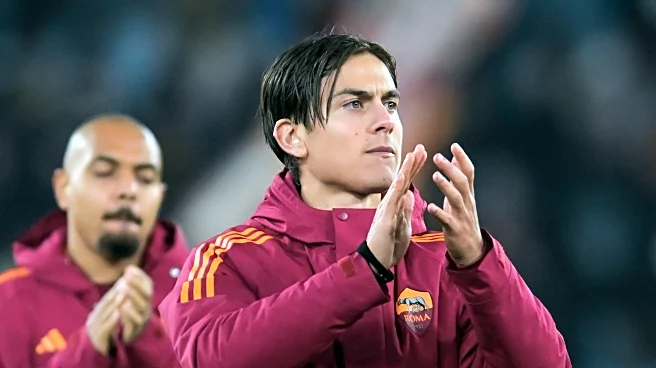
I think it’s hard to look at one season in isolation, because Roma, like Juventus and a number of Italian clubs, they always carry with them the legacies of before and what they need to do to comply with financial stability rules and whatnot. Gasperini likes doing things a certain way, which is very different from before. He’s a rather odd character, but it worked very well for him at Atalanta. Roma are more exciting and playing on the front foot under Gasperini, and he’s got the fans on his side. I like the fact that he’s pushed younger players like Niccolò Pisilli, but I’m sad that he couldn’t find any room in his team to develop Tommaso Baldanzi. But you still have certain things like Paulo Dybala, who is gobbling up 20% of their wage bill and plays one out of three games. Is this good resource allocation? Is Dybala a Gasperini-type player at this stage of his career? Probably not. He inherited that situation, whereas the guys that he had at Atalanta, you assume that they’re the type of players that he wants.
Roma have the best defense in Serie A, but their attack isn’t quite up to standard. They’ve scored fewer than each of the teams in Serie A’s top seven; they’ve scored fewer than 10th-placed Bologna…what’s your take on their lack of attacking prowess?
I think we always have to grade everybody on a curve, but what I struggle with a little bit is some of the choices that were made. I’m all on board with Evan Ferguson, but if you already have Artem Dovbyk there…unless you’re planning to pull all your eggs in Ferguson’s basket and think he’s going to be your center forward for the next 5-7 years, I don’t know that you necessarily want to bring him in, unless you’re sure that you can get rid of Dovbyk. What I definitely wouldn’t do is then tell people, ‘Oh, I don’t like Dovbyk, and I don’t like Ferguson, I don’t like either one.’ These are some of the odd things that you have to deal with.
Lastly, there have been complaints about not just Roma, but Italian teams in general, that they don’t do as good a job promoting young players as other nations like France, England, Portugal, etc. How do you think Roma and Gasperini have done with youth development?
This has been a long-running thing in Italian football, although there are some obvious exceptions like Parma and one or two others, but there’s this idea that you’re still a kid until you’re 23/24 years old. I’m like, ‘Bro, look around Europe. Look at what some of these young players, when given the chance, achieve elsewhere. I think it’s got to be really, really frustrating for a lot of younger Italian players and for anybody who just wants to see Italian players do well. I saw a graphic the other day. I’ll get this wrong, but you can check this out. Italy are consistently going deep in youth tournaments and even winning competitions like the World Cup and Euros, so clearly, these guys were good enough to be at an equal footing with the guys from France, Brazil, Spain, and all these other teams, right? And then you look at these guys and where they are now, and you look at how many of them are playing regularly. And you’re like, ‘Whoa! It’s only a couple of people!’
You’ve got Francesco Pio Esposito at Inter, Francesco Camarda at Lecce, and a couple of others like Michael Kayode at Brentford. I’m like, ‘How is your professional arc supposed to develop if all of a sudden, you’re not given opportunities? I find that, frankly, stupid and sad. I think it’s a complex answer, and it would take a lot of time to discuss the structural deficiencies in Italy when it comes to not developing young talent, but not giving young talent an opportunity to play, that’s something that definitely hurts you. And it hurts Roma, because Roma have a really, really good youth academy. They produce a lot of players, it’s just that they end up doing well at other clubs.