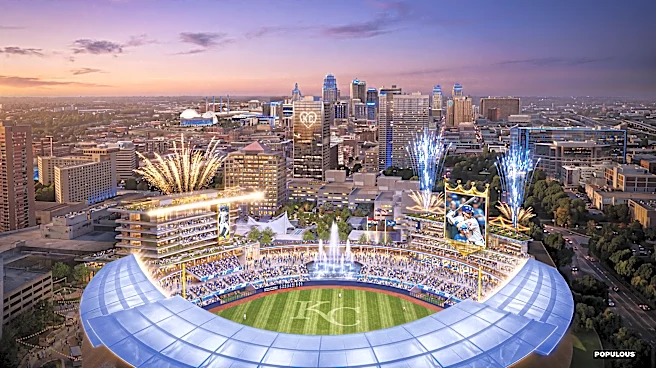






The Royals finally have at least the bulk of a plan in place to build their new downtown stadium. The plan they unveiled last week is complete with city- and state-level funding that seems primed to pay for at least half of the actual stadium, while the Royals will develop a whopping 85 acres of land around the new stadium as a new ballpark district for which the team will expect to profit handsomely. It will be the largest such district in a downtown area in the country. Compare that to The Battery
in Atlanta around Truist Park, which is a touch less than 10 acres.
I wrote extensively about this topic back in 2024, and if you were reading then, you know the whole idea of a publicly funded stadium bugs the crap out of me. So I’ve taken a couple of days to try and let some of my immediate negative responses filter out, so I could see if I could find some positives, and – wouldn’t you know it? – some were able to filter to the surface. So let’s go over some of the pros and cons of what we know about the new stadium plan.
Pro: Downtown baseball is good
I’m not listening to your arguments about the parking or traffic. You don’t know what the parking or traffic will be like. I know this because no one knows yet. Nothing has been set in stone. Construction hasn’t begun. Studies haven’t been completely performed. If parking becomes an issue, the free market will step in and provide more spaces. Yes, they’ll cost money, but let’s not pretend that the Royals haven’t been charging an arm and a leg to park for a while now, too.
Tailgating will probably die, but it’s never been a huge thing for baseball games anyway. Most of them are played on weeknights, and it’s hard to have the time to do that sort of thing. You should, however, have infinitely more restaurant options before the game, now. That will end up being pretty nice. Being downtown also means there will be additional public transportation and walking options. Rideshare and taxi services should cost less for many people, too.
Making it easier to get to games means more people should be able to attend. That can only benefit the team and the sport.
I’ve come around to the idea that a baseball stadium is a civic good. They provide a large gathering place not just to watch a sports team but for other touring events such as musical concerts, disaster relief, and more. They can also serve as a gathering place to perform civic duties like voting. It’s in the public’s best interest to have at least one large stadium, such as the Royals’ new ballpark, in their city. Building it in a more centralized location makes it better able to serve its purposes.
Con: The funding seems problematic
Residents voted down the 2024 attempt for many reasons. Some of them were because of the location and the rushed nature of the planning. However, some just didn’t want a new tax. So Kansas City came up with a way to get the funding without creating any new taxes except for in this new area, so they could avoid another vote that they might lose. That seems well and good until you start to do the math. If you follow that link, you’ll see a pretty good breakdown of the numbers involved, and there doesn’t seem to be a realistic path to Kansas City covering the costs of the stadium they’ve promised to pay via the methods they plan to use. Unfortunately, if the city can’t recoup the costs via the proposed tax plan, that means they’re going to have to cut spending in other areas.
A stadium is of public benefit, but so are affordable housing, medical care, education, and emergency services. Programs funding these things will likely suffer as a result of these decisions. Maybe having a stadium will be worth the losses in those other programs, but it seems exceptionally unfortunate that the people aren’t being given an opportunity to make that determination for themselves.
I have heard that the team is still working on a new Community Benefits Agreement that could theoretically abate some of these issues, but I don’t have a lot of faith in that process. When the Royals last negotiated such an agreement, it was with the need to convince people to get on board with their plans. Even then, the agreement amounted to a promise from the Royals to donate money to charity – something the team already did – while putting in writing that they could consider themselves a charity. Essentially, they promised nothing.
Additionally, even if they hadn’t named themselves a potential charity recipient and even if they weren’t already donating to a variety of charities, charitable donations aren’t what a CBA is for. Now that the Royals don’t need to persuade the community to do anything and the city and state have agreed in principle to give them what they want, they have less incentive than ever to do the right thing here.
Finally, they’re promising this will create a lot of jobs, and while doing that, they highlighted that the construction of the new stadium would generate 20,000 new jobs in that field alone. What they disingenuously failed to mention is that, of those 20,000 jobs, many if not most of them will be temporary. It also disregards the number of jobs that will be lost at the old Truman Sports Complex. Many of the team jobs being lost will be necessary at the new park, but don’t be surprised if they try to call those new jobs, too. It’s a very common business practice/accounting trick to stop doing something and then start it again under a new name to pretend you’ve created something new instead of continuing to do the first thing.
Pro: There could be some economic benefits
Unlike their 2024 attempt, which smacked of gentrification, this time they appear to be providing an opportunity for economic revitalization. From my understanding (and my opinion on this is subject to change if I discover differently), the Royals will not be displacing many, if any, businesses or homes to build their new stadium, except for Hallmark’s headquarters, which will not be harmed by such a move.
The primary difference between gentrification and revitalization is whether you’re forcing out people when improving an area. If they had moved to the Crossroads location, that would have required a lot of tenants to move. Even if city programs suffer due to the path they’ve chosen for funding this thing, there should be opportunities for individuals to improve their lot by investing in the new area while minimizing harm to existing tenants. That’s a good thing!
Additionally, a new stadium should convince MLB to award Kansas City an All-Star Game shortly after construction is complete. I don’t know how much that would actually benefit the city economically, but it would at least be really cool, and that’s not nothing!
I know I’m fighting what seems like a losing battle by complaining about the funding of the stadium, but I’m encouraged by the Community Benefits Agreements we’ve seen in places like Nashville and Milwaukee, as cited in my original article about the CBA linked above. I’m also encouraged that politicians have had to resort to tricks and games to get the funding for these projects, as the public sentiment has moved against them. People are wising up, and I believe that someday we’ll live in a world where the teams have to pay for their own stadiums. Or at least pay a reasonable rent to use them.
Until then, I’ll settle for mocking concept art that inexplicably has a massive fountain where the batter’s eye should go and fantasizing about how cool it will be to look out at the field from behind home plate and see the Kansas City skyline instead of a solitary Denny’s.