

Three years ago, I gave a grave warning that most dismissed as clickbait or alarmism: A lockout was coming to MLB in December 2026.
At the risk of asking the owners how many times they need to learn this lesson, I am not generally in the business of making predictions, but I will venture out on a limb and make a prediction today:
The owners are going to lock out the players (again) in December 2026 when the current collective bargaining agreement expires.
You may ask why. Well, I blame two “culprits”
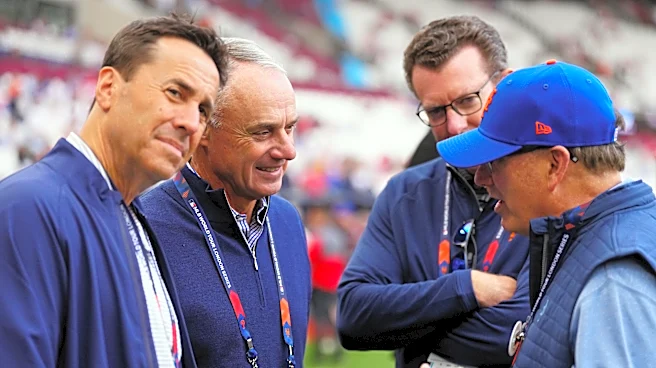
who frankly have not done anything wrong in a baseball context: Mets owner Steve Cohen and Padres owner Peter Seidler.
Today is not the day to break down proposals and argue who is in the right and who is in the wrong, and why the owners are a bunch of money-grubbing morons who are going to strangle the sport when it has finally regained a measure of popularity to be the second-banana in American sports again, only behind the behemoth that is the National Football League.
Today is not the day I break down in graphic detail what I really think.
We have time for that trainwreck and to fully explore the anger and stupidity, as well as the slow march that got us here. We have time to discuss the cancers that have been allowed to metastasize and spread that we covered earlier this year.
Now, like a blip on Doppler radar that has grown scarier and angrier on the screen, the oncoming storm lumbers towards our figurative shores. It will come ashore, and it will be bad. But before the doom and gloom, we can take a second to mock the deserving.
This fact just in: I was wrong as to one solitary point. Steve Cohen did not become baseball’s boogeyman; Mark Walter and the Dodgers did. However, we’re not here to talk about the Dodgers. Even with all of the investment in Queens, and Lord, there has been a lot of investment, the New York Mets remain a laughingstock.
It’s like accidentally making a flop in the style of The Producers every year.
Now, on the verge of the imminent lockout that we are powerless to stop, we need to do three things. Today, we are going to present a prebuttal to an argument that I know will persist only to annoy me and highlight folks who are either terribly ignorant or lack any semblance of empathy.
Next time, we’ll present an idea that would make baseball stronger and better for the next century. It’s fan-friendly and would be a generational change, transforming the landscape of American sport forever. Accordingly, this idea has no chance in hell of ever being implemented. Ever.
The owners would hate it. The players would hate it. The traditionalists in the media would hate it. But the fans would probably love it.
Then, we discuss expansion: both how it would look in this new system and what we’re most likely going to get.
Controlling the Message
“It’s millionaires versus billionaires:” this framing of the coming labor dispute is so incredibly lazy.
We have extensively covered that the average player in MLB is not a millionaire, at least not yet. And even if they were, what we are dealing with here is a manufactured labor crisis where management doesn’t want to pay its employees what they are actually worth. For as conservative-leaning as baseball generally is, there’s a movement to socialize the risk for owners, which is my view of the current argument.
Certain sportswriters clearly come from some degree of privilege (guilty as charged here), and that shows in how they discuss labor issues. Invariably, a stinker from Brittney Ghiroli or Jim Bowden at The Athletic usually makes you question your sanity. Although Pedro Martinez, analyst at ESPN, unleashed a corker recently:
“Please, for the fans, both sides, figure it out, a good way to get it done, and do not lock out baseball,” Martinez said.
“I hope the commissioner can see me and hear and the players’ association hears what I have to say. I might be insignificant, but I lived it before. I experienced that before,” Martinez said. “… I was one of the most punished players at that moment because I had talent, and I needed to wait until arbitration to make my money. So I hope they don’t mess it up and they don’t mistreat the fans.”
“Back then, there was a need for other things to change, and they changed for the better. This time, there’s no excuse,” Martinez added in comparing the 1994 strike to today. “On both sides, not the PA, not the owners, not baseball. The fans do not deserve to be mistreated.”
In Boston for the Pedro Martinez Foundation’s 10th annual gala, Martinez said that “honestly speaking, I’m pissed” as he appealed to both players and owners to find a solution.
It’s as if the former Dodger planned to give the perfect segue to present the argument that I shall rebut:
The argument goes, if there is a salary cap in baseball, the owners will pass that savings along to the fans. Because really this salary cap is about the fans. Too many teams have no shot of winning at the start of the year. No one is worrying about the fans!
As to the Math
First, people have argued about trickle-down economics for about fifty years in the United States. As of this essay, this timeframe goes back to Ronald Reagan in 1980, before I was born.
The math ever since, every time it was tried, is pretty clear: it doesn’t work. At all. The richer get richer, the poor get shafted. That’s not politics; it’s math.
Wage disparity has grown into an ever-widening chasm between the haves and have-nots, starting in the Reagan Administration and continuing almost in a straight line to now. If you think a salary cap will lower ticket prices, concession prices, or parking prices by a single dollar now, fifty years later with clear, empirical evidence in every other instance that says to the contrary, then nothing likely will sway you short of a shock to the system that breaks past dogma.
Everyone is entitled to their opinions; no one is entitled to their own facts. There are not two sides to every issue.
As to the Cap
Second, baseball already has a salary cap; it’s just a soft cap, with financial penalties. The proponents of the stoppage want a hard cap where teams are barred from spending over a set amount. What these cheapskates want is the reserve clause back in all but name, and their best players being forced to play with one team for the duration of their career in the name of parity, which does not pass the laugh test.
Under the expanded playoff format, every team but six has made the playoffs: San Francisco Giants (2021), Sacramento Athletics (2020), Washington Nationals (2019), Colorado Rockies (2018), Pittsburgh Pirates (2015), and Anaheim Angels (2014).
Also, 13 unique teams have played in baseball’s final four, but sure, the Dodgers have somehow ruined baseball.
- Arizona Diamondbacks (2023)
- Cleveland Guardians (2024, 2026)
- Houston Astros (2022, 2023)
- Los Angeles Dodgers (2024, 2025, 2026)
- Milwaukee Brewers (2025, 2026)
- New York Mets (2024)
- New York Yankees (2022, 2024)
- Philadelphia Phillies (2022, 2023)
- San Diego Padres (2022)
- Seattle Mariners (2025)
- Tampa Bay Rays (2026)
- Texas Rangers (2023)
- Toronto Blue Jays (2025)
Yes, the Tony Gwynns and Clayton Kershaws of the world stayed with their respective organizations for their entire careers. The entire notion that homegrown stars are ripped from the fans of so-called small-market teams was perpetuated by Moneyball. Yes, so-called large-market teams overpay for players all the time.
Look at Tarik Skubal. The unspoken truth about the fact that he was dealt in 2026 stems from the fact that the Detroit Tigers tried to lowball him to an absurd degree, making a midseason move all but a fait accompli. Will a player accept less to stay put? Sometimes. What a player won’t and shouldn’t accept is being paid less. A hometown discount is one thing; being paid pennies on the dollar is another, unless you’re Shohei Ohtani, which is both an accounting joke and a gross oversimplification of his contract.
A lot of the discourse surrounding Skubal at the deadline largely missed the mark. Much was said about the Dodgers trading for Tarik Skubal. Some of it was insightful and thought-provoking. However, most of the discourse was devoid of rational thought, said with the emotional maturity of a sleep-deprived toddler.
While other hypotheticals were publicly being bandied about, it’s important to remember that Dave Roberts previously mentioned acquiring Skubal and, for the Dodgers, per Fabian Ardaya:
At the time, there was plenty of excellent coverage here at True Blue LA to sort through that needs no repetition here, only citation.
The default argument that the Dodgers bought Skubal was just silly and a declaration that one does not understand how trades work. Skubal did not have a no-move clause, unlike the also-traded Kevin Gausman. Skubal no more chose to be in Los Angeles than Kyle Tucker chose to arrive in Chicago last year after being traded from Houston.
Skubal was in the last year of his contract, costing about $10 million for the remainder of the year, and any team could have afforded that financial cost.
The Dodgers gave up some prospect depth in Zyhir Hope and River Ryan, but the system retained its prospect depth, particularly in the outfield. The trade of River Ryan for Skubal felt oddly kismet because I had worked on a trade proposal essay in 2024 about that basic deal I had to spike due to Ryan’s injury. A 2024 Dodgers’ team that had a rotation of Skubal-Yamamoto-Buehler-Knack likely would have had a much easier postseason run.
Yes, the Dodgers had Skubal and bowed out with alacrity in October. It happens. It seems likely Skubal will be playing elsewhere next year.
Yes, the Brewers tried to get Skubal with public reports about the packages they proffered to Detroit to no avail. “The Tigers, though, wanted a controllable Major League pitcher in the deal. None of the sources would say who they favored, but Logan Henderson was among the names teams were asking for most often.” In most years, the Brewers’ frugality is their downfall. This year, they won in spite of that trait. Good for them.
As to the Fans
Third, the fans shouldn’t have a say in this dispute. Imagine if, in your work, your customer tried to intervene in how much you got paid at work, arguing you should just take what you get; you wouldn’t stand for it.
That said, the fans do have a way to voice their opinion in these proceedings, once baseball returns: if you’re truly that unhappy with baseball, don’t go, don’t watch. We have a dispute between management and labor. If the customer doesn’t like the price of the service, the customer can stay home, which leads to the unspoken truth: baseball’s antitrust exemption.
If you want baseball, MLB is the only game in town. Even the Savanna Bananas and their ilk are something else. Baseball is a legal monopoly. And frankly, it is long past time for the exemption to die.
Everyone tends to forget that MLB pruned minor league baseball with a figurative ax over the last few years. The MLB draft is a shell of itself, as rounds 21 through 40 no longer exist.
Given the proposals from the league that seeks to further prune the avenues for people to enter the sport, it seems apt to point out the Hall of Famers and other notable players who were fortunate enough to make it when they did, because they are currently out of luck in the current system.
- John Smoltz (Round 22, 1985, inducted 2015)
- Andy Petittitte (Round 22, 1990)
- Mike Piazza (Round 62, 1988, inducted 2016)
- Roy Oswalt (Round 23, 1996)
- Brett Butler (Round 23, 1979)
- Mark Grace (Round 24, 1985)
- Paul LoDuca (Round 25, 1993)
- Dusty Baker (Round 26, 1967)
- Dave Roberts (Round 28, 1998)
- Kevin Kiermaier (Round 31, 2010)
- Mark Buehrle (Round 38, 1998)
The average fan will not be affected one iota by the strike, as they, we, just lose an entertainment option. Most writers will have to find something else to drive traffic and generate interest in baseball. Most will have to learn or relearn to love the art of long-form essay writing.
Note, I say fan, because there is a segment of regular people who will be deeply affected by the lockout.
I’m shining a light on the people who are already losing their jobs, those people who are caught in the crossfire of management’s unfettered greed: the support staff people in baseball. And the cull has already started.
No one will highlight the actual regular people until it’s too late.
People in operations, marketing, sales, security, and every ancillary person who isn’t a player but depends directly on baseball to operate and have a job. The tour guides, the media people, the medical personnel, the food service people, the parking attendants, the regular people who are forced to sit around or find other work because management is trying to grow their balance sheets.
I’m sure I’ve forgotten or missed someone, and that failure is one of imagination rather than intent.
This oncoming storm is appropriate for the age we are in. The retroclassic ballpark age ended a while ago. We now live in the Faux-Wrigleyville / The Battery Era, where the goal is creating an entertainment/mixed use district that keeps dollars flowing to organizations every day of the year, regardless of whether baseball is in season or not.
The utter rage I feel at these regular people being screwed is the genesis of this essay. Because there is a better way, and baseball will likely never do it. So next time, we’re going to describe the layout ourselves as we engineer the future.