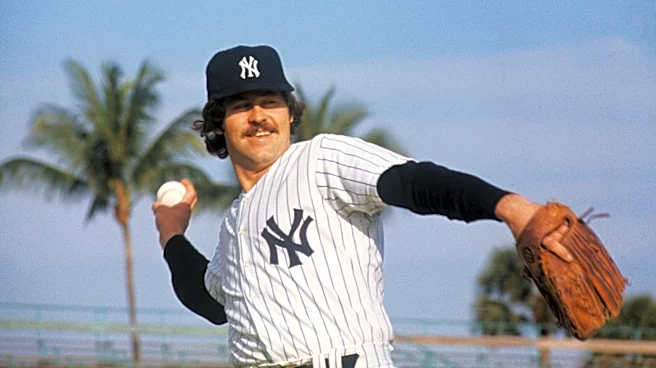



Today’s edition of our Yankees birthday series brings us to another member of the Baseball Hall of Fame. Owner of one of the most iconic nicknames in the game’s history, Jim Hunter may have only played a third of his career in pinstripes, but in the Bronx, and within the game in general, the right-hander was a historically important figure, not to mention a mighty fine pitcher.
Jim “Catfish” Hunter
Born: April 8, 1946 (Hertford, NC)
Died: September 9, 1999 (Hertford, NC)
Yankees Tenure: 1975-79
After
a highly successful decade with the Athletics, Hunter’s arrival is hard not to correlate with the success of the Yankees in the late 1970s. Already having six All-Star selections, a Cy Young Award, and three World Series rings, Catfish’s prowess on the mound was hard to argue, and it clearly made an impact on the organization’s success on the whole.
As a member of the Kansas City Athletics organization, Hunter made a particularly quick ascent through the minor leagues. pitching just nine minor league games before making his big league debut in May of 1965. He finished with a pedestrian 4.26 ERA across 133 inning of work in his rookie year, but he would hit the ground running in the ‘66 season. Starting 25 games for Kansas City, Hunter managed a 4.02 ERA, and pitched well enough to earn his first career All-Star selection.
Hunter’s full breakout began in ‘67 when he set career bests in nearly every category, boasting a much improved 2.81 ERA (114 ERA+), en route to his second All-Star selection in as many years. Despite the franchise following that year with a move to Oakland, Catfish Hunter’s impressive performance on the mound proved no worse for the wear. Notably, he joined baseball immortality in a hurry by throwing just the ninth perfect game in AL/NL history on May 8, 1968 by blanking the Twins at the Coliseum.
In 1970, the right-hander led the league in starts and earned his third All-Star appearance. But his final three years by the Bay were perhaps his most memorable, as he helped lead he A’s toward the promise land. He crafted an eye-opening 2.04 ERA in ‘72, and tallied 20 wins for the second straight year, as he finished fourth in Cy Young voting. He won 21 more and finished a spot higher in Cy voting a year later, all culminating in an electric ‘74 campaign. That year, his 25 wins and 2.49 ERA both led the league, as he pitched over 300 innings and completed a whopping 23 games. He earned his sixth All-Star selection, and was named the American League’s Cy Young Award winner.
All of these personal accomplishment’s aside, Hunter helped lead the A’s to three consecutive World Series championships from 1972-74, and played a vital role in each of them, something the Yankees would come to appreciate as well.
It would be difficult to have a better ten-year stretch with an organization, particularly at the end, which featured a trio of championships and a Cy Young Award on the personal side. Following the ‘74 season, a contract dispute between Hunter and the A’s drove them to a breaking point, and resulted in the star pitcher hitting the market. The move resulted in Hunter becoming the first big-money free agent in baseball, as he signed a five-year, $3.2 million deal with the Yankees. It was a watershed moment for the league, and one whose ripple effects are still being felt decades later.

The historic signing paid immediate and significant dividends for the Yankees. 1975, his first season in pinstripes, proved to be one of his finest. Hunter picked up right where he left off, as he pitched to the tune of a 2.58 ERA over a whopping 328 innings of work, and his season was perhaps highlighted by his 30 complete games, a number that has not been reached since by a big league pitcher. He finished second in Cy Young voting.
In 1976, his production took a slight step back, but Hunter was still as durable as they come. He still tossed nearly 300 innings, though his more pedestrian 98 ERA+ was the worst such mark in years for the right-hander. Nonetheless, Hunter earned his fifth consecutive All-Star selection, and helped the team capture their first pennant since 1964.
Now into his thirties, Hunter’s decline was evident in the latter years of his contract with the Yankees, but you wouldn’t know it by the team’s success. In 1977, he pitched just over 140 innings, a number that would decrease in each subsequent season. In those final three years, he was a below-average run-preventor, but the Yankees soared in the later years of the decade.
Hunter took a loss in Game 2 of their winning effort in the ‘77 Fall Classic. But, after doing the same in the ‘78 Series against the Dodgers in wake of a strong second half in the Yankees’ fierce AL East comeback over Boston, he was able to push aside any negative impressions after he pitched seven innings of two-run ball in a Game 6 victory that sealed their second championship in as many years.
With his production and longevity dwindling, as well as his continued arm problems and diabetes diagnosis the year prior, 1979 would wind up being Hunter’s final big-league season. He once again set a new lows in innings pitched, ERA and FIP. It was also a difficult year for him personally, as well. Scout Clyde Kluttz who recruited him both to the A’s and Yankees suddenly passed away, as did his father Abbott. This was, of course, also the year that batterymate Thurman Munson, with whom Catfish was very close, tragically died in a plane crash in August.
1979 being his final year in the majors was always the plan for Hunter, and he remained true to that word.
Hunter retired at just 33 years old, but did so to the life he likely wanted: a quiet and simple one. He was elected to the National Baseball Hall of Fame in 1987. Although only five of his 15 seasons in the big leagues came in New York, his impact would be difficult to overstate. The winning ways he brought from his incredible run with the Athletics paid off massively for the Yanks, who enjoyed the final two of Hunter’s five World Series rings.
Catfish Hunter tragically did not have very long to enjoy his life as a Hall of Famer. A decade later, he was diagnosed with ALS, the same terrible, incurable disease that afflicted fellow Yankees legend Lou Gehrig. By mid-September 1999, Hunter was gone at only 53 years old. His widow, Helen, has remained a familiar presence at numerous Old-Timers’ Days since then, representing her husband with pride alongside the likes of Diana Munson.
Although Catfish has been gone from this world for over a quarter-century now, his impact on the game—and anecdotally on those who crossed paths with him—was undoubtedly a positive one. On what would be his 80th birthday, it’s as good a time as any to look back on his Hall of Fame career.
See more of the “Yankees Birthday of the Day” series here.