
After the NFL Draft concluded, the Seattle Seahawks had very little room left to add undrafted free agents. Even so, the Seahawks chose to bring in tight end Lance Mason.
At first glance, that decision seems difficult to justify. Seattle’s tight end room is already crowded. AJ Barner emerged as a legitimate contributor following a strong second season. Elijah Arroyo remains one of the organization’s most significant recent investments at the position. Eric Saubert received a somewhat surprising extension
during the middle of last year, while Harrison Bryant, Nick Kallerup, and even Brady Russell continue fighting for specialized roles throughout the roster.
On paper, there simply doesn’t appear to be much room available.
Then again, that’s true for most undrafted free agents who ultimately make NFL rosters. They enter crowded rooms by definition. And Seattle, perhaps more than most organizations, has built a long history of finding contributors where other teams saw camp bodies.
Who is Lance Mason?
Growing up in Rockwall, Texas, he spent much of his high school career playing on both sides of the ball at Rockwall-Heath High School, lining up as both a linebacker and a tight end. He never developed the prototypical frame of a dominant inline tight end, but he did carry over many of the traits associated with defensive football: physicality, spatial awareness, and a natural comfort operating near traffic.
Despite that versatility, he barely registered on the recruiting landscape.
Mason finished high school as an unranked prospect in the 2022 recruiting cycle and ultimately landed at Missouri State in the FCS. His first two seasons were relatively quiet from a production standpoint. He functioned primarily as a complementary piece within the offense, rotating snaps and serving as a security blanket in underneath situations.
The breakthrough came in 2024.
With a larger role in the Bears’ offense, Mason posted 34 receptions, 590 yards, and six touchdowns, emerging as one of the more productive tight ends in the conference.
That season opened the door to a much bigger opportunity.
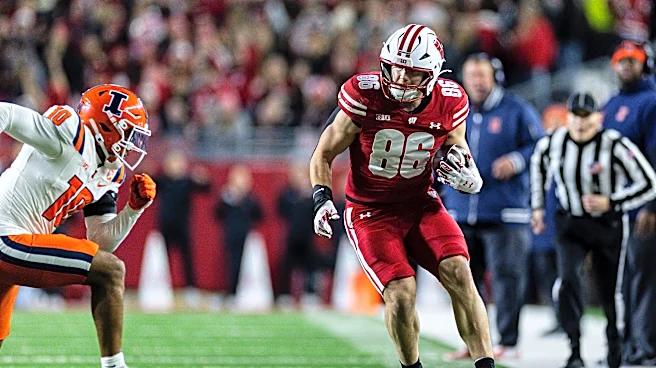
In 2025, he transferred to Wisconsin.
Many FCS tight ends produce because they overwhelm inferior competition physically. Mason’s transition is notable because he did the opposite. He jumped up a level and remained productive despite playing within an offense that struggled to consistently generate explosive plays through the air.
Leading Wisconsin in receiving yards with 398 may not immediately jump off the stat sheet, but context matters. The Badgers’ passing game was inconsistent throughout much of the season. Protection issues, limited vertical efficiency, and an overall lack of explosiveness frequently constrained the offense.
Yet Mason kept finding ways to contribute.
And that’s one of the more interesting aspects of his NFL projection. The tape consistently shows a player capable of remaining useful regardless of the offensive environment around him.
Why the Seahawks were interested
The Seahawks aren’t building a tight end room based solely on athletic mismatches.
There is a clear preference for players who can align in multiple locations, execute a variety of assignments, and help preserve offensive flexibility without telegraphing tendencies. Mason checks several of those boxes.
The first thing that stands out on film is his understanding of spacing against zone coverage.
Many college tight ends simply run through zones at a constant speed, making life easier for linebackers and safeties. Mason operates differently.
He shows a natural feel for changing tempo within routes, subtly throttling down without disrupting timing with the quarterback. Small head fakes, slight variations in pace, and an understanding of defensive leverage allow him to settle into voids rather than carry defenders directly into throwing windows.
On stick concepts, spacing routes, and shallow sits, he consistently presents clean targets.
Several of his most important receptions at Wisconsin came from his ability to identify soft spots in underneath coverage while simultaneously adjusting his path to avoid unnecessary contact from defenders closing downhill.
He doesn’t create separation through explosiveness.
He creates it through discomfort.
Against aggressive defenders, Mason frequently uses hesitation and pacing to manipulate reactions. On the rep above, facing a defender with superior athleticism, he generates unexpected vertical separation simply through subtle tempo variation. The corner briefly stops his feet, loses timing within the rep, and Mason gains enough space to create a throwing window.
His hands may be the most NFL-ready aspect of his game.
Mason is exceptionally comfortable catching outside his frame. He adjusts naturally to high throws, extends well away from his body, and rarely appears uncomfortable tracking the football through traffic.
His functional catch radius is larger than his measurements would suggest because of his body control at the catch point.
That reliability consistently shows up on tape.
More importantly, he transitions extremely well after the catch.
Many college tight ends require an extra beat to gather themselves before becoming runners. Mason often catches the football already prepared for the next phase of the play. He secures the pass in stride and immediately transitions into runner mode.
That trait has significant value in quick-game concepts.
While he isn’t an explosive athlete, there is a noticeable level of competitiveness after the catch. He runs with relatively compact pad level, absorbs contact better than expected, and consistently fights for hidden yardage.
He isn’t the type of modern flex tight end who will routinely make defenders miss in space, but there is creativity in congested areas. Small cuts, angle changes, and balance through contact frequently allow him to turn modest gains into chain-moving plays.
One of the most encouraging aspects of his tape is how consistently he works leverage against linebackers and safeties. He understands spacing, recognizes zone rotations, and repeatedly finds intermediate windows between the hashes.
The Wisconsin offense often struggled to create favorable situations for its pass catchers.
Mason still found ways to produce.
As mentioned earlier, he wasn’t creating separation through raw athleticism.
He was creating it through pacing, timing, and route nuance. This rep against Caleb Downs is a perfect example.
His lone season at Wisconsin was beneficial for more than just his receiving development.
There are legitimate signs of growth as a blocker.
The overall strength profile still needs significant improvement, but the technical progress is visible. His angles improved. His urgency improved. His willingness to engage physically improved.
Against higher-level competition, those developments matter.
When aligned in motion, operating from sift actions, split-flow concepts, or condensed formations, Mason becomes a much more effective blocker. In those situations, he can win with positioning, timing, and leverage instead of having to absorb power directly at the point of attack.
That distinction is important when projecting his NFL role.
Concerns and limitations
The biggest issue is fairly straightforward.
Mason simply doesn’t possess the size or play strength to consistently survive as a traditional inline tight end.
Asking him to live against NFL edge defenders in wide zone schemes or sustain blocks for extended periods in pass protection would likely create significant problems. His frame struggles to absorb and anchor against power.
That weakness shows up repeatedly against heavier defensive fronts.
When defenders establish their hands inside his chest early, his anchor can collapse quickly.
Inside zone and duo concepts frequently expose those limitations.
Defenders often gain access to his frame too easily, raising his pad level and eliminating his ability to generate movement.
Even when his initial hand placement is technically correct, he lacks the functional strength necessary to sustain blocks throughout the entire rep.
There are snaps where Mason arrives in perfect position only to lose the rep because his feet stop on contact.
Instead of continuing to work leverage and reposition himself, he becomes reactive.
Against NFL athletes, those moments tend to lead to quick sheds.
As a receiver, the biggest concern is his lack of explosiveness.
He takes time to accelerate off the line and can struggle creating separation during sudden route transitions. More fluid safeties are often able to mirror his breaks without sacrificing leverage, limiting his ability to threaten vertically.
The tape shows a technically competent player.
What it doesn’t show is a truly defining trait.
For undrafted free agents, that matters. Making a roster often requires one immediately translatable skill: elite special teams value, rare athleticism, dominant blocking ability, or an obvious mismatch profile.
Mason doesn’t clearly possess any of those traits.
Final Thoughts
The most realistic path for Lance Mason likely involves a very specific role.
He needs to convince coaches that he can provide value as a hybrid piece capable of aligning off the line of scrimmage, operating in motion, functioning within movable heavy packages, and contributing on special teams.
In offenses that prioritize pre-snap multiplicity, there are intriguing tools to work with. His spatial awareness, dependable hands, and assignment discipline could eventually make him a useful complementary target in specialized situations.
But two areas of development will ultimately determine whether he sticks.
First, he needs functional strength.
Not necessarily enough to become a dominant inline blocker, but enough to survive contact without immediately losing reps against NFL-level power.
Second, he needs further route refinement.
Without above-average explosiveness, Mason will need to continue winning through technique. Better leverage manipulation, sharper breaks, and a more developed route tree can help him create enough separation against professional athletes.
The competition isn’t getting any easier, either.
Seattle finished last season carrying four tight ends plus Brady Russell, and then added veteran Harrison Bryant during the offseason. The room is crowded.
There is legitimate receiving upside here, particularly for a player entering the league as an undrafted free agent.
But before any of that matters, Mason will need to prove he can withstand the physical demands that come with playing tight end in the NFL.
We’ll find out soon enough whether he can.