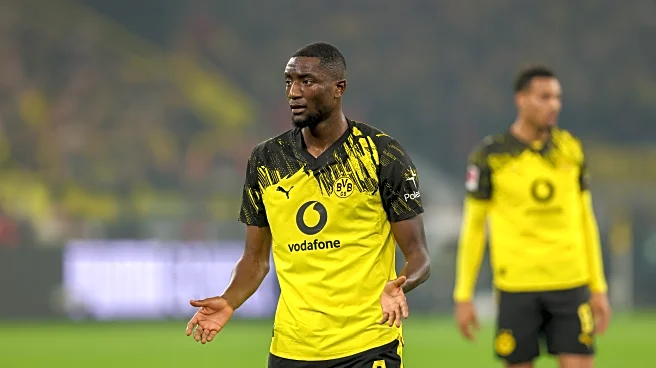




While the first half of the Bundesliga season is not technically over, the Winterpause is as good an opportunity as any to take stock of the how the season is going so far, and to determine what can be done to improve. So far, things aren’t looking bad. With a 9-5-1 record through the first 15 games of the season, Dortmund are in second place in the Bundesliga, three points above RB Leipzig, and nine points behind Bayern Munich, who are flying high with a 13-2-0 record.
Things could be worse. Dortmund
are on pace for about 72 points, which is certainly a respectable finish. It would’ve been enough to win the title in 2022-23. It would be Dortmund’s highest point total since 2018-19. While Dortmund are out of the DFB Pokal, they are positioned to at least contend for a spot in the top-eight in the Champions League table. So given that the club’s results from the first half are at a minimum perfectly acceptable, why does it feel so much worse than that? Why are so many fans upset with the club’s management, to the point that some want individuals like Niko Kovac or Sebastian Kehl to be fired?
My instinct for that the reason that Borussia Dortmund’s decent record is being overlooked is that it’s due to Dortmund’s stellar defensive record. And yes, it really is stellar. Of the 96 teams in Europe’s top five leagues, only four have conceded fewer goals than BVB in their domestic leagues (note: a few Italian and French teams have played a game or two more, but on a per-game basis, the results would be the same). In expected goal terms, it’s the same case. Dortmund are right there alongside Arsenal, Bayern, Inter, PSG, and Juventus as one of the top defensive sides.
The difference between Dortmund and these clubs is that, with the exception of Juventus, those clubs actually score goals too. This is where the results are less pretty. Dortmund have scored 26 goals in 15 domestic matches, which amounts to 1.73 per game, or a pace of about 59 goals over the course of a full season, which would be Dortmund’s worst total since the club’s disastrous 2014-15 season. In the aforementioned top five leagues, it ranks them 25th out of 96. Their expected goals? 35th. Even so, Dortmund’s defensive record is so strong that even with the lackluster offense, in overall expected goal differential per 90 minutes, Dortmund rank 10th in Europe—which is quite good! This is a undoubtedly a good football team, but with some offense, it could be great.
So the reason that Dortmund is successful is because Niko Kovac has them playing very solid defensive football, and over the course of a game they are usually able to nick out a goal or two while mostly keeping the ball out of their own net. This is quite an unusual situation for Dortmund fans, who have gotten used to high-flying offense, often at the expense of defending, over the last two decades. When Dortmund are in complete control of a game on paper, the final scoreline can still be too close for comfort, and it does leave room for things to go awry.
The question of what is causing this is a little vexing to me. On paper, many of the secondary stats suggest that Dortmund are successfully getting the ball into dangerous areas. They’re second in the Bundesliga in passes into the penalty area and seventh in total touches in the penalty area. In touches in the attacking third, they’re second in the league. This indicates to me that what you would call the “buildup,” or the process of moving the ball from the defensive third through midfield into goal-scoring areas, is not the issue. The primary issue is a lack of “clinicality,” if that’s a word, or the ability to convert possession in dangerous areas into actual shots or scoring chances.
The numbers back this up. Despite their possession in attacking areas, Dortmund are in the bottom half of the league (14th, in fact) in total shot attempts. As Dortmund’s leading striker, Serhou Guirassy leads the team both in total shots and shots per 90 minutes with 2.73. This is slightly low for his career, but not horrible. The real issue is that almost nobody else is even close. The only other players with more than two shots per 90 are Karim Adeyemi (2.44), Julian Brandt (2.27), and Maximilian Beier (2.18). That’s four BVB players total who shoot at a rate higher than twice per game. Meanwhile, in Dortmund’s last three seasons, that number would’ve been six, eight, and nine. It’s also worth noting that each of these three players has barely played half of the total minutes of the season. Very rarely are they all on the pitch at the same time.
Between this data and what I’ve noticed from my experience watching games, here’s my hypothesis on why this is happening: at any given moment, only 2-3 players on the pitch at any given moment are genuine shooting threats. This means that when BVB get the ball into attacking areas, defenders are able to focus their efforts on only a handful of threats. Players like Julian Ryerson, Daniel Svensson, Felix Nmecha, and Pascal Groß are great at getting the ball to the attackers, but they are unlikely to be prolific goalscoring threats themselves.
Further, in Kovac’s 5-2-3, the two central midfielders have major defensive responsibilities, and they often seem quite hesitant to risk getting caught out of position by advancing too far. With or without the ball, Guirassy is almost constantly marked or double-marked, and when he gets the ball to his feet, he has almost no one to play off of. So he either loses the ball or tries to force a shot that is easily blocked, or he loses the ball to a challenge before he even gets the shot off.
I’m hesitant to suggest any individual tactical changes, because I believe that a major reason for BVB’s defensive success is because of the conservative positioning of Nmecha, Sabitzer, and Bellingham. If they start to get involved in the attack more, then they will be caught out of position. But it’s a fine line to ride, and it’s also entirely possible that there are some instances where Dortmund could be more aggressive without risking too much on the other end.
I would not be opposed to certain players taking more long-shots too. Felix Nmecha and Marcel Sabitzer in particular have proven to be threats from range in the past, and both are at their career lows in shots per 90 minutes this season. There is definitely debate in the analytics community about the value of long-shots and whether it’s worth potentially losing possession over a shot that has such a small chance of scoring, but they aren’t without their defenders.
So all that was a very long-winded way of saying that to score more goals, Dortmund need to take more shots and get more bodies in the box. I’ll take my $1,000,000 consulting fee now.
Note: All data in this article is from FBRef
Your Thoughts
What do Dortmund need to do to score more goals? Are there other tactical considerations I didn’t raise? Let me know your thoughts!