



Last night, the Colorado Rockies signed RHP Michael Lorenzen to a one-year, $8 million deal, and while that transaction may appear totally irrelevant to the Red Sox on the surface, it does leave Boston as the only team in baseball that hasn’t spent a cent on a major league free agent so far this winter. So yeah, get your pitchforks out!
But before I light up the torches and join you by getting knee deep into another article about how much of a disgrace I think it is that ownership is acting like it’s
more concerned about winning the upcoming labor war in December than the World Series in October, I’d like to step back for a moment and speculate — Because at this point, what I think SHOULD happen vs. what I think WILL happen are so divorced from each other, they might as well exist on different planets.
My thesis goes something like this: The Red Sox are not building a baseball team. They’re on an endless value collection quest.
Specifically, they have complex in-house baseball metrics that when combined with financial tools spit out dollar values they believe any player is worth over any number of years. The goal? Get as many players as possible under contracts creating surplus value based on these metrics and hold firm when resisting temptation to acquire productive players that will require long-term contracts that ultimately sour on the value scale. In short, the contract matters more than the player.
So signing extensions to players you already have under control like Roman Anthony, Garrett Crochet, Ceddanne Rafaela, Kristian Campbell and Brayan Bello are in, and making big splashes on the free agent market are out.
I’m sure every team has some version of this plan, but the Red Sox under their increasingly penny-pinching proprietor have taken abstinence in free agency to a new level. In the now nearly two and a half years since bargain bin Breslow took over, the Red Sox have only handed out nine major league contracts to free agents, and it only gets weirder and more shameful as they layers are peeled back.
First of all, eight of the nine contracts have been given to pitchers (that should tell you something), and all eight of those pitchers signed for less than $40 million. Here’s that list:
- Lucas Giolito: Two years, $38.5 million
- Walker Buehler: One-year, $21 million
- Patrick Sandoval: Two-years, $18.2 million
- Aroldis Chapman: One-year, $10.8 million
- Liam Hendriks: Two-years, $10 million
- Justin Wilson: One-year, $2.2 million
- Chase Anderson: One-year, $1.2 million
- Cooper Criswell: one-year, $1 million
If you break this down further, the five highest paid pitchers listed here are filled with guys looking to rebuild their value at the time from either injuries or a poor off field reputation, which is essentially the Red Sox gambling on striking gold and reeling in massive surplus value. Again, they liked the upside of the contract more than they feared the devalued player.
As far as the bottom three are concerned? Their contracts are so small they hardly matter in this discussion. What does matter however is the one exception to all of these rules: Alex Bregman.
He’s the only major league free agent hitter they’ve signed the last three winters. He’s the only free agent Breslow’s signed to more than a two-year deal, and he’s the only guy this group’s given a contract to worth more than $40 million, which ended up not even ringing true because he opted out after year one of his three-year, $120 million deal.
So against this backdrop, where does this leave us with Bregman this winter?
Well, both Jen McCaffrey and Buster Olney have indicated that the Sox have gotten what “they feel” is “aggressive,” but good luck finding out what that actually means in terms of dollars since today’s baseball environment guards details about trades and pending free agent contract discussions closer than we protect national security secrets.
Even Lou Merloni, a team broadcaster, is left wondering what “aggressive” means in this case:
On that note, I’d like to take a stab at this.
For the exercise, let’s assume a Win Above Replacement (WAR) is worth $9 million on the free agent market, both because that’s pretty darn close to the values some recent offseasons have landed at, and because we’re not getting anywhere close to the bone unless we assume the Red Sox used their metrics to assign some value to a free agent.
From here, we’ll get into heavier and heavier speculation, but let’s assume Bregman provides a projected 3.4 WAR in 2026 and then declines 0.5 WAR each season thereafter given he turns 32 in March. Why 3.4 WAR? Well, it’s the midpoint between Bregman’s 2026 Steamer projection of 3.7, which is actually the highest of any remaining free agent left on the board for that system, and the slightly less optimistic ZiPS projection, which has him coming in at 3.1 WAR.
Assuming a five year contract, that would get you to $108 million when it comes to on field WAR production (see the table below) given the $9 million cost per free agent win and the average of our Bregman on field projections declining 0.5 WAR per season.
But this is Alex Bregman: The exception to the Red Sox free agent rules. The guy who is a clear difference maker in the clubhouse, and the player rumored to be getting an “aggressive” offer from the team. So the question around Lou’s question becomes what constitutes “aggressive” in the Red Sox mind beyond that $108 million?
Well, as a shot in the dark, I plugged in $5 million per year for intangibles. These are things that will be completely overlooked by the WAR projections. Being a leader in the clubhouse, helping guide the young guys through their development, and bringing postseason experience to October. You know, the things championships tend to require beyond baseline talent.
Anyway, added all up, here’s what I think an “aggressive” offer might look like from the Red Sox perspective.

Again, this is complete speculation, but that $133 million figure also works for another reason. When added to the $40 million the Red Sox paid Bregman in 2025, it comes out to a total of $173 million over six years, which just barely tops the six-year, $171 million offer Bregman reportedly had on the table last February from Detroit before coming to Boston. So it serves both as an “aggressive” offer from the Sox perspective, and as a way for Bregman to save face and not lose money after turning down Detroit’s offer and suffering a quad injury that shelved him for seven weeks in 2025.

But now that we’re in this staring contest that feels all too similar to last offseason, I have to wonder if anything has really changed. The more I look at the track record of this iteration of the front office, the less likely I feel they are to sign any big free agent bat that isn’t Bregman (because they literally haven’t at any point over the last three winters!).
While this game of chicken is taking place, there’s also growing speculation the Red Sox could engage with Bo Bichette and sign him to a big contract to play second base — But I think the Bichette rumors are absolute hogwash. When was the last time the Red Sox got involved with a free agent like that?
A stud in his 20s, a key piece wrestled away from a division rival? The guy who blasted a three-run moonshot off the best player in baseball in Game 7 of the World Series in what should have been the greatest moment of his career as he fought back from a knee injury to get back on the field for this spectacle:
Instead, he ended up getting pinch run for in the ninth inning (after collecting another clutch hit) because his knee was still hampering him on the basepaths. And just because baseball is a fickle mistress and likes to rub it in, Isiah Kiner-Falefa (the guy who pinch ran for him) completely botched the lead off third base on the Daulton Varsho and ended up costing Toronto the World Series. (Nobody brings the fire and brimstone like the baseball gods!)
But now I’m getting off topic. The bottom line is you could knock me over with a feather if the Red Sox end up breaking the bank for for Bichette given their recent track record, especially with the question marks surrounding his defense and their recent disasters at second base.
This feels like Bregman or bust when it comes to the Sox landing a free agent bat. And if it’s bust …

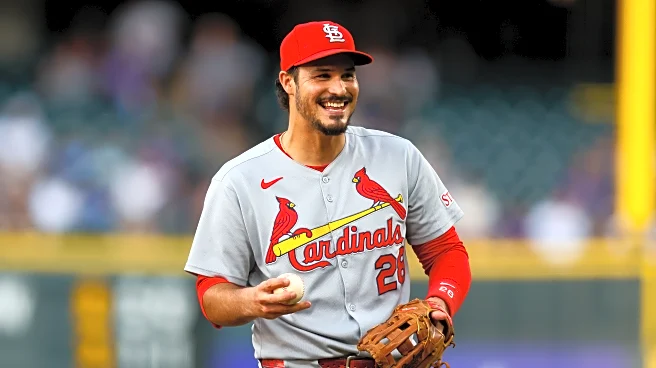
… I think we go right back to the exact same spot we were a year ago, which is Nolan Arenado as a fall back option if Bregman doesn’t take their final offer. By most accounts, the Sox were ready to pull the trigger on an Arenado deal last February before they got creative and handed Bregman the opt-out stacked deal.
But this time, there’s no way Bregman chooses that style of contract. Not with the Qualifying Offer shed from his services, not with him being a year older, and not with the pending work stoppage lurking later this calendar year. He’s taking what will surely be the biggest free agent contract of his career, and my guess is the Sox front office is not moving off whatever contract number they’ve already offered. They don’t need to if they think they’ve got an Arenado deal in their back pocket.
Now granted, I ultimately think Bregman takes whatever contract the Red Sox are offering, both because I don’t think the monster deal is out there for him (too many factors lined up against him the last eight months), and I think that if things are relatively close money wise, which they would be if no greener pastures are truly out there, he wants to be in Boston. (Again, speculation on my part.)
But when it comes to the Arenado piece of this, there are too many factors to ignore: In addition to the talks last year, Craig Breslow and Chaim Bloom have also been frequent trading partners over the last 12 months. It’s hard to imagine Arenado’s name and reshaped value haven’t come up in at least some of these conversations.
Digging deeper, here’s a list of all the teams Breslow has made trades with during his time in the Sox front office. Not only do the Cardinals come up the most, but he’s actually made deals with 20 of the other 29 teams, suggesting he’s pretty good at landing on agreements despite his reputation in some circles of being difficult to work with regarding some players. He’s been forced to use to trade market to make do while handcuffed financially by ownership, and actually, despite all my complaints, I think he’s actually done a pretty good job here all things considered.

Arenado’s contract also seems pretty easy to deal with here. He’s owed $27 million in 2026 ($5 million already paid by the Rockies) and $15 million in 2027. The Cardinals would be happy to shed pretty much any portion of that given their rebuild, and the Red Sox would likely look to limit the amount they took on so it didn’t anchor them with any negative surplus value. There’s clearly some middle ground to be found there from two guys who have already proven to work well together multiple times.
Going further, Arenado is also a veteran player with a no trade clause who desperately wants to win on the big stage before the sand runs out of his hourglass. He’s exactly the type of player I’d expect to get a seemingly inexplicable bump in production if moved to a place where he has one last shot at glory. He posted a .708 OPS last year through June 29th when he suffered a sprained finger that set off a cascade of injuries and a .536 OPS down the stretch. With defense that’s is still solidly above average at the hot corner, Arenado was on pace to post about a 2.0WAR season before thing came unglued.
For the Red Sox, two years of that kind of production while they only pay a fraction of the contract is probably ideal in their mind. Piecing it together with the future, check out the current SoxProspects.com list. Only five of the top 17 guys are now position players, but four of those five are either second basemen, third basemen, or a shortstop, with three of them in Franklin Arias, Mikey Romero and Henry Godbout likely knocking on the door between the end of this year and the early part of 2028.
In a world where Arenado is under contract for just two seasons, it gives the Sox a perfect transition window to evaluate these guys and slowly work them in if they stick. And if not, they’re free to reenter the free agent market again as they reset their infield. And they’d have to funds to do it with no big free agents signed and the sport likely under a new CBA by that point. Win-win for them.
Of course, an Arenado trade sure as hell doesn’t make sense from a “do everything you can to win the World Series this year” standpoint, but we’re not dealing with a team that prioritizes that anymore (my pitchfork is just about done being sharpened for Saturday). Instead, we’re dealing with a team that refuses to hand out long-term free agent contracts likely to end up underwater, and the hope there (again, speculation) is that if you just stack so many “good contracts” up together on the roster, eventually you’ll breakthrough and contend for your fair share of championships because the surplus value will overwhelm everything else.
I don’t personally believe it’s that simple, but I do believe that’s the baseline to where we are until the Sox show real tangible signals they’re moving off this strategy. I also believe we’re getting Nolan Arenado if the Bregman stuff falls through.