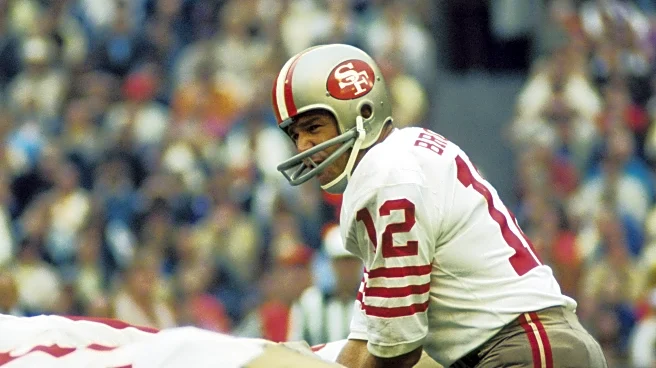




Former San Francisco 49ers quarterback John Brodie is one of those players who was steady, received a ton of accolades, was a leader of men, yet is not quite Pro Football Hall of Fame material.
Brodie was also with a single team for 17 years. He passed away from a stroke on Friday at the age of 90.
RELATED: RETIRE JIM BROWN’S NUMBER LEAGUE-WISE?
The 49ers organization issued a statement from 49ers co-chairman John York:
“The 49ers family is saddened to learn of the passing of one of the franchise’s all-time
great players, John Brodie,” 49ers co-chairman John York said. “As a kid, my 49ers fandom began by watching John play quarterback on television. He displayed an incredible commitment toward his teammates and his support of the organization never wavered after his playing days.
John became a dear friend of mine, and he will always be remembered as an important part of 49ers history. We express our deepest condolences to his wife, Sue, and the entire Brodie family.”
The talented QB has been enshrined into the Niners Hall of Fame, had his #12 jersey retired, was the league MVP in 1970, named First and Second Team All-Pro twice, voted to two Pro Bowls, selected NFL Comeback Player of the Year (1965), was the NFL passing TD leader twice (1965, 1970), Three Time NFL Passing Yards Leader, and became the NFL completion percentage leader in 1958 and 1965.

Brodie started 201 games and played in 158, had 2,469 completions on 4,491 attempts for 31,548 yards with 214 TDs to cohabitate with his 224 interceptions, 55.0% completion percentage, sacked 207 times, with a career 72.3 QB rating.
Again spent his entire 17-year career with San Francisco, a team record. Brodie was the guy everyone depended on, and he was a great leader.
So, what does this have to do with the Cleveland Browns?
Brodie was the first domino to the Browns getting FB Jim Brown.
Cleveland head coach Paul Brown was one of the first men to realize that the offense could live and die without an extremely talented quarterback. Coach Brown was a former QB himself in high school, and knew then how the offense would revolve around this one position.
The Browns began in 1946 and had Otto Graham as their quarterback from the start. Graham was an amazing specimen who could throw long with little effort, was a good runner, and was very intelligent. From 1946 to 1955, the Browns were in every league championship game, winning seven. That’s 10 straight title game appearances, a pro football record.
Cleveland slammed the Detroit Lions 56-10 in the 1954 NFL Championship Game to capture their sixth pro football crown. Graham had business dealings that he started a few years earlier, and felt like it was time to hang up his cleats after winning the 1954 title and go out a winner.

He had been voted league MVP five times and been named First and Second Team All-Pro six different years so there wasn’t much left to prove. A lot of his teammates from the early championship days had retired or were close. In the 1954 championship game, he became the first player to throw for three TDs and run for three TDs in a single game. (Josh Allen would later tie this in 2024).
Graham retires, sort of
Graham had opened an appliance store and an insurance agency, and wanted the time to develop each with his post-football career. Winning another championship seemed like the way to leave the game.
During this time, the best college football players would suit up for an exhibition game against the reigning NFL champions to support Chicago area charities labeled the “Chicago Charities College All-Star Game.” These rookies looked forward to it, and mostly, the professionals would win.
The 1955 season would become the first time that Graham was not suited up as the starting QB for the Browns.
To start with, the All-Stars beat Cleveland 30-27. Coach Brown’s teams don’t lose much, but certainly not to a bunch of rookies. Then, the Browns went 1-5-0 in the preseason. On opening day, the Washington Redskins defeated the Browns 27-17 as Cleveland’s offense sputtered.
In the 1955 NFL draft, QB John Borton from Ohio State was chosen in Round 13. Under center, Coach Brown used Graham’s backup, George Ratterman, as both players performed poorly. Coach Brown received a telegram from a rookie named Johnny Unitas, who had been cut by the Pittsburgh Steelers, asking for a tryout.
But Coach Brown had other plans. He contacted Graham and worked out a deal to bring him back for one more season. The 1955 season would go on with Graham and Ratterman as Unitas got a reply from Coach Brown stating that if he hadn’t landed on a roster, to come back next season and attend training camp.

Graham righted the ship as Cleveland won eight of nine games and finished 9-2-1. This earned a place in the 1955 NFL Championship Game. The Browns won 38-14 over the Los Angeles Rams for the franchise’s seventh title.
But this time, Graham wasn’t coming back. Coach Brown was on his own. In 1956, Coach Brown experienced his first losing season – ever, going back to high school and college levels. Cleveland finished 5-7-0 and began the season losing five of their first six games with Tommy O’Connell as the starting QB with Ratterman in the backup role.
Not going to happen again
The next season was 1957. There weren’t going to be anymore losing seasons for Coach Brown. He had a good roster going into the 1957 season, but he just couldn’t get the quarterback position solved.
The Browns had the sixth overall pick in the 1957 NFL draft. There were five really good quarterbacks in this draft: Milt Plum from Penn State, UCLA’s Ronnie Knox, Sonny Jurgensen of Duke, and two exceptional quarterbacks rated in the Top-10: Lenny Dawson of Purdue and Stanford’s John Brodie. Coach Brown didn’t care whether it was Dawson or Brodie; he just knew he had to come away with one of them.

If he failed to draft either quarterback, he would leave the Warwick Hotel in Philadelphia with minimal chances for a rebound season.
The first overall pick was a lottery pick won by the Green Bay Packers. They chose halfback Paul Hornung of Notre Dame.
Next up: the Rams. They selected halfback Jon Arnett from a local school, USC.
Pick #3: San Francisco. This should be safe since the 49ers already had Pro Bowler Y.A. Tittle under center. In a bit of a shock, the 49ers took Brodie.
With the fourth pick, the Packers got WR Ron Kramer from Michigan.
Next up at pick #5: Steelers. 25-year old Ted Marchibroda was entrenched as their signalcaller with former Redskins first-round draft pick Jack Scarbath, age 26, at backup. Although they seemed good at the QB position, the Steelers then selected Dawson.
Coach Brown was floored. Yes, there were three other very good quarterbacks, but he had been used to “elite” status at the QB position, and he wasn’t going to be satisfied until he had accomplished this.
Cleveland was now on the clock with the #6 pick.
What now? What positions need the most help? He had 32-year-old Lou Groza at left tackle, and his left guard was 31-year-old Abe Gibron. Both were aging out. WR Dante Lavelli was slowing down at age 33. Three of four defensive linemen were also in their 30s.
But no more quarterbacks worth taking in the first round. If ever there was a time for a grown man to cry, this was it. Coach Brown reluctantly scribbled a name on his index card, then handed it to the runner.
NFL Commissioner Bert Bell sauntered up to the podium with Coach Brown’s card in the Grand Ballroom at the Warwick, and with his early Quaker accent, stated, “The Cleveland Browns have selected fullback, Jim Brown, Syracuse.”
Coach Brown was forced to “settle” on Jimmy Brown.
In 1957, Brown was voted the league MVP. He was named NFL Rookie of the Year. He was voted First Team All-Pro and made the Pro Bowl. Brown was the NFL rushing yards leader and the NFL rushing touchdowns leader. All of this in just his first season in the NFL.

Cleveland returned to the NFL Championship Game, losing to the Lions. Paul Brown was voted NFL Coach of the Year.
In that same year of 1957, rookie QB John Brodie held the clipboard for Tittle and tossed 21 passes for 160 yards. Brodie would become the 49ers’ starting QB beginning in 1961 after Tittle was traded to the New York Football Giants, but by then, Brown had been named to five Pro Bowls.
And Coach Brown’s stud quarterback? He did draft Plum in Round 2 of the same draft, but it became apparent that the Browns would become a running team with Jimmy Brown holding the rock.
So, the importance of the quarterback position with the Browns diminished. Why spend all that money on a guy who is just going to hand the ball off each game?