
Early in the season, the Steelers’ Week 15 Monday Night Football matchup versus the Dolphins looked like an easy-to-predict win for Pittsburgh. Miami started the year 1-6, and would be playing in the cold,
on the road against a Steelers team that historically does very well on MNF.
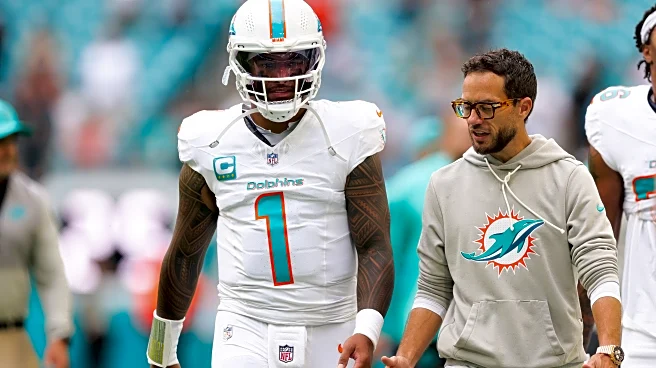
But since then, Miami has morphed into a completely different team. After that dismal start, the Dolphins have gone 5-1, turning the beginnings of a tank into a campaign that might just save head coach Mike McDaniel’s job.
Now, it’s a battle between two AFC teams with similar records in Pittsburgh Monday night, with the 7-6 Steelers hosting the 6-7 Miami Dolphins.
What to expect from the Dolphins’ offense

Rushing YPG: 126.5 (8th)
Passing YPG: 178.2 (28th)
PPG: 21.6 (22nd)
RP: If you haven’t been keeping up with the Dolphins for a while, you might have some outdated assumptions about this offense.
When Mike McDaniel and his brand of Shanahan-influenced offense first arrived in Miami, the Dolphins had a prolific passing attack. In 2022, the arrival of McDaniel and Tyreek Hill revived quarterback Tua Tagovailoa. Miami’s new coach designed an offense built around Tagovailoa’s specific skillset. Tagovailoa is not the most physically imposing, nor does he have the biggest, most powerful arm. But he does have a quick release and he’s been lauded for his ability to make even quicker reads in the short-to-intermediate passing attack. With a new focus on exploting space to create favorable matchups in the intermediate middle of the field, Tagovailoa began to show some of the promise that made him a star at Alabama, and both Hill and Jaylen Waddle eclipsed 1,300 yards receiving yards. But even so, defenses — most notably the 49ers and Chargers — started to find solutions to Miami and Tagovailoa’s quirks by the end of the season.
That offseason, McDaniel began to form some new wrinkles into his offense. On the whole, the offensive concepts remained the same, but the Dolphins would begin to innovate ways to use pre-snap motion to get quick, free releases for their speedy skill players. Miami offense thrived, averaging 265.5 passing yards a game, mostly through feeding the ball to Hill, Waddle, or whichever running back was on the field. The Dolphins ranked second in scoring while Tagovailoa led the league in passing (4,624) and finished top-five in touchdowns (29).
But that’s not what the Dolphins offense is nowadays. Simlarly to previous season, defenses began to slow down Miami’s high-octane offense towards the end of the 2023 season. And the Dolphins have never really recovered from that. With the book out on Tagovailo’s seemingly limited skillset, the Dolphins offense regressed in 2024 and a turbulent offseason did little to improve their situation for 2025. Even before Hill had his season ended by a gruesome leg injury in Week 4, the Dolphins passing attack was struggling. Tagovailoa’s averaged depth of target (7.3) has nearly decreased by nearly a full yard from where it was in 2023 (8.1). That highlights how much the field has shrunk vertically for Miami’s passing attack. Tagovailoa’s 34 attempts of passes 20-plus yards down the field ranks 23rd, behind even Aaron Rodgers. His 35.3% completion percentage ranks 26th, and he’s thrown five interceptions against three touchdowns when attempting these throws.
The Steelers can’t sleep on these throws entirely, however, because the Dolphins’ concepts are still meant to exploit the middle of the field. Here they are creating an explosive downfield throw just last week.
But the quick passing game is primarily where the Dolphins operate. Miami has built their offense around Tua getting the ball out quick to create opportunites for YAC from their pass catchers. When Tua led the league in passing, 50.7% (roughly 2,344 yards) were from yards after the catch. Hill, Waddle, Achane, and 2024 draft pick Malik Washington all have similar builds and speed. Recently unretired tight end Darren Waller also has plus-speed for his postion.
Unfortunately for Miami, the scheme is no longer getting these players the separation it used to and Tua has regressed mightily with his timing and accuracy. His completion percentage (66.9%) on the whole has dropped nearly three points from where it was in 2023. And since Hill has gone down, the Dolphins offense has basically siloed down to Waddle, Achane and Washington. That’s not an exageration, here are Miami’s leading target getters:
- Jaylen Waddle – 86 targets
- De’Von Achane – 73 targets
- Malik Washington – 56 targets
- Tyreek Hill (played 4 games) – 29 targets
- Nick Westbrook-Ikhine – 19 targets
- Greg Dulcich & Darren Waller – 18 targets each
On the whole, the Dolphins are asking Tua to throw less in general. In 2023, the Dolphins called a pass on 56.7% of their plays, and Tagovailoa averaged 33 attempts per game. Now, whether it’s because they’re without Hill and almost exclusively feature Waddle and Achane, or because they’re just trying to limit how often Tagovaila can put the ball in harms way, the Dolphins average 27 passing attempts per game. During their current four-game winning streak, they asked him to throw even less, with Tagovailoa has averaing just 21.5 passing attempts per game.
I am a little concerned that Miami will be able to catch a few breaks with explosive plays in the passing game. The Steelers middle of the field has been exploitable for defenses all season. Tackling will be even more paramount against this team if the Steelers can’t keep Miami and Tua out of the middle of the field.
Of course, as Ryland alluded to earlier, there’s also the whole “Tua can’t play in the cold” narrative to consider.
The Dolphins likely know this about their quarterback too. And even though Miami has regressed as a passing unit, McDaniel still knows how to scheme up the run. As a desciple of the Shanahan coaching tree whose rise up the ranks involved designing the rushing attack for Kyle Shanahan, that’s to be expected. In 2023, the Dolphins also nearly had two 1,000 yard runners, with Raheem Mostert (1,012) and a second-half emeregence from Achane (800). And McDaniel still has some creative designs up his sleeve.
Miami still has a top-10 rushing unit, with the offense now featuring Achane as the player who carries the most gravity on the field. Achane has 193 carries and 73 targets on the year, which means he’s either been handed the ball or had it thrown his way on 35.8% of the Dolphins offensive plays. Stopping him, whether that’s setting a strong edge or tackling him in open space, will be crtical. He’s accounted for 1,126 rushing yards at a 5.8-yard per carry clip and has 35 runs of 10-plus yards, and has become increasingly improved at running between the tackles, where he can now just as frequently create explosive runs. Meanwhile, because he’s frequently targeted behind the line of scrimmage, Achane has more YAC (461) than receiving yards (383). Simply put, the guy’s a nightmare who will make you pay for sloppy angles and missed tackles.
Rookie Ollie Gordon has primarily served as a short yardage and goalline back this year, but even he has five runs of over 10 yards this season. Second-year running back Jaylen Wright — who is practically a Raheem Mostert clone in size, speed and running style — has recently returned and has four explosive runs as well. Miami’s best shot will be gouging Pittsburgh on the ground.
What to expect from the Dolphins’ defense

Rushing YPG Allowed: 131.9 (25th)
Passing YPG Allowed: 202.6 (12th)
PPG Allowed: 22.8 (15th)
RB: Over the totality of the season thus far, the Dolphins’ defensive numbers have been fairly middle of the pack. However, they’ve been the average of two extremes.
Miami started off the season allowing three consecutive 30-plus-point games to opposing offenses. Now, over the last four, the most they’ve allowed is 17. While Miami’s run game has received a lot of deserved credit for the team’s turnaround in recent weeks, the defense has also played a massive part.
Of course, some context is needed. Over that four-game winning streak, the Dolphins have faced the Bills, Commanders, Saints, and Jets. Holding Josh Allen and co. to 13 points proved the Miami defense is a real threat, but the other dominant showings came against Marcus Mariota, Tyler Shough, and Brady Cook – not exactly a murder’s row.
Still, the Dolphins defense has looked impressive, and it’s been a good showing for coordinator Anthony Weaver, who I consider to be one of the more underrated defensive minds in the NFL.
Against the Jets offense last week (where the only touchdown the Dolphins allowed was on special teams), Miami dominated at the line of scrimmage. Up front, they’re led by veteran defensive lineman Zach Sieler, who has only logged 3.5 sacks so far this year after back-to-back 10-sack seasons. Still, he’s a quality player who has flown under the radar in recent years.
Part of why Sieler’s production has dipped this year is because he’s been playing alongside two rookie defensive tackles: first-rounder Kenneth Grant (who was high on a lot of Steelers-related boards this offseason), and fifth-rounder Jordan Phillips (not the Buffalo Bills defensive tackle with the same name).
After a slow start to the season, things have started to click for the immensely-talented (and just immense) Grant.
On the edge, the Dolphins dealt Jaelan Phillips to the Eagles at the trade deadline, but still possess a strong pass-rushing tandem in Bradley Chubb and Chop Robinson.
Chubb, who has 6.5 sacks this season, fits into the Alex Highsmith mold of very good but not necessarily elite outside linebackers, making impact plays against both the run and pass.
Robinson (3.5 sacks) hasn’t taken a huge step forward from his promising rookie season last year, but still brings a dangerous speed rush and surprising power.
Against New York last week, Miami logged a whopping six sacks. However, the Dolphins rank at a modest 18th in quarterback pressure percentage for the season as a whole (34.4%) along with the eighth-slowest time to pressure (2.76 seconds) despite having the fifth-highest blitz percentage in the league (31.9%).
However, as evidenced by the Jets game, when it works, it works. Weaver can draw up some exotic pressure packages, using a lot of sim pressures to maximally confuse offenses.
While the Dolphins’ run defense has tightened up in recent weeks, they can get gashed due to Weaver’s tendencies to crowd the line of scrimmage and use two-high shells in coverage. That can leave the second level of the box a little thin, allowing big gains for runs that find a crease through the line of scrimmage.
Still, linebacker Jordyn Brooks has had a great year for Miami, leading the league with 142 total tackles through 13 games. He’s been flying around, making plays.
The Miami secondary is where it gets really interesting. After trading Jalen Ramsey to the Steelers this offseason, the Dolphins entered the season with what looked like the worst cornerback room in football. However, while Rasul Douglas and Jack Jones haven’t magically turned into a no-fly zone, they’ve certainly held their own. Douglas has especially stood out with 11 passes defensed and two interceptions so far this year.
The Dolphins lead the league in cover 2 usage, helping keep a lid on opposing passing games with Weaver using plenty of disguises and inverted coverages. And former Steelers safety Minkah Fitzpatrick has been a weapon defending both the run and the pass, even filling in at nickel when needed.
He still hasn’t reached the heights of his prime with the Steelers, but remains a high-end defender in the Dolphins secondary.
That’s not to say the Miami pass defense is an unbeatable force, however. Even Jets rookie Brady Cook was able to successfully hit a number of hole shots last Sunday.
Ultimately, the Dolphins – now 6-7 and miraculously still in the playoff hunt – are still trying to prove they’re a real team. The Steelers offense might not be a great test, but a healthy Aaron Rodgers, who tossed four touchdowns against Miami when he played them last season, might prove a greater challenge than the likes of Cook or Mariota.
The keys to victory will lie in whether or not Rodgers can dissect the Dolphins’ coverages and drive throws into open windows, and if the Steelers can get a run game going to stress Miami’s two-high tendencies. After a slow start to the season, this Dolphins defense looks like a real challenge for Pittsburgh.