
Price was recruited to Mississippi State in the 2021 cycle as a high 3-star (.8763) in the 24/7 composite. He appeared in four regular season games as a true freshman but recorded no touches. As a redshirt freshman in 2022 he was the third back in the rotation behind two experienced juniors.
In December of 2022, the head coach who recruited Price, Mike Leach, passed away from illness and a heart attack. In addition to being a sad loss for his family and the entire college football community, this
touched off a series of events at Mississippi State which affected a wide network of careers, including Price’s. Tracing the history of subsequent decisions made, which moves were by necessity and which might have been mistakes, has been a remarkable research project for me, and an indication of what a profound effect Coach Leach had on the game.
It’s necessary to lay this out in order to understand Price’s journey — what his contributions have been, what he might have been unfairly denied, and what he may yet promise — but it’s rather lengthy and winding, and requires careful statistical analysis to contextualize. I’ll save it for the second part of this article and start with the film review of Price’s time on the field.
To briefly summarize the rest of Price’s career to date, he played in the 2022 bowl game under the interim coach and coordinator, then remained at Mississippi State with a new staff in 2023 but was effectively sidelined that season with no meaningful touches and virtually no developmental time, though as far as I can tell was healthy. He transferred to Coastal Carolina in 2024 where he was one of two roughly equal backups to a well established redshirt senior running back. Price then transferred to Colorado in 2025 where he played in the first four games as part of a nearly equal three-way split among backs (in those four games at least), but then took a medical redshirt for the rest of the year, which means he has one year of eligibility to play one at Oregon in 2026.
I charted the entire 2022 Mississippi State and 2024 Coastal Carolina seasons as well as the first four 2025 Colorado games (that is, all meaningful offensive plays, not just Price’s) to perform cohort analyses. I did not review the 2023 season, except to verify the handful of plays Price was in for. I’ll detail the historical context and statistical controls below, but in summary I found Price to be a powerful workhorse ballcarrier with strong acceleration and pathing. His main developmental issue in my opinion is vision and when to cut out – I believe this has been steadily improving, though it’s challenging to document because his development keeps getting interrupted and hidden by a variety of factors.
Since Price was a backup or rotational RB on three different offenses that were each much more interested in passing the ball or QB runs to the outside and just weren’t very good at blocking up the middle, there are long stretches of the tape where Price is getting very little production, punctuated by big breakout runs. I think from the beginning of his tape in 2022 he showed high quality skills in the backfield prior to hitting the hole — pathing, patience, momentum conservation and balance — so that when the run is there he’s able to hit it for the maximum gain. There’s not much appreciable change over time in terms of yards gained vs opportunity yards on the play as drawn up given the blocking; he was close to topped out as a freshman against top SEC teams and an excellent B1G bowl defense, and that continued in 2024 and 2025. Some examples:
(Reminder – you can use the button in the right corner to control playback speed)
- :00 – Good press and redirection as a freshman here, the center and RT are giving up penetration and Price reverses for open grass. The receiver blocking is poor as well so there’s even more work to the field, but we get a good view of Price’s balance through contact and his early instincts to hit the tackle obliquely and spin through it.
- :14 – Now to the bowl game at the end of the year against a defense filled with future NFL players. Great pathing, the backer buys it so much that when the LT comes up to seal him he has nothing to do. Price breaks several DBs’ tackles and puts the Bulldogs on the goalline for the winning score.
- :44 – The LT and RG lose their blocks here, the cut is appropriate and Price gets across the formation to where the RT has cleared him room, but the slot has lost his downfield block on the nickel so as soon as he does he gets hit. Price keeps his feet through the contact insead of being driven back, so he can be tackled forward for a five yard gain for not giving up on the play.
- 1:07 – Price’s pathing here pulls the LB out of the way, far enough that it doesn’t matter when the RG just forgets to block him. Everybody else on the line nails their block including a nice pull by the LT and Price goes for a long run, but the WR has the wrong leverage on the corner so Price gives him a correction to get to the sideline and gets seven more yards out of it.
The quality that I notice Price using as a tool to solve problems at different phases of the run — in the backfield, through the hole, and into contact — is his burst. His rapid acceleration means he’s comfortable being patient in play development and then hitting the hole at the right time, but he’s also pretty eager for high speed contact to break tackles, power through them for extra yardage, and even (actually, fairly frequently) realign poorly positioned downfield blockers to give himself extra room to run. Here’s a representative sample:
- :00 – The defense is spread out by the formation and running a T-E stunt on the right, they’re just expecting a run at all here. Great footwork as he’s getting through the hole by Price to take advantage, and when the center fails to control the LB he leans into into it, accelerates, and spins through the tackle for extra.
- :14 – The flag is for the defense being offside resulting from a failed stem, the play is to the other direction so he offensive line finally has a chance to win a rep by just pushing them in the direction they were already going. Price makes a nice move jumping through the DB’s tackle and punch out attempt, and would have had more if he tackles were in conrol of their defenders.
- :34 – The RG doesn’t climb to the 2nd level but the rest of the blocks here are good, so Price gets through but then has to be his own blocker for more and it results in a pileup. The officials likely would have blown this dead several yards earlier but Price goes into it with the leg drive that gets them 3-4 more and sets up a managable 2nd down following a penalty.
- :46 – Good blocks and the nose guard overrunning mean there’s no contact until Price is four yards downfield through the A-gap, when the backer whom the center hasn’t cleared steps free. With three DBs converging from all angles there’s nothing more to be done here; Price does his thing and bursts into the contact to get an additional four yards.
In my opinion, Price’s qualities made him a good candidate for a short-yardage back, and I thought his previous teams were making a mistake in not giving him a larger share of the touches in those situations. The cohort analyses showed he outperformed other rushers — or throwing the ball — on 3rd or 4th & short in like circumstances, and his career-long success rate in short-yardage situations is over 84% conversion. Here’s a representative sample:
- :00 – This play includes several qualities I mentioned previously: the guards are in the process of losing control to the DTs so the hole is going to collapse fast and Price solves it by bursting through faster rather than patiently finding something else, and since he needs to go left of the center as the DB is coming down from the right, he powerfully corrects his lineman into blocking for him properly and taking out both the LB and DB so Price can get the conversion plus four more yards.
- :14 – (The chyron is incorrect; it’s 3rd & 2, LTG is the 35). Price has to do this almost all on his own, the LG and LT lose their blocks and the pulling RG blocks the wrong defender through the hole, and there’s no cut available because of how well the defense is setting the edge against the TE and RT plus the leverage the C has lost in the B gap. There’s nothing to it but to push right through the mess and keep churning till the whistle, and Price gets it done.
- :22 – The LT washes down his guy but the LG whiffs, the C is struggling, and the overhang backer is unblocked, so this is a narrow hole and there are two unblocked defenders coming right at Price. He puts his shoulder down and drives two yards through the pile to pick it up.
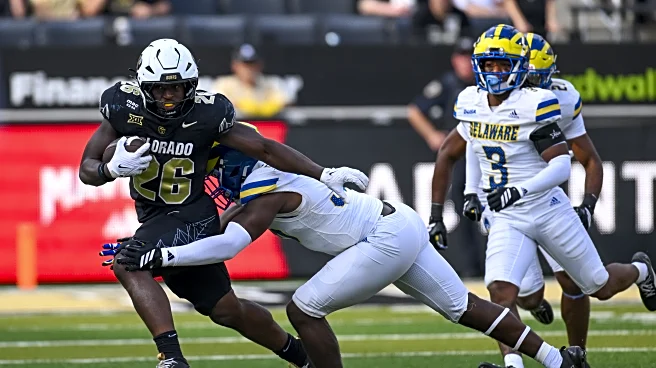
- :30 – Here was the reverse, the tackles losing control at Colorado but the interior getting some good push. Price sees the space if he can punch past the first wave while keeping his feet to fall forward to break the plane, and gets the touchdown on his final play in uniform.
While my tally sheet shows about a 28% plus-value for Price when the blocking wasn’t there, it was still the case that on a third of his carries the blocking was so poor and in my evaluation of the tape, there was no available cut lane on the play so Price just had to shoulder it for a minimal gain. Another seven percent were read-option plays where the QB made the wrong call handing the ball off and Price was immdiately tackled by the unblocked defender, making it around 40% of his carries that were failures given the down & distance but I don’t believe there was anything Price could have done about it. I had to watch all of these rather dull affairs and by rights I should include a dozen or so for accurate representation, but I think these will suffice:
- :00 – The pull to the left and unblocked read defender to the right means there’s no cutback lane here, Price has to push through and the backside blocks are so poor that the DL has crossed over the formation to the frontside to bring him down.
- :10 – On the reverse angle we can see Price’s patience and gap reading, but the blocking is so poor that his plan B doesn’t work either. The play design is meant to have the center and RG release up to the 2nd level, which is what Price is waiting for; the RG is late and the LB gets to the backfield so the RG clears him laterally but the center just never does anything at all. In the meantime the RT loses the block without the RG’s help, so the gap is gone and Price checks out to the C-gap, but the DE that the slice-blocking TE isn’t controlling plus the unblocked safety find him.
- :24 – The LG just immediately allows the DL into the backfield, Price cuts around him but the center spins around and smacks his belly into Price’s face, and now three more guys that the line has failed to block eat him up.
- :31 – I’m not sure if this is a misread of the unblocked defensive end or if the RT failed to block the DE by mistake, though I am sure that the LG is not supposed to block the backer by bellyflopping. Price doesn’t have a good escape route, between the unblocked DB to the left and the unblocked DE to the right.
The limited tape meant not much opportunity to evaluate Price’s super explosive play potential – he generated chunk-yardage rushing at a nominal or superior rate compared to his cohort, but because of the field position and defensive compression at the spots when he broke his longest runs we don’t have a good sample to assess true open field running. I have a hard time saying what Price’s top gear is, because he’d hit the goalline defense or the endzone after clearing the 2nd level and getting ~30 yards whenever he had the chance. Here’s a representation sample of the explosive rushing Price did create:
- :00 – Well designed blocking scheme, a great lead block by the top back (more on him below), and nice pathing by Price to sell it to the backers. Downfield, the DB tries to reach around for Price’s outside arm as he goes for the ball, but no dice, excellent ball security his entire career.
- :17 – The OLB bites on the pitch option and Price takes it in stride, nice hands and immediate putaway to the outside arm, and underestimating Price’s burst causes the post safety to miscalculate the intersect and take a bad angle.
- :34 – Gap schemes were far and away the most effective for CCU, it was a terrible failure of self scouting that they ran them so rarely. The center is playing high here and gets folded back into the gap so Price has to dance through the gap with good balance and conserving his momentum. The LG hangs on the DT which isn’t his job, he’s meant to get the backer so that guy is free to harass Price but he makes the dodge. Price executes judo’s first throwing form (ippon seoinage 一本背負投) to reverse momentum past the DB, then breaks two more tackles to the sideline.
- :54 – Given his offset this looks like Price is going to the left A-gap but he bends it to the right A-gap, the pathing fools the nose guard to push the wrong way and the backer bites too so it doesn’t matter that the LG whiffs, the RT seals the DE, the TE pulls off his slice block (this is where Sa’velle Smalls wound up, for the old heads), so Price just needs to run the RG’s heels at the 2nd level and burst between the DBs before they can converge.
I suspect that Price’s instinct is to run the play as designed and when the tackle becomes inevitable, go into it hard and create extra yards. On a down-to-down basis, that’s served him well most of the time and kept his efficiency rate higher than the line’s blocking grades would predict. Earlier I described him as a workhorse back; I think his style of running would be ideal for an offense that’s committed to pounding the ball then hitting play-action passing — e.g., Stanford, Michigan, Oregon State of the recent past — and some of what makes his journey so peculiar is that he’s wound up on three different teams I wouldn’t describe in those terms in any way.
However, Price’s careerlong per-carry success rate is about 6 percentage points lower than it could be if he’d maximized his opportunities to read the defense vs the blocking, and cut to a different rush lane or while running downfield. The arc over time bends positively, while the data is noisy the modulated trendline appears to start at about 9 percent missed opportunities and most recently is down to 4 percent. He’ll want to continue that presumed progress and work on his vision to identify bigger runs when the hole isn’t there, particularly by keeping his head up instead of ducking it early:
- :00 – This was very early in Price’s career, his first carry in meaningful play (his only prior meaningful touch was a 20-yd pass against Memphis). The designed gap isn’t there, and it’s obvious even before the handoff – the RG is being crushed to his knees and has knocked over the LG pulling around to lead block, creating a pile up which the backer has read. But all the defensive attention there has created a huge B-gap and the DE is playing too deep, so the cutback is readily available – Price should have taken it instead of barreling in for nothing.
- :17 – The tricky play design here works, as the TE, QB, and tailback pull most of the defense to the boundary. This would probably have worked except they switched the usual LG, who was their weakest blocker, to the right side where he has the key block on the play and he predictably blows it. But Price doesn’t identify it; he could have profitably taken the A-gap or C-gap here but instead hits the one spot that’s a no-go.
- :25 – JMU is dropping six into coverage on 3rd & 9, and the TE motion works as intended pulling the lone backer in the box to the backside … the defense isn’t anticipating a run and Price gets through clean for five yards, but the LG (at his usual spot, doing his usual thing) fails to contain that backer so he’s catching up to Price with a ways to go for the conversion. Instead of cutting away from him, Price reverts to instinct and ducks his head into contact. That gets some extra yards but not enough, and with this field position they have to punt – this was an all or nothing situation so cutting was the only valid choice.
- :34 – CCU spent all year running this wide zone read play and had a success rate in the single digits when they handed the ball off between the tackles (it’s meant to open up the QB run). Price should be thinking bounce from the get-go, there’s no way the guards are going to execute these blocks. On the other hand the RT is blocking well and the Z-receiver has blocked the boundary safety, so the same four yards Price got through muscle running were pretty much guaranteed if he’d bounced outside plus a strong possibility of getting to the sideline for much more. Unfortunately, Price came up limping from this play and it was his last with the Chants.
- :49 – The interior of the line fails here so the RT has to the nose guard spilling over instead of his assigned backer, so both LBs are coming for Price at once and he just puts his head down. But there’s no edge to the defense and the WRs have created a lot of room to the right side to run for open grass, this is potentially a touchdown if Price keeps his head up and sees it.
There are substantial gaps in the data for Price’s contributions in the passing game. None of the teams he played for used running backs extensively for pass protection, instead releasing them as checkdowns or playing empty sets in pressure situations. While each team did have actual downfield routes that were legitimate parts of the passing progression and not designed screens or emergency outlet dumpoffs, each team designated just one of the three backs as the near-exclusive target for these routes, and it wasn’t Price (I couldn’t even do a proper cohort analysis between the two non-Price backs each year in the passing game).
Furthermore, the majority (58%) of the targets Price did get just weren’t wise throws – generally the QB panicked at phantom pressure and either dumped the ball off short and into a quick tackle when he didn’t need to, or put the ball off target or to the wrong target. As a result the sample is largely constrained to simply saying that Price did as well as he could with a bad situation:
- :00 – There’s no real pressure and this throw is pointless on 3rd & 13 with two backers right there, and it’s a bad throw to boot with Price having to go to the ground for it so he can’t even run for the slim chance of conversion. But you can’t say Price didn’t do his job.
- :06 – I don’t know what the QB is thinking, the X-receiver is one-on-one and by definition is a better shot in this situation. Price helps the struggling RT, catches a weirdly placed ball, hangs onto it through contact, and gives the punter three yards’ more breathing room.
- :16 – This isn’t where the QB needs to place the ball, it should be put in front of Price’s path so he can catch it in stride and it leads him naturally downfield to turn along the sideline. Instead he’s placed it high and inside which forces Price to jump and twist backwards, robbing him of momentum and allowing the backer to catch up. But we can see good body control, hands, and anticipation at least.
- :23 – This is caught in the backfield but it’s not a called screen, it’s an RB wheel as part of the passing progression, and the wrong read of the defense. They know from presnap motion and the DB spinning down that it’s zone, the CB will stay put and they don’t have a blocker for him, so the wheel is doomed and the correct throw is to the X-receiver who’s iso’d now that the defense has matched unbalanced. I like the secure catch and trying to sell that he got back to the line of scrimmage but the loss on the play was inevitable due to the QB’s choice.
The data we do have on Price’s hands out of the backfield are more suggestive than conclusionary, but the tape shows good hands, good ball security, and the same fight for extra yards as in the run game:
- :00 – More defensive space on this 3rd down catch than the ones in the previous compilation, I suspect this was planned based on the defensive structure and the field position. Price does his job and quickly earns 10 yards to set up 4th & short, which the offense converts.
- :10 – The pocket is collapsing and the QB gets rid of the ball on the scramble, Price catches it two yards deep as the designated dumpoff man and gets another three and a half on pure fight. I’m not wild about the play overall but Price does his job about as well as can be asked for.
- :20 – The LT is being driven back so the ball has to bend around them and it’s a little behind Price, he twists his upper body back on a good adjustment but his lower body remains ready to quickly run into the space created by the rub to get 5 yards.
- :29 – The line doesn’t have enough blockers to pick up this six-man pressure, the quick throw to Price to fill the void is appropriate. Good hands and ball security through immediate contact fo the conversion.
This section of the article will fully detail Price’s career history as well as the players and coaches around him. I’ll provide advanced statistical analysis with data controls using that context to make some projections about Price’s 2026 potential and identify the unknowns.
In 2020, Coach Leach’s first season at Mississippi State after leaving Wazzu, he recruited three freshmen who should be familiar to Oregon fans: QB Will Rogers, RB Woody Marks, and RB Dillon Johnson. Stanford transfer QB K.J. Costello started the covid-shortened season, but the true freshman Rogers took over and played the last seven games, then remained the starter through the full 2021 and 2022 seasons and most of 2023, though at the end injuries forced him to split time with running QB Mike Wright (who later resurfaced at Northwestern). Rogers transferred to Washington in 2024 where he played most of the season, though as predicted he lost the job at the end of the year to future starter (whether he likes it or not) Demond Williams.
Marks and Johnson also played extensively as true freshmen running backs, and became the 1A/1B with an upperclassman as the third back in 2021. The next year in 2022 that upperclassman departed and Price joined the rotation as a redshirt freshman. While the Air Raid offense passed on 71.5% of meaningful plays, and only on 3rd & short was the situational run frequency any higher than a third of designed playcalls, there were still about 200 running back carries prior to garbage time plus about 100 targets for the backs on screens and dumpoffs. Marks and Johnson fairly evenly split the vast majority of those touches in 2022, with Price getting the last 7.5% of them as the third back in the rotation.
Leach’s death came after the conclusion of the 2022 regular season but prior to the bowl game against Illinois. The team’s defensive coordinator, Zach Arnett, took over as interim head coach, and Arnett had WR coach Steve Spurrier Jr call plays in the bowl game (Leach’s teams historically had no independent offensive coordinator or playcaller, as Leach filled this role himself). One of the top running backs, Johnson, had gotten in the portal to transfer to Washington, so Marks had most of the load with a somewhat different offense against an excellent defense (Ryan Walters’ unique scheme which finished that year ranked 3rd in F+ advanced statistics and has been getting him work ever since), but Price had his workload increase substantially and played for most of the final gamewinning drives.
In 2023, Rogers, Marks, and Price remained with Mississippi State, Spurrier left to become the OC at Tulsa, and Arnett had the interim tag removed and became the fulltime head coach. Arnett hired Kevin Barbay from Central Michigan to be the new OC, which turned out to be a very poor fit for the existing personnel as Barbay ran a pro-style offense and this managerial blunder almost certainly resulted in Arnett’s eventual firing.
Arnett and Barbay effectively sidelined Price for the 2023 season. Marks was the lead ballcarrier, but he missed several games midseason. Three other backs were brought in that year and all were put ahead of Price in the rotation: true freshman Seth Davis and Juco Jeffery Pittman wound up with a roughly even three-way split of carries with Marks due to Marks’ injury, and veteran Penn State transfer Keyvone Lee was used as relief.
Price appeared in eight games in 2023, though he only recorded touches in five, and these were one carry apiece in each game, all during garbage time. I reached out to my contacts who cover Mississippi State but no one has been able to confirm why this was, other than that Price didn’t seem to have any grevious injury at the time. It appears the new staff just wanted to bring in multiple alternative backs and systematically excluded Price from meaningful and developmental play, though the staff would not speak to why they wouldn’t encourage Price to transfer out in this case. (Incidentally, while Marks transferred to USC the following year and had an excellent 2024 then was drafted in the 4th round by the Texans, Davis and Pittman sat out 2024 while Lee played four games and redshirted, and all three spent 2025 at G5 schools.)
For the 2024 season, Price transferred to Coastal Carolina. I learned from The Strut podcast that the Chanticleers’ staff at the time — head coach Tim Beck, DC Craig Naivar, and some more assistants — had a personal relationship with Price’s former RB coach James Washington from when they were together at Texas; this was the same time that Oregon OC Mehringer was the TE coach for the Longhorns and may be the Ducks’ connection with Price as well.
CCU was going through their own transition during the 2023 season, as their coach and offensive leader for the last six years, Jamey Chadwell, had left for Liberty and taken with him his fascinating modern veer scheme. The running back Chadwell recruited in 2020, Braydon Bennett, has been the program’s top overall yards producer since he signed, as the leading or second back every year except one when he had to redshirt with injury. The new coach, Beck, recognized the asset and changed up the scheme I’d seen him employ at talented blue bloods like Texas, Ohio State, and Nebraska, and had QB Ethan Vasko running a wide-zone dual option scheme with Bennett – the run would go outside the tackle regardless, but left or right was determined by the read. At some point during the season Beck seemed to grow tired of Vasko’s lack of explosive passing production, and the offense switched to Michigan State transfer Noah Kim and the passing game became extraordinarily boom-or-bust.
Price was brought in along with New Mexico transfer Christian Washington to be the other kind of back, compared to Bennett – relief, as well as inside rushing. Complicating matters is that in addition to Beck’s fickleness (there isn’t a school he’s coached for without message boards bursting with apoplexy about this), all three backs seem to have missed time with some minor ding or another, and as a result all 12 FBS games have a unique mix of which back is primary, secondary, or out, and what style of running they’re doing.
A particular quirk attaches to the carry schedule vs opposing defensive quality grid during 2024, I think entirely by coincidence but with extraordinarily large effects on the statistical outcomes and which require unusual data controls. While it’s common for teams to face a wide variety of opponent qualities and for personnel usage to shift a bit over the course of the year, typically these balance out sufficiently that it actually enhances correlation robustness due to variety.
But with CCU in 2024, the defensive ranks in F+ advanced statistics were not a normal distribution, it was a flat arc with sharp points: eight teams clustered within four points of each other, one very good defense (James Madison), and three atrocious defenses. As it happened, Washington had no carries against JMU, and two-thirds of his carries came against those three awful defenses, creating a massive skew and making his per-carry numbers compared to Bennett and Price look much better than they likely would have been had they all faced an even slate. I’ve applied normalization controls to adjust Washington’s figures on a Gaussian scale for better comparison.
In 2024, Price transferred to Colorado. When I asked my friend Jack Barsch, with whom I’ve podcasted many times for past Colorado previews, if there was some personal connection to the Buffs, he directed me to this interview with Price in which he said it was instead about how much he admired running backs coach Marshall Faulk and modeled his game after the NFL legend.
Price’s best running of his career was during those four games with CU – while his development has been fitful and delayed there’s a clear ratchet effect, and the offensive line despite clear technical problems on the interior was at least big enough to win some plays at the line of scrimmage on sheer overwhelming size, unlike his previous teams which were always even matches or at a disadvantage.
I thought it was a little strange — and a bit convenient — that Price’s final play for the Buffs was a powerful run for a touchdown on which he looked great, and then no news for a long time, followed by word that was he was taking a medical redshirt so he’d have a sixth season of eligibility, but I could find no indication on what the problem was. But Jack told me that it was in fact a legitimate injury, probably a high ankle sprain, and the program was simply keeping it quiet for strategic reasons (I’m speculating now – those reasons would be that Price might have been healthy enough to play in the postseason and CU would have wanted to maintain strategic ambiguity about it, but then the season went south and that came off the table).
Having accounted for all of the above, I’m able to compute a tranched, rate-basis rush yardage generation cohort analysis for Price vs his contemporaries which adjusts for garbage time, field position effects, opponent quality, game situation, and play design. It follows:

Where Price has outperformed his cohort throughout his career is at the top and bottom ends of the spectrum – avoiding stuffs and getting consistent chunk yardage and explosive rushes. Where there has been some change over time are in the three middle areas. In minimal yardage runs, Price was better than average at Mississippi State and Colorado, but had real trouble at Coastal Carolina – that was the time when he had the smallest offensive line in front of him and it just wasn’t a great match for his core skillset, though he still would get something as opposed to stuffs due to his power and burst.
The growth in Price’s development can be seen in his 4-6 and 7-9 yd tranches. In Starkville, the moderate gains the top backs would get were scaled back about five percentage points in Price’s case. In Conway, Price’s 7-9 yd tranche disappeared entirely, as those shifted down to 4-6 yd runs, and in turn where the others had their 4-6 yd runs Price replaced them with another downshift to 1-3 yd runs – there’s a 10 to 15 point negative swing in those categories compared to his cohort in the adjusted numbers.
But when Price arrived at Boulder, he found what he was looking for – he reclaimed his 4-6 yd runs out of the 1-3 yd tranche and produced comparable rates in that category to the other backs, and massively improved his generation of 7-9 yd gains. Importantly, at no point was this at the detriment of his chunk-yardage generation — that remained superior to the other backs — meaning this was pure upshift from the minimal gain category.
I believe it’s a reasonable inference that Colorado gave Price what he needed – time and stability to develop, and an o-line that was big enough for him to work with. Further development along these lines in a similar situation can never be guaranteed, but is promising.