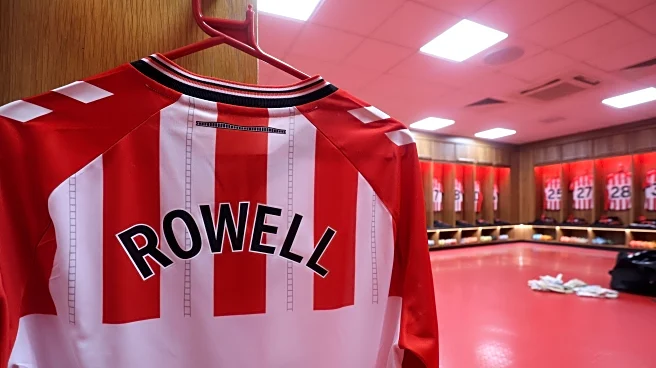




In the weeks following the premature loss of Gary Rowell, I — along with probably just about everyone else who saw him play for Sunderland — found myself reminiscing about some of his finest moments in a red and white shirt.
A glancing header into the net in front of the Roker End, a cracking volley from the edge of the box against Stoke, a hat trick against Arsenal, the hat trick at St. James’ Park…you can go on for hours and I wonder how many times “Lord Rowell” of Seaham found himself reminiscing
about those goals.
Rowell did something that very few who are good enough get to do: play for his hometown club. But then he scored 103 goals for his hometown club, which fewer still get to do.

That set me off on a mission to find out how many players Sunderland produced that have scored that many goals for the club. How does Gary Rowell’s record compare to the rest? Because the more I think about it, he appears to be pretty unique.
Setting the scene as I write — post-war, I pretty much know the answer; pre-war, I’m not sure, as that’ll take some research.
The criteria is that the player has to have come through the club ranks — be it the youth system, the academy or signed straight from school just as Rowell did — and have scored a least a reasonable number of goals for Sunderland.
Looking at the post-war period to the present day this means we can forget about players like Kevin Phillips (signed from Watford), Marco Gabbiadini (signed from York), Brian Clough (signed from Middlesbrough) and Len Shackleton (signed from Newcastle), but it’s worth a look at some of the players we did produce from our youth team who did make a significant goal contribution in a red and white shirt, because some might surprise you.
Billy Hughes
335 appearances, 81 goals
Spotted by Sunderland scout Tom Rutherford while playing for a schools side and invited south from Coatbridge to join the lads when he was sixteen, Hughes was predominantly a pacy winger who could shoot with either foot and would sometimes play as a striker.
When Bob Stokoe became Sunderland manager, Hughes played his best football and hit double figures in goals every year from 1972/1973 to 1974/1975, while also becoming one of the F.A. Cup-winning legends of 1973.
After leaving Sunderland, he only scored a further thirteen goals in his career, for Derby and Leicester.

Colin Suggett
93 appearances, 25 goals
Suggett only scored twenty five goals but he gets a mention because he was such a promising player that came through the ranks and into the first team — and is still revered by those that saw him in a red and white shirt.
A youth cup winner with Sunderland who made his debut in 1967 at nineteen years old, over the next couple of seasons, he made a strong impression as an intelligent creative forward capable of scoring goals and was top scorer in 1967/1968, with fifteen.
For reasons unknown to man (either that or we were skint) he was sold to West Brom in 1969, where he was often used in a midfield role. He ended his career with a total of sixty seven goals.
Gordon Armstrong
416 appearances, 61 goals
Armstrong started his Sunderland career as a seventeen-year-old left-sided midfielder before gradually moving into the middle of the park when Denis Smith became manager.
Hugely competitive on the pitch, he commanded central midfield with a great left foot and scored goals regularly through his ten year Sunderland career. He never played upfront but would time his runs perfectly into the box, and his most famous goal was a winning headed screamer — from another well-timed run — against Chelsea in a FA Cup sixth round replay at Roker Park during our run to the final in 1992.
He scored a further ten league goals for other clubs, and made close to another two hundred appearances.
Colin West
122 appearances, 28 goals
A 6ft centre forward, he came into Alan Durban’s team of young guns as an eighteen year-old in 1981/1982.
He was raw and played in a struggling team but scored some crucial goals for Sunderland, including strikes towards the end of his first season when the club looked doomed at the bottom of the First Division. He was a constant threat in the air and had a cannonball of a shot which produced more than a couple of spectacular goals — West scoring three during our win over two legs against Chelsea in the League Cup semi-final of 1985.
It has to be said if there was a case of a young player getting stick from the crowd, West would be one, but he gets a mention because despite being singled out as a youngster by the terraces, after playing for a number of clubs, he scored close to 150 goals in all competitions in his career.
Bobby Kerr
433 appearances, 69 goals
A legendary club captain and the last Lads skipper to lift any major silverware with the FA Cup win in 1973, Kerr always was a midfielder who came through the productive youth team of the 1960’s.
He won the FA Youth Cup as a teenager and was another from the seemingly endless conveyor belt of talent that Sunderland brought down from Scotland during that era. He twice broke his leg as a youngster, yet became one of the most important players for Sunderland for over a decade.
After leaving Sunderland, he had a short spell at Blackpool before ending his career at Hartlepool.

Nick Sharkey
117 appearances, 62 goals
Another of the club’s Scottish-raised players, Sharkey’s stats are fascinating and you wonder why such a prolific goalscorer just seemed to fade away from the top of footballing world. First introduced at sixteen, he didn’t really get his chance until Brian Clough suffered a career-ending injury.
Sharkey scored five goals for Sunderland in one game against Norwich and there was also another hat trick against Swindon. He scored seventeen goals in thirty three league appearances when Sunderland were promoted in 1964, and then eighteen in thirty two in the top flight in 1964/1965 — all from open play. A slightly-built forward, new manager Ian McColl never appeared to rate him after a few heavy defeats in 1965/1966.
From then on, he only made odd appearances for the first team before being moved on to Leicester and then Mansfield, without ever really recapturing the form of his early Sunderland career.
Dennis Tueart
214 appearances, 56 goals
Coming through the successful Sunderland youth system of the 1960s, Tueart made his debut as a nineteen-year-old in 1968. A winger that could pop up on either flank, he could put in a peach of a cross, score goals, and was a key player in the 1973 cup-winning team.
He could also play as a striker, which helped him on his way to his outstanding career total of 196 goals.
Tueart was one of the first of the 1973 legends to leave the club when he joined First Division Manchester City early in 1974, but his career continued to soar. He scored a spectacular goal in the League Cup final for Manchester City against Newcastle in 1976, and also won caps for England.

John O’ Hare
59 appearances, 21 goals
Another “Scottish Mackem” and a youth recruit who was first introduced to the first team at seventeen when Sunderland were back in the top flight in 1964.
He started more matches over the following seasons without truly holding down his place and managed seventeen goals before his ex Sunderland teammate and then-Derby manager Brian Clough came in for him in 1967 after a short spell of being “sent” to Canada.
Footballing immortality followed for O’Hare in the Midlands as he became a key player in the Derby team that later went on to lift the league title before he was reunited with Clough at Nottingham Forest. Despite his career winding down at that point, he still made a contribution to the Forest team that won the league and two European Cups, and finished his career with a total of 120 goals.
Concluding the first part of our search, during the post war period — an era of eighty years, no less — no player produced by the club from 1945 onwards has got anywhere near Gary Rowell’s total of 103 Sunderland goals.
Three players surpassed it after leaving Sunderland, but certainly not in a red and white shirt.
Part two will look at the players produced pre-war and will show whether the iconic and legendary players from that era place Rowell’s total in a more modest light.