



As the Minnesota Vikings get ready for the start of training camp, one thing the Vikings’ offensive coaching staff is likely preparing for is continuing the installation of the offense. That carries added importance this season if the Vikings have a new starting quarterback, particularly in the passing game, but the run game is also likely to get a bit of a makeover with the addition of assistant head coach Frank Smith, who is focusing on the run game.
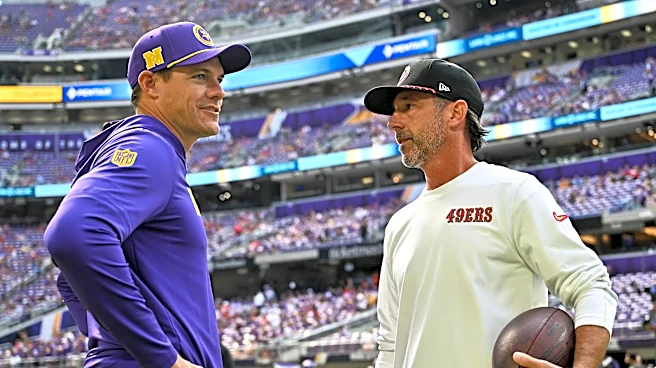
Kevin O’Connell is an offshoot of the McVay branch
of the Shanahan coaching tree while Frank Smith worked under Mike McDaniel in Miami, who is an offshoot of the Kyle Shanahan branch. McDaniel specialized in the run game working under Kyle Shanahan and Frank Smith will bring a lot of those concepts to Minnesota. I won’t go into the Shanahan coaching tree history, which you can get it here, but there is a lot of overlap between various offshoots, even as each of them evolve too.
Wide Zone Mixed with Power
A core feature of the Shanahan offense is the wide zone run scheme. When you see all the offensive linemen take a drop or bucket step and then all block horizontally in the same direction, that is zone blocking. In wide zone, the running back aims for the butt of the tight end or if there is no tight end on the play side, then the outside leg of the tackle. The back then reads the defensive end and makes his cut after 3-5 steps. If he moves inside, the back bounces the run outside, if he pursues outside, the back bends it back inside, if the hole is open, he bangs through. Below is a classic outside zone play, called on 1st and 10.
This isn’t new for the Vikings or Kevin O’Connell’s scheme. It’s been a staple for years. In fact, it’s not all that different than ‘super power left’ power sweeps we used to run in pee-wee football back in the 1970s
And if you watch the play, it didn’t fool the Bengals defense. The defensive formation was toward the play side, countering the double tight-end set, the linebackers flow toward the run immediately, there is even a backside defensive back blitzing to try and get to Mason behind the line of scrimmage. The play was successful because it was well blocked and Mason didn’t hesitate, but the play design itself didn’t do much to tilt the outcome in the Vikings’ favor.
The Frank Smith Factor
Here is a variation of outside zone that the Dolphins ran last season under Frank Smith, the new Vikings de facto run game coordinator:

On 3rd and 3, the Dolphins initially show five-wide with an empty backfield and a shotgun formation- strongly suggesting a pass play. However, De’Von Achane at the bottom of the screen, motions back to the backfield:

Following Achane’s motion to the backfield, the Colts have the linebackers shifted toward the 3-wide receiver side and the safety is cheating that way too on the far hash. The Colts are running a 5-man defensive front and the strong safety is covering the tight end at the bottom of the formation. Here’s how the play unfolded:
The Colts’ secondary was primarily concerned about the 3-wide group right, while based on Achane’s position, it seemed like the front seven were expecting either pass or an inside run. The play side edge defender’s first step was backward- perhaps looking to work down the line in run defense- and was easily taken out by the tight end. That left the playside tackle to take out the strong safety, which was a mismatch. The playside guard had a more difficult block on the 4i defensive tackle but got just enough of him to allow Achane to break an attempt at an arm tackle. The linebacker blitzed- whether that was the play call or because he was expecting an inside run or a pass isn’t clear, but Achane’s position just behind the quarterback is a tell that the play is a run. But the Colts’ defense wasn’t expecting the handoff behind the quarterback for an outside zone run and paid for it by allowing an explosive 26-yard run.
The Vikings run a variety of non-standard outside zone runs and have for years, but the level of deception here is more advanced. It caused the Colts’ defense to cheat a bit away from the play and a split-second hesitation in a key edge defender that provided an advantage for the Dolphins offense.
And beyond outside zone runs, Frank Smith worked with Mike McDaniel installing some outside-the-box run designs that really challenge defense’s ability to read the play. Here is an example the Dolphins ran last season:

First and ten for the Dolphins in the first quarter up 6-3 over the Chargers just past mid-field. The Dolphins are in shotgun and 22 personnel- two running backs and two tight ends- with wide receiver Jaylen Waddle in the backfield to the quarterback’s left. Running back De’Von Achane is at quarterback depth to his right, with the other running back positioned further right in the backfield outside the inline tight end while the other tight end, Darren Waller, is lined up as a receiver at the top of the picture.
The initial formation and personnel package is something most defenses never see all season, if ever. The Chargers’ defense counters with a 4-3 personnel look (with strong safety Derwin James in a linebacker role) with the line strength matching the offensive formation strength. The secondary shows a Cover-2 look. Overall, a base defense look that the Dolphins might anticipate with this personnel package.
Now see how the play unfolded:
The beauty of this play- and its successful execution- is both the play design and the attention to detail. A few examples:
- De’Von Achane lines up at quarterback depth in the backfield, rather than just behind. Normally a ‘tell’ for a run play from shotgun is when the running back lines up a step or so deeper than the quarterback. Lining up at equal depth can sometimes indicate a blocking assignment or receiving route or possibly a toss to that side- none of which is the right read in this case.
- The pre-snap motion of the running back, Darren Waller blocking the defensive back, Jayden Waddle looking back for a pass, and Tua Tagovailoa looking at Waddle while he hands the ball off to Achane, all contribute to the idea of the play being a screen pass to Waddle. That works to have the linebackers and safety take a couple steps toward the direction of the motion and in the case of the safety makes him just a step late to make the tackle (although his line was a bit off too).
- The center and right guard pulling and taking out Derwin James and the cornerback while the left guard got in front of the nose tackle and the tight end pinched the edge rusher were all well executed blocking assignments that got Achane to the second level and beyond.
These are the type of run plays the Vikings may incorporate into their offense this season with Frank Smith coming over from Miami. Just a little more detail, a little more nuances, and some fresh thinking built into the play design to help give the Vikings’ offense an advantage.
More Fullback?
Another aspect of the acquisition of Frank Smith as the de facto run game coordinator is fullback use. The Dolphins had Alec Ingold at fullback and he averaged around 400 snaps a season over his four years in Miami under Mike McDaniel- closer to 350 his last two years and around 425 his first two years. That’s characteristic of the Kyle Shanahan tree that McDaniel is a part of as the 49ers used fullback Kyle Juszczyk on around 600 snaps a season over the past five years. By contrast, C.J. Ham has been used on just over 200 snaps a season on offense in the KOC era.
So, with the Vikings having spent a fifth-round pick on fullback/H-back Max Bredeson, will the Vikings use a fullback on a significantly greater percentage of their offensive snaps this season? If so, who sees their snapcount reduced as a result? It seems unlikely that either Justin Jefferson or Jordan Addison would be on the field less, which leaves new WR3 Jauan Jennings and tight ends T.J. Hockenson and Josh Oliver.
Oliver is one of the best blocking tight ends in the league, so it doesn’t really make sense to replace him with a rookie blocking fullback/H-back in Bredeson. Hockenson took a pay cut to remain with the team this season, but he’s still being paid $15 million and maybe could have something of a bounce back season? Last season’s WR3 was Jalen Nailor, who played on around 650 snaps in each of the last two seasons. I would be surprised if Jennings is on the field that often, but he is also somewhat of a WR/TE hybrid who could potentially take some snaps from Hockenson if the Vikings felt he offered a better receiving/blocking threat combination than Hockenson. So, between Hockenson and WR3 snaps last season, there is room for a fullback to play roughly a third of the offensive snaps this season, if Bredeson is worthy of them and that’s the direction the Vikings decide to go.
Having a fullback on the field, who often fills the role of lead blocker, can lead to more base defenses and added attention from a linebacker, typically, who often keys on the fullback in run defense. But sometimes the fullback can be a decoy sent in another direction in hopes of taking defenders with him. A fullback can also help as a decoy in the pass game too, adding to the look of a run play. Below is the first play of the second half by the Dolphins against the Jets last season (1st and 10):
You can see how the Jets’ 4-3 base defense reacts to the changing strength of the formation as first the wide receiver and then the fullback (#30) motion right, suggesting a run in that direction. The Jets sold out for what appeared to be a zone lead run, only to be fooled by the play-action bootleg. The Dolphins had the weakside receiver and the tight end run clear out routes while Tyreek Hill (#10) ran a crossing route that left him wide open for an explosive gain.
Often these explosive plays are setup by run plays using the same personnel which may or may not have been successful but serve a purpose in revealing how a defense reacts to the personnel package in a given situation which the offensive play caller can exploit later in the game. The ability to run different plays from similar looks, which is a hallmark of the Shanahan tree, helps keep the defense honest and off-balance.
Play-Action Bootlegs
A core element of the Shanahan scheme and its offshoots is the play-action pass. The Vikings, 49ers, Rams, and Dolphins were four of the top eight teams in play-action pass percentage last season. One core concept in the Shanahan scheme is running a quarterback bootleg off of play-action (as shown in the play above). Sometimes half-bootlegs can be run this way too, where the quarterback completes a half-circle after the fake handoff to end up behind the original ball placement. These bootleg plays work for both J.J. McCarthy and Kyler Murray as they can create some easier reads and sightlines.
The McCarthy bootleg pass is probably the most common bootleg concept in the Vikings’ playbook with short, intermediate, and deep route options and an easier half-field read. The Murray bootleg pass was from 2024 and appears to have Trey McBride as the first read crossing over on a backside seam route, then Marvin Harrison Jr. on a crossing route which he deepens on this play to great success. There was a short drag route available as a check-down as well. But it appears a deeper route was the target on the play as a tight end was kept in to block.
The bootleg concept works for both Murray and McCarthy because it creates some easier reads and sightlines beneficial to both quarterbacks. Here are several bootleg or half bootleg passes from Brock Purdy in the Shanahan scheme, with pauses at the launch point to show the reads/sightlines that were made available to Purdy on these plays:
At the end of the day offensive schemes evolve over time as defenses respond to them and personnel change. Sean McVay’s version of the Shanahan scheme went from being the heaviest user of 11 personnel (3 wide receivers) in the league for many years to the heaviest use of 13 personnel (3 tight ends) last season. I don’t know that Kevin O’Connell will make as drastic a change as McVay did last year, but I would not be surprised with some evolution along these lines.
Stay tuned.
Follow me on X/Bluesky @wludford