




The New York Giants’ stunning trade of Dexter Lawrence to the Cincinnati Bengals for the 10th pick in the 2026 NFL Draft, blew up a lot of things.
The first round of the draft, and the idea that the Giants would have to settle for a less-than offer if they could not reach a new contract with Lawrence were among them. The deal also blew up the mock draft I had planned to present in this space, and consequently a massive portion of my Saturday night as I confirmed the deal and pieced together both a Lawrence trade
story and a new mock draft.
Here are the results of a hastily-conceived mock draft with the Giants owning the 10th pick. The mock, as you will see, includes a twist of its own. Thanks to the folks at Pro Football Network for getting their simulator updated quickly enough that this mock could be done properly.
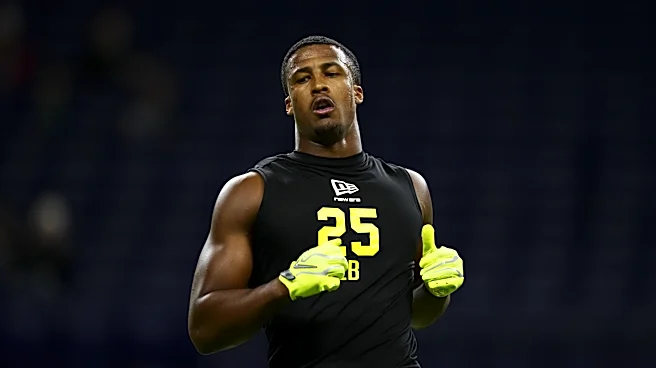
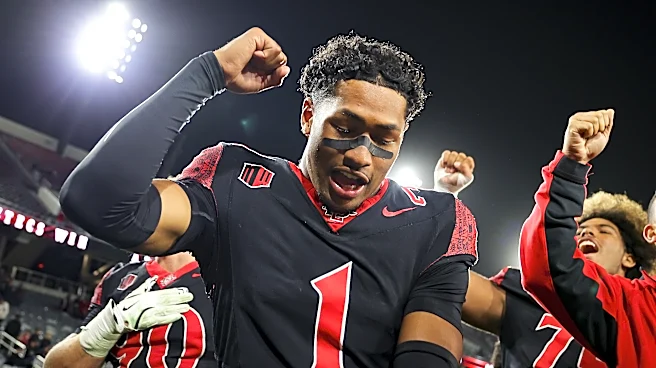
Round 1 (No. 5) — Sonny Styles, LB, Ohio State
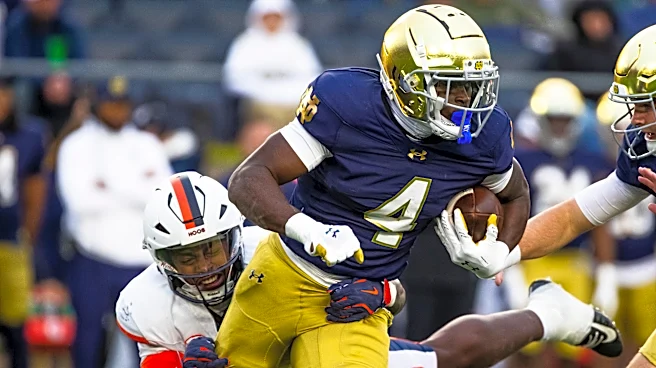
Jeremiyah Love was available here. I just couldn’t bring myself to make that choice. John Harbaugh and Joe Schoen might. I just can’t. Harbaugh seems to love to build a team through its spine (running back, quarterback, center, interior defensive line, off-ball linebacker, safety). Styles’ athletic traits, instincts, and leadership capability make him the right choice here.
PFSN says:
At 6’5″, 243 pounds, with over 33-inch arms, Styles’ size and length, combined with his explosiveness, quickness, and playmaking range, can take over in both phases, and he’s an incredibly intelligent defender with elite read-and-react skills. With his safety background, he’s an incredibly natural coverage defender who can manage short and intermediate zones, but he’s also a combative block attacker, a shrewd gap invader, and a dynamic pass-rushing presence with bend and burst. Positional value will naturally come up in conversations regarding Styles, but he’s a blue-chip LB prospect with his raw grade, and has All-Pro potential as a MIKE or WILL in the NFL.
Other players considered: Jeremiyah Love, RB, Notre Dame; Caleb Downs, S, Ohio State
- NY Giants draft odds: Caleb Downs has entered the chat
- NY Giants mock draft tracker: Sonny Styles at the top, but there is movement
- NY Giants select LB Sonny Styles at No. 5 in SB Nation Writer’s Mock Draft
- Caleb Downs or Sonny Styles? Giants in ‘great position’ in 2026 NFL Draft
- NY Giants 2026 NFL Draft scouting report: Caleb Downs, S, Ohio State
- NY Giants 2026 NFL Draft scouting report: Sonny Styles, LB, Ohio State
- LB Sonny Styles checks a lot of boxes for Giants coach John Harbaugh
- 4 players who might have the ‘gold jacket’ potential John Harbaugh wants at No. 5
Round 1 (No. 10) — TRADE!!
Giants get: Picks 25, 57, 60, and a 2027 second-round pick
Chicgo Bears get: Picks 10 and 105
I could have taken Vega Ioane, Jordyn Tyson, Jermod McCoy, or Makai Lemon here. I chose to make another splash. I more or less doubled the Giants’ number of selections in the top 100, and I put myself in position to draft a badly-needed defensive tackle as the Giants begin life without Lawrence in the middle of their line.
In all honesty, I think Tyson is probably the pick here if the Giants stay at No. 10. They get a defensive leader to build around, and a weapon for Jaxson Dart. That is the latest intel from Todd McShay of The Ringer, and I think it could⅛turn out that way on Thursday night. I am going to explore another way, though.

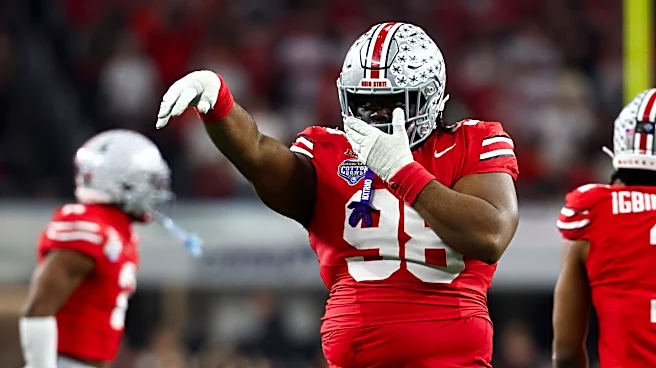
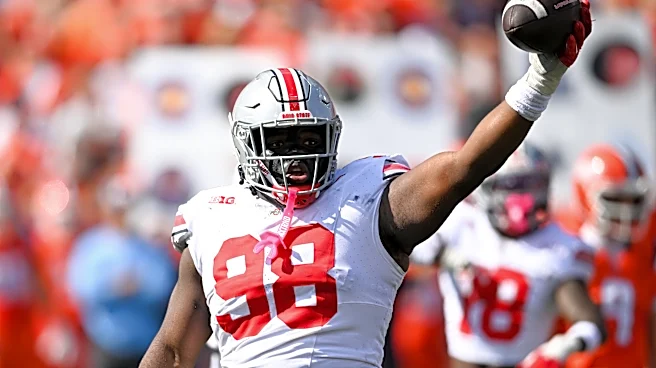
Round 1 (No. 25) — Kayden McDonald, DT, Ohio State
The Giants need a young mountain in the middle as they begin to try and rebuild their defensive line. In this draft class, the 6-foot-2⅛, 326-pound McDonald is the best place to start.
PFSN says:
McDonald tips the scales at 6’3″, 326 pounds, and at his size, he has awesome on-attack explosiveness and raw power capacity. Juxtaposing McDonald with Williams, Williams was visibly more flexible and alignment versatile.
Nevertheless, McDonald serves his early-down purpose well as a double-team magnet, combo absorber, line reset specialist, and block shedder. Meanwhile, he has the high-level linear explosion and throttling point-of-attack power to cave in step-up space on passing downs, as well as the motor to finish plays. While he’ll never be an elite pass-rush force, McDonald is an excellent orbit DT at 0-tech and 1-tech, with the overwhelming point-of-contact power to wreak havoc in the run game, and the juice to be a respectable three-down presence.
Other players considered: Denzel Boston, WR, Washington; Colton Hood, CB, Tennessee; Chris Johnson, CB, San Diego State
Round 2 (No. 37) — Chris Johnson, CB, San Diego State
I would not have minded if a wide receiver I really wanted had shown up in this spot. That didn’t happen. And, as I said above, if the Giants stick at No. 10 there is some indication they will fill their need for a playmaker opposite Malik Nabers by grabbing Tyson in that spot.
I think Johnson could challenge for a starting spot from the jump.
PFSN says:
Chris Johnson was one of the best cornerbacks in college football in 2025, and he has a chance to be one of the first Group of Six prospects taken in the 2026 NFL Draft. At 6’0″, 185 pounds, Johnson is a bit smaller and lighter than preferred, and this plays into his stylistic preference to match with cushion in off-man coverage and zone. But in space, he’s one of the best raw movers in the class, with hyperactive foot speed and recalibratory athleticism, crisp fluidity and transition freedom, and swarming range and closing ability out of breaks.
His coverage mobility helps set the foundation for his elite ball-hawking ability, and for his size, he does a great job engaging blocks and holding up in support on crack-and-replace reps. A high-level playmaker and click-and-close operator who sizes up well for his build in the run game, Johnson has impact starter potential.
Other players considered: Colton Hood, CB, Tennessee; Germie Bernard, WR, Alabama
Round 2 (No. 57) — Keylan Rutledge, G, Georgia Tech
I had to turn my attention to getting help for Dart on offense at some point. The way the board fell, the first order of business was getting a guard who could perhaps win a starting job in a competition with the group of veteran players the Giants currently have.
PFSN says:
Rutledge stands out as a potential gem in the middle-round range. At around 6’4″, 330 pounds, Rutledge is a compact block of fury inside the tackles; in fact, there’s an argument to make no offensive lineman brings more energy and relentless zeal than him on a down-to-down basis. Rutledge is similarly energized with his foot speed and play pace, and he has the combined mass and width to levy devastating bouts of hand force and rotational torque.
In the run game, he’s assignment-sound, angle-sound, and role versatile, with the hip flexibility to execute reach blocks, and in pass protection, he blends the line between patience and proactivity well, and is aggressive on help blocks. His limited knee bend affects his leverage acquisition and pad level maintenance, but he has the temperament to be a tone-setter on Sundays.
Other players considered: Gennings Dunker, OL, Iowa
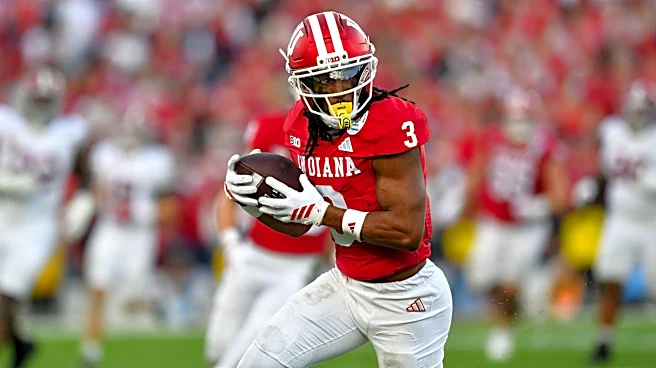
Round 2 (No. 60) — Elijah Sarratt, WR, Indiana
The selection of Sarratt at No. 55 in a trade-down scenario I ran last week drew a mixed reaction. Here, with this being my last chance on the first two days to select a wide receiver, I pick Sarratt again. This would be moot, of course, if the Giants take Tyson at No. 10. My choice was between Tyson and Ted Hurst of Georgia State.
PFSN says:
Elijah Sarratt has been one of the most productive WRs in college football since 2022, and he maintained that reputation this year. He eclipsed 1,000 yards with James Madison in 2023, and led the Indiana Hoosiers in catches, receiving yards, and receiving touchdowns during the team’s surprise CFB Playoff campaign in 2024. In 2025, he achieved a career-high 15 TDs, distinguishing himself as a deadly catch-point and red-zone threat against the highest level of competition.
At 6’2″, 209 pounds, Sarratt fits a mold of WR that has been polarizing time and time again on the NFL Draft circuit. He’s not the most explosive, nor does he have seam-stretching speed, but he has the necessary foot speed, sink, and tempo IQ to separate independently, and at the catch point, he’s a high-level convertor and a true late-hands master with extraordinary composure, timing sense, and body control. That toughness and play strength translates in the RAC phase as well, and as a blocker, where Sarratt brings consistent effort and plays smart.
Athletic traits do matter, but elite execution supersedes them at the NFL level, and Sarratt is a platinum-level operator who has the sky-high floor to underlie tantalizing usage versatility, production upside, and utility as a chain-mover and red-zone trump card.
Just for fun, and I know some of you will hate this, I asked NFL.com’s artificial intelligence tool, NFL IQ, if I made the right choice. It said:
Both Ted Hurst and Elijah Sarratt are WR prospects projected in a similar draft range, but they’re very different players — and for the Giants, Elijah Sarratt is the better pick.
Here’s why:
The Giants’ top WR need is a complement to Malik Nabers — someone who can contribute as a reliable target, not just a developmental project. Sarratt fits that profile better.
Elijah Sarratt (WR, Indiana)
- Projected: 3rd–4th round | Grade: 6.17
- NGS: OVR 78 | ATH 66 | PROD 83
- 58.3% starter probability — solid for a Day 2/3 pick
- Year 3 starter probability climbs to 52.5%, showing real developmental arc
- 6’2.5″, 210 lbs — a big-bodied possession receiver who wins with size and route running
Ted Hurst (WR, Georgia State)
- Projected: 3rd round | Grade: 5.95
- NGS: OVR 76 | ATH 87 | PROD 70
- Only 34.4% starter probability
- Elite athleticism (87 ATH, 4.42 speed) but modest production at a Group of 5 school
The key differentiator is production vs. projection. Sarratt’s 83 PROD score and 58% starter probability signal a player who has already proven he can produce at a high level. Hurst is a tantalizing athlete, but his 70 PROD and 34% starter probability make him a higher-risk developmental bet — not ideal for a Giants team that needs WR contributions now to support Jaxson Dart and a returning Malik Nabers.
Sarratt is the higher-floor pick. Hurst has the higher ceiling, but the Giants’ situation calls for reliability over upside at this position.
Do with that what you will.
Other players considered: Ted Hurst, WR, Georgia State
Round 5 (No. 145) — Trey Zuhn, OL, Texas A&M
OK, so this was an annoying reality after trading pick No. 105 in my deal with the Bears. I ended up sitting out 85 picks, early three full rounds. Still, before the Lawrence trade the Giants had two picks — 5 and 37 — in the top 100. The Lawrence deal and my move with the Bears give the Giants five picks in the top 60 of this mock draft.
Zuhn is a player who will convert from tackle at the NFL level, and is thought to have center-guard flexibility. With left guard Jon Runyan Jr. and center John Michael Schmitz both in the final years of their contracts, perhaps Zuhn could develop into a starting option at one of those spots.
PFSN says:
Center could ultimately be where Zuhn sticks at the NFL level, but in truth, he has three-position versatility inside, and his experience at tackle serves as an anchor for his utility.
Standing at 6’6″ and 319 pounds, Zuhn brings imposing size, strength, and impressive foot speed and flexibility. His arm length under 32″ is less than ideal, and is a prime driver of Zuhn’s likely transition inside, but for a taller lineman, he has the flexibility and leverage acquisition skills to fit in easily playing interior alignments. His quick feet and hands, stout anchor, and competitive edge in both pass protection and the run game insulate his value, and in time, he could be a quality starter at the fulcrum.
[NOTE: Since I did not get Dart any help on offense with the first three selections, my idea with the trio of sixth-round picks was to try to identify some potentially useful offensive players who might contribute in the margins early on. I think I was able to do that].
Round 6 (No. 186) — Eli Heidenreich, WR, Navy
I have taken Heidenreich late in the draft a couple of weeeks in a row now. I don’t know exactly what he is, but I wouldn’t mind see the Giants try to figure it out.
In his draft guide, Matt Waldman of the Rookie Scouting Portfolio says:
Expect Heidenreich to begin his career as a return specialist or coverage player while competing for situational opportunities in an offense in a utility role.
Heidenreich has special teams promise as a return specialist and/or coverage option who can
contribute to an offense as a fourth or fifth receiver but more likely as a utility player who earns as many touches as a running back as he does a WR3-WR5.
Heidenreich has the ball-carrying skills on the perimeter and the open field to deliver as an extension of the ground game from a variety of spots. He tracks, adjusts, and catches the ball effectively in the capacity of a zone receiver, an outlet from the backfield, or on schemed plays up the seam or boundary for big plays.
For Heidenreich to become a wide receiver, he must develop a complete route game, and he’s not as far from that possibility as his role with Navy might lead you to believe. He has developed techniques for releases, setups, and breaks, but he must expand the precision of their execution beyond the shallow range of the field.
Developing these skills may prove easier than trying to develop a ground game between the tackles and add 10-15 pounds of muscle to try to become an every-down back. Heidenreich has limited experience as a runner who works between the tackles. This is a bigger challenge to learn than what he must learn to compete at wide receiver.
Round 6 (No. 192) — Adam Randall, RB, Clemson
It has been a couple of weeks since I selected the 6-3, 232-pound converted wide receiver in a mock draft. The Giants have had success with converted wide receiver Tyrone Tracy, and that might encourage them to try that path again. I just keep thinking that the big-bodied Randall would appeal to John Harbaugh as a potential powerful, slashing inside runner.
PFSN says:
As one might expect from a young player in just his first year at a position full-time, Randall’s vision and creative instincts are very raw; when he has less space to use and less time to react, he can struggle. However, in space, Randall has the explosiveness, speed, and churning leg drive to chew up space and finish with physicality. He flashes above-average press and stem IQ when approaching blocks 1-on-1, and with his WR background, he’s a naturally versatile pass-catching threat, who also proves competent as a blocker.
In the immediate timeline, Randall serves as a versatile rotational piece, but he has exciting upside.
Round 6 (No. 193) — Josh Cameron, WR, Baylor
I think I have a thing for big, strong wide receivers who can become contested-catch guys.
Pro Football and Sports Network says:
At 6’1″, 218 pounds, he’s a uniquely-built WR with high-level frame density, compact mass, proportional length, and long-strider burst, but he also has the ability to reduce and use stride variations to separate quickly. He has strong hands at the catch point, and he’s built for RAC with his contact balance and burst. Cameron doesn’t have field-stretching speed, and his athletic profile isn’t elite, but there’s a lot of utility in his short and intermediate route tree, chain-moving catch reliability, and active RAC element.
Pre-Dexter Lawrence trade mock draft
Here is the mock draft you would have been reading about had the Giants not made the Lawrence trade:
Round 1 (No. 5) — Sonny Styles, LB, Ohio State
Round 2 (No. 37) — TRADE!!
Giants get: Picks 48 (Round 2) and 79 (Round 3) | Total Value: 178 points
Atlanta Falcons get: Pick 37 | Value: 162 points
Round 2 (No. 48) — Keylan Rutledge, G, Georgia Tech
Round 3 (No. 79) — Ted Hurst, WR, Georgia State
Round 4 (No. 105) — Chris McClellan, DT, Missouri
Round 5 (No. 145) — Demond Claiborne, RB, Wake Forest
Round 6 (No. 186) — Eli Heidenreich, WR, Navy
Round 6 (No. 192) — Thaddeus Dixon, CB, North Carolina
Round 6 (No. 193) — Dontay Corleone, DT, Cincinnati
How did I do this time, Giants fans?