


Louisville changed the momentum of their game against Florida State very quickly in the second quarter. I broke down some of the key plays that helped shift the tide of the game.

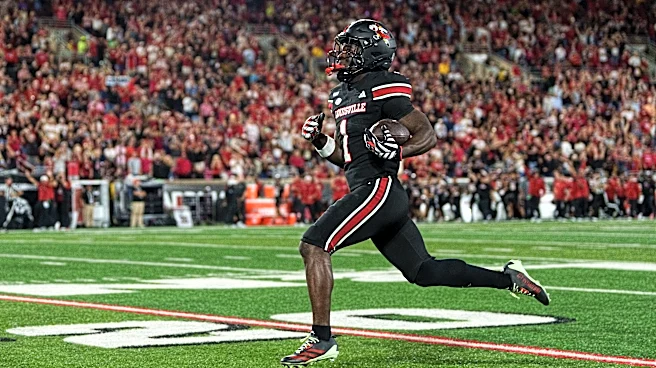
It hasn’t happened often this year, but all the credit for this run goes to the offense. Isaac Brown’s speed gets him to the endzone, but the blocking he got was superb. Eryx Daughtery gets a freebie on his pull because the FSU defender slips, but I don’t think it would have mattered. He had him squared up. Lance Robinson
takes out the defensive tackle on a nice tandem block with Evan Wibberly that essentially caves in the left side of the defense. Jaleel Skinner does an impressive job of dipping under the end to get up to the second level to get hands on the safety who walks up on the play. Lawayne McCoy does an excellent job of sustaining his block down the field without holding as well.
My favorite block on the play is Justyn Reid in the hole. He takes a perfect angle to his block and meets the linebacker right where he needs to so this play can get outside where Brown is at his best. Taking this block head-on instead of trying to wall off the defender allows for more space for Brown. It also forces the linebacker to take him on instead of trying to shoot a gap. Really good stuff from all of the blockers on this play.
It also stands out that Isaac shows really good patience on this run. It’s tough to see, but he slows down just a bit while Reid takes on his block before he bursts outside. It’s something he was not doing on a regular basis to start of this season.

Stanquan Clark was benched for a series after blowing a coverage in the first quarter. This was his first play back on the field. Accountability is not a bad thing. Your leaders will respond to it, and their response will bleed into the rest of the team. Clark ended up having his best game of the season, and I truly believe it was because he had to sit after making a mistake.

It’s hard to really quantify how much Lincoln Kienholz adds to this offense because he is a threat to run the football. He makes defenses respect his legs, but he also forces defenses to play assignment football on every play. Here you can see the edge defender and the backside linebacker take steps towards Kienholz, which allows Marquis Davis to get around the edge.
The edge defender sees the puller and Kienholz showing option, so he steps down the line just enough to take himself out of the play. The backside linebacker takes an angle towards the handoff point before angling more towards the sideline. That’s all the space Davis needs to outrun him before running through his dive attempt. Here’s to hoping we see more of the inverted veer so that we can see the backs on the edge with a full head of steam, or Kienholz getting downhill through a gap in the defense.

Chris Barclay is well known by Cards fans for how he has developed his running back room over the last few years, but this is the type of play that gets you noticed around the country. Davis takes this handoff, and he immediately has blockers being pushed back into him. He doesn’t try to break this outside or just run into the back of his blockers. He slows his feet but doesn’t stop them. He then picks his way through his line before sticking his left foot in the ground and bursting forward.
There’s an aspect of this that is natural ability, but Barclay has done a great job scouting guys who fit what they do on offense. Davis isn’t a burner like Duke Watson or Isaac, but he runs through tackles, which is a must when you use these stretch runs where the defensive linemen will be fighting blocks to get an arm on you. He blows right through an arm tackle at the line here before he finishes the run with power.

Louisville’s defense has been gashed all year, and the fix was simply to play man coverage and let the linebackers get downhill. I could write 3,000 words about how frustrating that is, but that’s for another day. The uptick in general aggression leads to this play being DOA for FSU. Usmane Kromah had been getting 6-10 yards on nearly every run up to this point, but the Cards blow up the blocking scheme with Stanquan crashing the line. This forces the run outside, where Jerrod Smith is there to make a nice tackle on a big back.

This play is the exact opposite end of the spectrum of what we’ve seen from the pass defense this year. This is what every guy playing assignment football looks like. FSU runs an RPO slant to the boundary. The corner on the play is in press coverage with a safety in the middle of the field. Ben Perry is in man coverage on the tight end to the top of the screen. When the tight end stays in to block, Perry freezes. His assignment is to take away this throw, which is exactly what he does. He doesn’t fly up the field to stop the run; he instead takes a slight step forward before reading the throw.
Another great aspect of playing man coverage like this is that your pass rush will have more time to get home. Clev Lubin fights through the tight end while one of the defensive tackles works through the center to collapse the pocket around Austin Daniels. Stanquan Clark chases this down from the outside, and Demeco Kennedy comes in late as well. Four guys get to the quarterback because everyone played their role. This is what it’s supposed to look like.

This is what this defense can look like when you play man coverage. They have the horses up front to get after the quarterback even when they rush three guys. They mug up the linebackers at the line of scrimmage, which leads to enough confusion from the offensive line that all three pass rushers get a one-on-one matchup. I can’t stress enough how important that is. This is a three-man rush, and Daniels has to immediately bail to give himself time.
The secondary is in off-man coverage so that they can keep things in front of them, but look at how they don’t bail at the snap. They allow their cushion to get eaten up by the receivers before reacting to their breaks. The ball is either coming out quickly, or they will need to run with the receiver. The space from their alignment gives them time to identify the route and adjust their plan. If the outside receivers run a deep route, they will be in position to run with the receiver. If they break on a comeback or an in-breaking route, they can close down on the space.
The linebackers on the inside of the play drop deep in zone coverage to help take away those in-breaking routes and to have eyes on any screen plays or other designed delayed plays. Blake Ruffin is playing a zone/spy role on this play, and as soon as Daniels bails, he gets downhill to take away the scramble. These are the types of plays that get me excited for what this defense can be.