



Not everything is sunshine and rainbows under the bright lights of the Major League stadium. Some are able to cherish it and milk it for all it offers, making an impact on fan bases throughout their time in a big-league uniform. But others can lose their way and fall by the wayside. When that happens for certain players during their careers can vary, with some not being heard from early on and others carving out a decent living before the game or their bodies (or both) fall out of love with them.
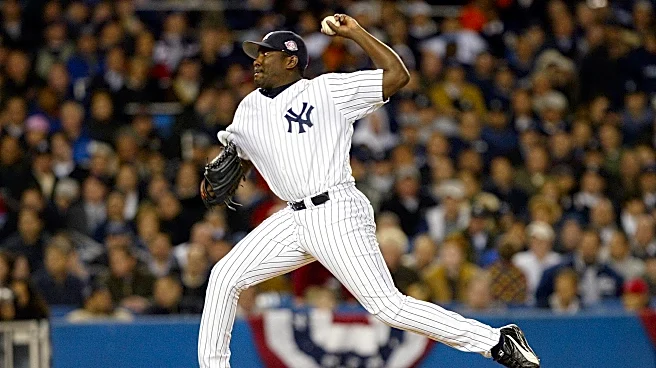
For Félix Heredia, it was a mix of poor performance, injuries, and arm problems, along with a scandal whose punishment he never got to serve because of those issues, that saw his big league career come to a crashing finish.
Félix Santo Heredia
Born: June 18, 1975 (Barahona, Dominican Republic)
Yankees Tenure: 2003-04
Heredia was born on June 18, 1975, in Barahona, a city on the southwest Dominican coast which, as of 2022, is home to around 221,000 residents. He grew up and attended Escuela Dominical while playing baseball. He was signed as an international amateur free agent by the Florida Marlins at age 18 in 1993, giving him the opportunity to pursue his dream and come to America. He played his first baseball on American soil with the Gulf Coast League Marlins, pitching and starting in 12 games and finishing with a 5-1 record alongside a 2.47 ERA.
In 1994, Heredia began his career in A-ball, pitching for the Kane County Cougars in the Midwest League, and it wasn’t as nice a welcome as he may have envisioned coming in. He moved into a bullpen role but still managed to start a handful of games through the course of the season. He appeared 24 times on the mound, eight of which were starts, and finished with a record of 4-5 and a 5.69 ERA over 68 innings. But despite the poor final numbers, he moved up to High-A the next season and played for the Brevard County Manatees in the Florida State League. And not only did he see more action (he started the same number of games but appeared in 10 more), but his ERA dropped considerably. He gave up fewer runs in more innings pitched (38 earned in 95.2 innings versus 43 in 68), putting his ERA at 3.57. He still wasn’t much of a strikeout threat and had a hard time keeping men off the bases via hits and walks, but overall, he didn’t allow runs, and that’s what was most important in his 6-4 record.
Heredia was promoted again, this time to Double-A Portland in the Eastern League, where he became strictly a reliever, and this move was quintessential for his career path. He once again saw a boatload of playing time (55 games) and, over 60 innings he posted a 1.50 ERA. He allowed only 10 earned runs the entire season, and while walks were still a bit of an issue, he kept men from crossing the plate, and thanks to that fact, after the season and spring training, he became a Florida Marlin.
On August 9, 1996, Heredia made his MLB debut out of the bullpen against the New York Mets, one of his future teams at just 21 years old. He threw 0.2 innings and gave up no hits and no runs with no strikeouts and a walk. Following his debut, he would throw in 21 more games for the Marlins and never returned to the minor leagues. He finished his rookie season with a 4.32 ERA, just under the average mark.
At 22, Heredia remained a part of the Marlins bullpen throughout the season. He appeared in 56 games in 1997 and finished with an ERA just under his previous mark at 4.29, along with a 5-3 record. While he would never finish with a strikeouts per inning rate over one in his career over the course of a regular season, the 1997 season was one of the times he got the closest, tallying 54 in 56.2 innings pitched. He also ended with the second-lowest hits per nine rate of his career at 8.4 and the second-best strikeout-to-walk ratio of his career at 1.8. He really made his name in the 1997 postseason.
Over the six games and 8.2 innings he pitched in the NLCS and the World Series, Heredia finished with a 2.08 ERA and nine strikeouts. He allowed only five hits and came up huge, particularly in Game 3 of the Fall Classic, when he tossed 2.1 scoreless innings against Cleveland.
Heredia became a World Series champion for the first and only time in his career at the age of 22, and not only was he on the roster, but he was an integral part of the team on the biggest stage.
The next season following his awe-inspiring postseason was not kind to the young Dominican lefty, though. He pitched in a career-high (at that point) 71 games, including the only two starts of his career, but his ERA skyrocketed to 5.06. Heredia was traded to the Chicago Cubs in the middle of the season, along with Steve Hoff, in exchange for Justin Speier, Kevin Orie, and Todd Noel on July 31, 1998, and following a 5.49 ERA performance with the Marlins things got better following the trade, but the bar was low. He finished his season in Chicago with a 4.08 ERA across 17.2 innings pitched with 16 strikeouts.
The Cubs would be where Heredia spent most of his career, playing three full seasons with the team. From 1999 to 2001, he was used plenty by manager Ed Lynch in 1999 and Don Baylor in 2000 and 2001, including a career-high 74 games played in 2000, when he also finished with his best ERA of that stretch (4.76). His worst came the following season, when he played fewer games, pitching 48 innings and finishing with a 6.17 ERA and an ERA+ of 68, the worst of his career. Heredia gave up 11.6 hits per nine innings and 1.5 home runs per nine innings, both career-lows. Eventually, the Cubs had seen enough and decided to ship him north of the border to the Toronto Blue Jays along with a player to be named later. In exchange, the Cubs received Alex Gonzalez on December 10th, and the player to be named later became James Deschaine just three days later.
Heredia spent one year with the Blue Jays in 2002 and saw a return to the form he had been searching for in Chicago and in his last season with the Marlins. He pitched in 53 games and finished with an ERA+ of 128, the first time in his career managing a number over the 100 average. But after the season, he became a free agent on October 28, 2002. And on January 7th, he returned to the National League after signing a minor-league deal with the Cincinnati Reds and receiving an invitation to spring training.
After making the team out of spring training, Heredia made sure not to blow his chance; in fact, he did the opposite. The 2003 season was his best year on a major league mound. He recorded the sixth save of his career (the last one he would ever register) and finished with a 5–3 record and a 2.69 ERA in 69 appearances. But the season came in two different places.
Following 57 appearances and a 3.00 ERA (138 ERA+, a career-best for a singular team that he pitched more than 20 games in a single season for) between the road and the Ohio Riverfront, the Yankees claimed the lefty off waivers in mid-August, hoping to add a specialist to their pennant run since some aspects of their bullpen had faltered as the season went along. Same-handed batters actually had better splits against Heredia that year, but in 2002, he’d held them to a .698 OPS in this high-octane era for offense.
In 12 games with the Yankees, Heredia finished with a 1.20 ERA over 15 innings pitched, letting fans see the kind of potential he, as a 28-year-old, could bring to a bullpen. Joe Torre was careful with his deployment of Heredia, as he could occasionally be shaky with his control, so he picked his spots. Indeed, Heredia pitched just once in the ALDS rumble with the Twins and not at all in the World Series against the righty-heavy Marlins. But he made five appearances across the seven-game ALCS classic with the Red Sox, most notably retiring the only two batters he faced in the climactic Game 7.
With New York trailing Boston 4-1 and trying to stay in the game against Pedro Martinez, Heredia fanned Johnny Damon to begin the seventh before getting Todd Walker to foul out. Nomar Garciaparra was due up next, so in came Jeff Nelson to get the start shortstop swinging. Aaron Boone of course had the most memorable moment of Game 7, but it was truly a team effort to get the comeback going in earnest to make extra innings even possible. Heredia played his role for the pennant-winners.
Re-signed to a two-year, $3.8 million deal, the next season was when things began to go south.
With an exciting new beginning on the horizon, Heredia stepped onto the mound for his first appearance in pinstripes in 2004 on March 30th against the Tampa Bay Devil Rays in a special Opening Day series at the Tokyo Dome. He pitched two innings and gave up two runs on four hits through 27 pitches. His next appearance on April 6th back at Tropicana Field was much better, throwing a clean inning and getting out of there before any damage could be done. However, it was three days later that the struggles became apparent.
Against the Chicago White Sox, he walked two men, allowed a double to Miguel Olivo, and departed without recording a single out. All four runners would score and he wouldn’t pitch in the majors for another 41 days, dealing with a left hand contusion. Heredia’s ERA did not get below the 6.00 mark until July 16th, and it never went below 5.93 following a July 24th game at Fenway Park when he gave up an RBI double to David Ortiz and was immediately removed.
The Dominican reliever finished the 2004 season with a 6.28 ERA, growing more and more unpopular with the fans. Rostered for the playoffs anyway, he got beat up by the Twins but actually fared OK against the Red Sox while used sparingly in the ALCS rematch, retiring three of the four hitters he faced. That wasn’t enough to save his Yankees career, as he was traded across town in December for fellow southpaw Mike Stanton, who had previously been with the Yankees during their dynasty run in the late 1990s.
Heredia made only three appearances with the Mets in 2005. Following those appearances, he went on the shelf in June with a left shoulder aneurysm, and he missed the rest of the season. And not only did he miss the rest of the season due to that injury, but he was also suspended 10 days for performance-enhancing drug usage during his rehabilitation. He was the 11th player in MLB history to be hit with such a suspension.
Heredia signed with the Arizona Diamondbacks on a minor-league deal the following year, but was released during spring training. Four days later, he signed with Cleveland and played eight games in Triple-A before being released there as well. Then, in December, the Detroit Tigers signed him to a minor-league deal, but they released him during spring training as well. He made some appearances outside of MLB in the Mexican League following his release in 2006, and he played there for the next six years before ultimately hanging up the spikes in 2012.
While he only spent parts of two seasons with the Yankees, Heredia made his mark on the 1997 Marlins and even had a couple nice playoff moments in pinstripes. Happy birthday, Felix!
See more of the “Yankees Birthday of the Day” series here.