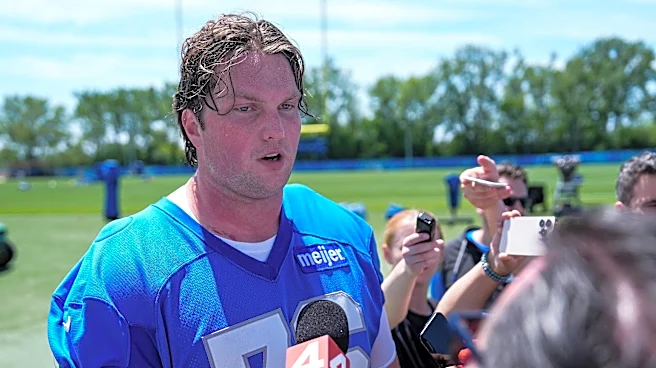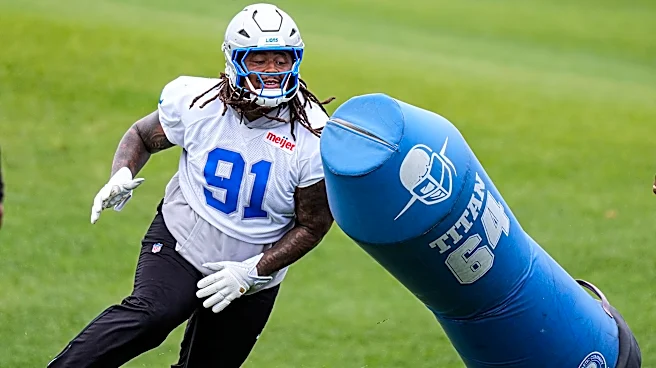


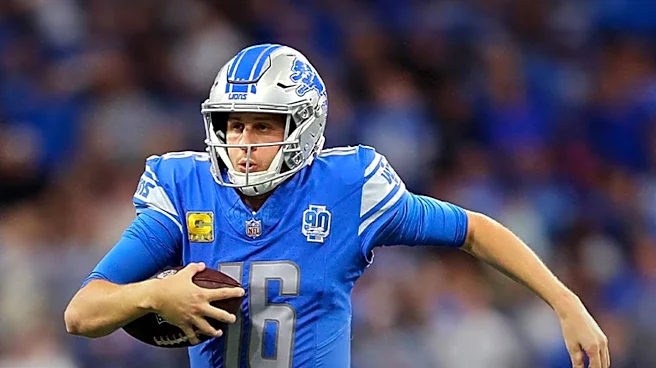


In this installment of our Detroit Lions 2026 training camp preview series, we shift over to the defensive side of the ball and start by examining the Lions’ interior defensive line, speculating on current and future roles, and discussing how many players from this group could make the 53-man roster.
Previous training camp previews:
- Quarterback: Can Luke Altmyer force a QB3 role?
- Running back: How RB roles could shift in 2026
- Wide receiver: WR depth roles up for grabs
- Tight end: How many TEs will make the roster?
- Offensive tackle: Can Blake Miller win the starting RT job?
- Interior OL: How quickly will Cade Mays adapt to scheme?
Roster construction
Under the Brad Holmes and Dan Campbell regime, the Lions have deployed several different styles of defensive front, but they’ve remained consistent in maintaining the number
of players they’ve dedicated to the position.
Let’s take a look at what they’ve done on the interior defensive line in the previous five seasons:
- 2021: With a two-gapping look with three starting interior defenders, the Lions initially kept and ended the season with seven interior defenders.
- 2022: When the front shifted to a 4-3, the Lions reduced their number to five but ended the season with four players active and Levi Onwuzurike on injured reserve.
- 2023: The Lions opened and closed with five interior defenders on the roster.
- 2024: Rinse and repeat: Open and close with five interior defenders.
- 2025: Again, opened and closed with five interior defenders; typically keeping four active on game day.
Planned change
The Lions’ defensive front has undergone a lot of change under this regime, initially operating out of 2-gapping concepts, then flipping to 1-gapping style, before finally landing on a gap-and-a-half approach. And while the Lions front has been relatively consistent for the last few seasons, it appears they’ll undergo some slight tweaking this season as the team increases its focus on pass rushing.
The most noticeable changes among the personnel are that the Lions allowed nose tackles DJ Reader and Roy Lopez to leave in free agency and replaced them with rookies Skyer Gill-Howard and Tyre West, who are more pass rushers than pluggers. The Lions did sign two nose tackles, veteran Jay Tufele and UDFA rookie Aidan Keanaaina, but they appear to be more situational or practice squad players, as opposed to heavy rotational players.
This transition wasn’t simply an adjustment to personnel, as we’ve seen at other positions, but something planned well over a year ago when they drafted Tyleik Williams in the first round and planned to pair him with Alim McNeill in the starting lineup. By deploying two players with nose tackle bodies but pass rusher skill sets, the Lions can now present offenses with difficult decisions in the trenches. Much like we see with the Lions’ safeties, the pairing of McNeill and Williams gives the Lions two interchangeable pieces in the middle of their line that can adjust on the fly and disguise intentions pre-snap.
If McNeill can return to form now that he’s a year-and-a-half removed from his ACL injury, and Williams takes another step in his development, in theory, the Lions appear to have upgraded their starting talent level and improved their schematic options.
The concerns with the interior defensive line reside with their depth. In addition to the young depth mentioned above, Levi Onwuzurike returns after missing last season due to an ACL injury; Tyler Lacy and Mekhi Wingo will hope to expand their limited roles, while Chris Smith and Myles Adams will work to elevate their statuses from the practice squad.
The battleground
How much time will McNeill and Williams play together?
Injuries have been a problem for the Lions’ interior defensive line over the past few seasons, but if we look back at snap counts, we can get some idea of how much the Lions prefer to deploy their interior players.
Last year, McNeill didn’t see the field until Week 7, but in his 10 games played, he averaged almost 76% of defensive snaps. The year prior, he averaged around 70% of snaps, but saw over 80% of defensive snaps in half his games.
As for Williams, he saw the field roughly 41% of defensive snaps his rookie season, but is expected to see that number significantly increase this year. For reference, if we look at McNeill’s history, we see that he saw 37% of defensive snaps as a rookie, then jumped to roughly 70% of snaps the next two seasons before elevating to 70+% the following two years.
Therefore, if McNeill sees roughly 75% of defensive snaps, and Williams is on the field 70% of the time, you can estimate that they’ll likely be paired together for around 50% of defensive snaps, while also pairing up with other players, or in situational fronts the other half of the time.
What happens when the starters are not paired together?
When McNeill or Williams exit the field, the likely next man up will be Onwuzurike, who pairs with the remaining starter.
In the spring, Onwuzurike operated as the Lions DT3, taking the majority of his reps at the 3-technique, but his positional range suggests he could be a weapon the Lions can use up and down the defensive line. While he didn’t play in 2025, in 2024 he was on the field for nearly 60% of defensive snaps, operating at both defensive tackle spots, as well as “Big” end (4i/5T) and traditional defensive end. With the Lions’ investment in edge rushers and Lacy taking on a larger role at the “Big” end, Onwuzurike should be available for more interior snaps this season.
What’s the depth plan after Onwuzurike?
At this time, there is no clear DT4 on the roster, but instead, a collection of players who are projected to operate in situational-specific roles.
As mentioned previously, the Lions only have two traditional nose tackles on the roster, and it’s not clear exactly where they fit in the defensive tackle rotation. The Lions coaching staff tends to prefer veterans, which should benefit Tufele, but Keanaaina received $267,500 in guarantees in his contract—the most this regime has ever handed out to a UDFA rookie—which is worth taking note of.
Mekhi Wingo and rookie Gill-Howard look like pass-rushing specialists at this stage of their careers, and while that is a role that certainly aligns with the Lions’ new defensive philosophy, there are no guarantees either will see the field, as was the case with Wingo last season.
West, another rookie, could also spend some time on the interior as a pass rusher, but his collegiate history suggests his skill set would be better utilized at the “Big” end, in a similar role to Lacy.
Smith and Adams have very balanced skill sets that allow them to be utilized across the Lions’ defensive line, but both spent last season on the practice squad, suggesting they represent reliable depth but are not considered impact players.
With the Lions traditionally keeping five interior players (six if you include the “Big” ends), you could surmise that after the trio of McNeill, Williams, and Onwuzurike, the Lions could be looking for one nose tackle (Tufele or Keanaaina) and one pass rusher (Wingo or Gill-Howard) to emerge from the depth battles.
That being said, the Lions operate on meritocracy, and it is not clear whether any of the players in positional battles will step up and earn a role. That uncertainty beyond DT3 is a big reason why the interior depth has raised so many concerns.