
The Dallas Cowboys potentially have a new defensive coordinator, with news breaking Thursday that the team is working on terms with Eagles defensive backs coach and pass game coordinator Christian Parker.
Brian Schottenheimer apparently chose Parker over several other candidates, including Jim Leonhard, Daronte Jones, and Jonathan Gannon.
Here’s a deep dive into Parker’s background and what to expect from his defense in Dallas.
Background
At just 34 years old, Parker would be one of the youngest coordinators in the league. The Virginia native played both wide receiver and cornerback at FCS Richmond and started his coaching career at FCS Virginia State. Eventually he got a graduate assistant job at Notre Dame and went to Texas A&M a year later.
That precipitated his jump to the NFL, serving as a defensive quality control coach for two years with the Packers. During that time, defensive coordinator Mike Pettine – who ran the Jets defense when Schottenheimer was their offensive coordinator – referred to Parker as his eyes and ears while calling games.
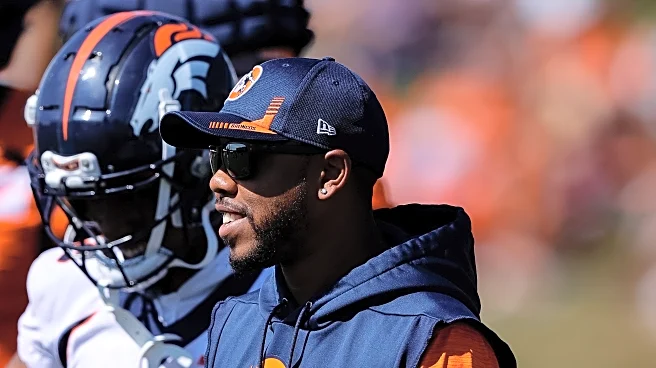
From Green Bay, Parker landed as the defensive backs coach in Denver under newly-hired head coach Vic Fangio. There, Parker quickly became a trusted voice for Fangio, and he started to generate buzz as a coaching star. Fangio openly praised his football acumen and communication skills. He left such an impression that Parker was retained by each of the Broncos’ next two head coaches.
When Fangio was hired to run the Eagles defense two years ago, he reunited with Parker, hiring him as his defensive backs coach and pass game coordinator. There, Parker has been instrumental in coordinating one of the league’s best defenses over the last two years, during which time Philadelphia is ninth in EPA/play.
Parker has also flexed his player development skills. In Green Bay, Jaire Alexander blossomed into one of the more respected cornerbacks. In Denver, Patrick Surtain II and JaQuan McMillan both became impact players. And last year, Parker was handed two rookie corners in Quinyon Mitchell and Cooper DeJean and had them ready to start most of the year in a season that saw the Eagles win the Super Bowl.
Scheme
In case you haven’t picked up on all the hints by now, Parker is a disciple of the Vic Fangio School of Defense.
This style of defense is built on the same philosophy as Eberflus, but with a completely different MO. Fangio (and his disciples) aims to keep everything in front of the defense and make the offense earn it with dinks and dunks. But while Eberflus preferred a straightforward pre-snap picture, Fangio has mastered the art of confusion.
His defenses often look the same pre-snap – four down linemen, very light boxes, and two-high safety shells – but what they do after the ball is snapped can change radically from play to play. He’ll employ a lot of zone coverage, but Fangio does use pattern match techniques, which allows defensive backs to switch to man coverage based on the routes being run.
He’ll frequently rotate his secondary, too, which requires a high level of understanding from his defensive backs. That’s one reason why Fangio was so eager to get Parker (and his communication skills) into Philadelphia: it takes a great teacher to instill these coverage principles into the roster.
Fangio isn’t much of a blitzer, though some of his disciples have departed from him on that tendency. Fangio does blitz, but he’s selective with it, and usually uses replacement techniques like creepers to achieve a free rusher while still only sending four after the quarterback. Most of the time, though, Fangio isn’t blitzing but instead using simulated pressures to win with just four men.
Roster Fit
As mentioned above, Fangio (and, by extension, Parker) prefer to only send four pass rushers but they do make frequent use of five man fronts. The Eagles made extensive use of this method due to their deep defensive tackle room, and Parker will inherit something similar. The trio of Quinnen Williams, Osa Odighizuwa, and Kenny Clark will offer plenty of ways to crowd the defensive line and confuse quarterbacks without needing to overwhelm the offense with blitzers.
This type of scheme also generally uses just two linebackers, and sometimes just one, in their effort to present light boxes to the offense. The Cowboys already have DeMarvion Overshown, who has flashed in both coverage and run support over the years, and they will have to decide who is in rotation with him next season at linebacker.
The secondary is where Parker will have his work cut out for him.
This scheme places a lot of pressure, mentally, on the secondary. That goes double for the safety group. Both safeties have to have the ability to play single high, deep halves, or come up in the box and be physical, either in run support or man coverage. Realistically, the Cowboys don’t have even one of those on their roster right now.
At cornerback, Parker has generally succeeded with the stronger types who thrive in jamming wide receivers off the line of scrimmage, but also pair it with clean eyes reading the quarterback. In that regard, Shavon Revel feels like a natural fit, but not much else on this roster – except for maybe DaRon Bland, who may not even be ready to play by Week 1 – feels like a fit right now.
That’s where Parker’s track record of developing young players comes in handy. Dallas has two first-round picks, and it would be a shock if at least one of them isn’t spent on the secondary. Parker will need to get his players up to speed in a hurry for the Cowboys to have a chance defensively in 2026.
Potential Staff
Parker is young but has already built an extensive network of coaching connections. His stints in college bring strong ties to current Texas A&M head coach Mike Elko. One such name to know from that world is Tyler Santucci, who was a graduate assistant alongside Parker at both Notre Dame and Texas A&M. Santucci was Elko’s defensive coordinator at Duke and spent this past season coaching linebackers for the Ravens.
Two other names that could get in the mix to coach linebackers in some role are Mike Smith and Kirk Olivadotti. Smith is currently the Patriots outside linebackers coach, but worked as a pass rush specialist with Green Bay while Parker was there; he also worked in the same capacity in Minnesota alongside Daronte Jones. Olivadotti was also on that Packers staff and spent the past two years coaching inside linebackers for the Seahawks. Neither coach would be available until their team is done in the postseason, of course.
If Parker opts not to retain Aaron Whitecotton on the defensive line, there are three names to know: Marcus Dixon, Clint Hurtt, and Jay Rodgers. Dixon is the Vikings defensive line coach right now, but worked alongside Parker in Denver and also under fellow Fangio disciple Brandon Staley with the Rams. Hurtt is the Eagles defensive line coach, giving him a direct tie to Parker, but he was also in Seattle while Brian Schottenheimer was there and has worked under Fangio across multiple stops.
Rodgers, on the other hand, is a stout Fangio coach. Currently the EDGEs coach in New Orleans under Staley, Rodgers has worked in the Fangio system for 10 of the last 11 years, alternating between coaching the defensive line and outside linebackers.
The secondary also brings myriad options, but the biggest name to know is Sean Desai. A longtime Fangio disciple, Desai was long thought of as the next Fangio, even succeeding him as the Bears defensive coordinator before the coaching staff was overhauled a year later. He also ran the defense in Philadelphia, replacing Jonathan Gannon, but was controversially demoted in favor of Matt Patricia halfway through the year.
Other names to know in the secondary are Jerry Gray, Tommy Donatell, and Jason Simmons. Gray and Simmons have worked with Parker in Green Bay, while Donatell is the son of Fangio’s longtime right hand man, Ed Donatell. Current Eagles assistant defensive backs coaches Roy Anderson and Joe Kasper also merit consideration given their connection with Parker.