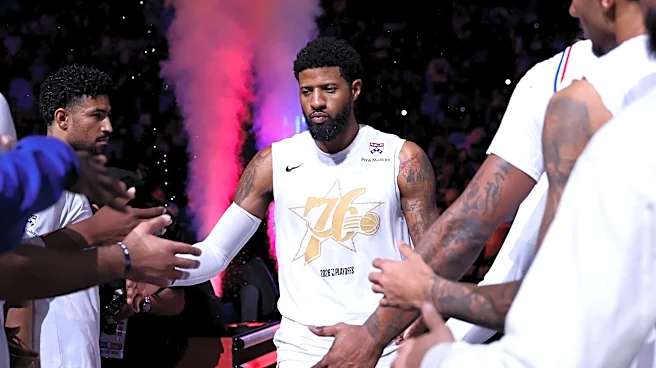








We saw quite the rise in impact from Paul George through 2025-26. The season started in typical Sixers fashion, with their star wing sidelined due to injury for the first 12 games. His play from mid November to the end of January was solid, yet he only averaged 16.0 points per game in this 27-game span. Even with the arrival of VJ Edgecombe to give the team’s offense a major uplift, that’s simply not the kind of production the Sixers expect or pay for from George.
Then came the startling, embarrassing
moment: George being suspended 25 games for violating the terms of the NBA’s anti-drug policy. It left him just 10 games of availability at the end of the regular season to get back into form and ramp up for the playoffs.
Yet sure enough, he did. He used the time to get right physically and came back with a clear extra spring in his step. From his first game post suspension putting up 28 points on 11-of-22 shooting with six made threes (a scoring tally he’d reached just twice in the previous 27 games), George suddenly hit a higher level than probably anyone saw coming. And he maintained it, putting together the kind of play that showed why the Sixers wanted him — and wanted to pay him star money.
George got started with 10 games to close the regular season after his return. In this stretch, he averaged 21.0 points on 47.2 percent shooting (including 41.5 from three, with his 8.2 attempts being the more notable number), 5.7 rebounds, 3.2 assists and a highly disruptive 2.2 steals per game.
The epitome of George’s performance — and what makes him more important if he can replicate it enough moving forward — was his first-round series against the Celtics. He was phenomenal at both ends of the floor, showcasing his varied offensive skillset and stellar defense against a tough Celtics squad. Like the Sixers as a whole, the steam ran out in the second round against the eventual champion Knicks. But the Celtics series was a perfect example of what George is still capable of.
Through the first round, George averaged 17.4 points on 48.9/55.0/77.8 shooting splits, 4.0 rebounds, 3.0 assists and 1.4 steals per game.
The scoring output didn’t need to be huge with Tyrese Maxey going off and Joel Embiid dominating after his return. George was efficient in the ways he needs to be as a secondary creator and dangerous shooter, all while pairing that with sound playmaking. He reliably made crisp extra passes to keep the offense humming, and composed passes to find cutters or kick out to shooters when initiating or running pick-and-rolls.
His shooting showcase was exactly what you want to see too, with his three-point volume up at 5.7 attempts per game for the series including two games with nine attempts. Quick-trigger threes from anywhere around the arc off movement, step-backs and side-steps when in isolation, smooth pull-ups when operating in pick-and-rolls. His driving downhill still leaves something to be desired, and needs to be an area of improvement next season if he can build on this play/improved health, but everything else was on display.
George had it all going in a reminder of what he can do.
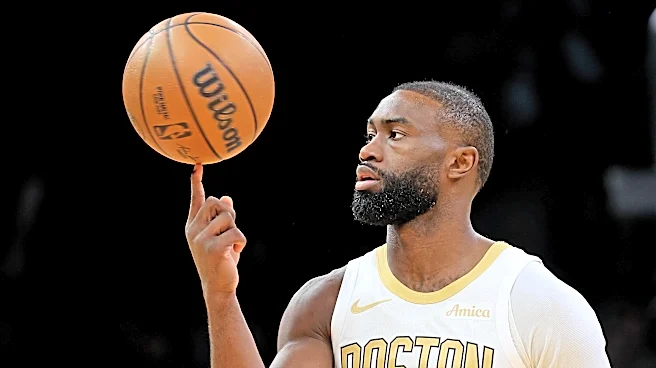
Defensively, George was everywhere. He played both Jaylen Brown and Jayson Tatum well, using his length, physicality, sharp anticipation against drives, and improved mobility to give them trouble. From guarding effectively on the ball and breaking up passing lanes, to contesting threes or providing timely help rotations around the paint, George was brilliant in all areas defensively.
If this PG can remain healthy and consistent next season, and maybe add a bit more dynamism attacking downhill, great. A healthy offseason could help him continue this momentum. The Sixers would be a better team — and more enjoyable team — for it. But for now, there isn’t enough evidence to show that George can sustain this healthy version of himself longterm at this stage of his career. We can only wait and see if George can show up at this level more often.
Apart from that, the biggest question around George’s future is whether it takes him to a new team. With the Sixers having so much money tied up in their stars, their only real way to find some financial flexibility and add depth is by trading a contract like George’s, which owes him an eye-watering $54.12 million in 2026-27. Finding any team willing to take that much money, when he also has a $56.58 million player option for 2027-28 which he’ll certainly take at that late stage of his career, won’t be easy whatsoever.
Until we see any reports that indicate that’s actually a possibility, though, I’ll keep focused on George as a Sixer and what that could look like. Hopefully for Philly, that’s something like the version we saw in his comeback after suspension. If he can be that kind of player (emphasis on “if”), that makes the Sixers more interesting.
Pair that with continued growth from Tyrese Maxey and the flourishing Edgecombe, who’s sure to take another step to stardom in his sophomore year, and ideally any extra depth they can find in free agency, and maybe the Sixers can take a step forward from being a 45-win level team.
Health depending, of course. Because, you know… Sixers.