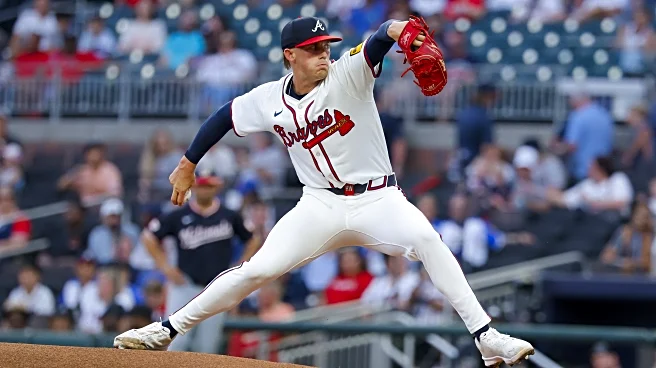

Today we get to look at arguably the second most surprisingly positive player performance of the Braves’ roster in 2025 (behind Drake Baldwin), with the breakout of Hurston Waldrep in the major leagues
during the last two months of the season.
How acquired
The Braves drafted Hurston Waldrep out of the University of Florida in the 2023 MLB Draft, in what was considered a great value pick late in the first round (24th overall). Waldrep got a bonus of just under $3 million, pitched at four different levels post-draft, and then split time in 2024 between Double-A and Triple-A, where he had an easy time in the former and much more of a mixed bag in the latter. That year also featured a disastrous two-start stint in the majors. In 2025, Waldrep made 19 starts in Triple-A before his promotion to the majors.
What were the expectations?
The expectations for Waldrep had fallen substantially since he was drafted and had a strong start to his minor league career. He got absolutely lit up in a brief MLB cameo in 2024 and looked to have persistent issues with his fastball shape, command, and really any pitch that wasn’t his splitter. Having one truly major league quality pitch with poor command is a rough spot to be in.
Things looked pretty dire for the former first round pick, with the expectations that perhaps he could tweak a few things and become a more interesting prospect, but with an appropriate dose of heavy skepticism. Even his pre-promotion 2025 results weren’t very inspiring, as he had a very meh pitching line for Triple-A Gwinnett.
Projections had him in the generic fourth/fifth starter tier, because projection systems tend to do that to most pitching prospects with some degree of minor league success and pedigree. The league isn’t all that awash in fourth/fifth starters, though, so you get the idea.
2025 results
It was a bit incidental that Waldrep even appeared in the majors this season.
His 2025 debut came in a de facto spot start that wasn’t technically a start, as he was called in for emergency duty after the Speedway Classic was rained out on its scheduled day. He put in a solid 5 2/3-inning performance that wasn’t spectacular (4/2 K/BB ratio) but also was an improvement on his 2024 results and enough to earn him another start in what was a lost season at that point.
He then reeled off a string of three straight amazing starts against the Marlins, Guardians, and White Sox — a combined 20/4 K/BB ratio in 19 innings, while having just a single run charged to him. There was then a weird blip against the Marlins where he somehow danced through the raindrops across 5 1/3 innings with an 0/1 K/BB ratio, but then he bounced back with another strong start against the Phillies. To this point, he had made six MLB appearances for the Braves, and Atlanta came away the victor in all of them, with Waldrep posting a combined 24 ERA-, 66 FIP-, and 86 xFIP- in the process. It was an exciting few weeks given what looked like a mini-breakout.
That idea then crashed to the ground as the Mariners and Astros crushed him in back-to-back outings. He followed that up with two starts against the Nationals to end the season — he was hilariously dominant in one, striking out eight and walking none across five innings, and was good-not-great in the other, with a 5/4 K/BB ratio across six frames.
All in all, Waldrep finished with a 68/79/89 line, good for 1.2 fWAR in 56 1/3 innings of work. That’s a gaudy fWAR per 200 innings of over 4, driven by a relatively low HR/FB rate of 7.1 percent, but even his xFIP was quite good when it comes down to it. The main concern was that he faced few good offenses on the season, struggled against some, and had command- and control-related issues even when facing teams he had previously dominated, like the Marlins. It’s a work in progress.
What went right?
It’s unclear whether Waldrep is now on the path to unquestionable starting prowess or not, but his quarter-of-a-season at the MLB level probably did at least a bit to quiet those who thought he was largely toast as a prospect or starting option after his 2024 season.
After battling in 2024 with a fastball-splitter-slider mix, he chucked the four-seamer and became essentially a junkball artist in 2025, going splitter-first and mixing in a cutter, sinker, curve, and slider when needed. The sinker and curve have bad pitch shapes, and the cutter didn’t really work to surprise hitters as a primary offering. Still, all those other pitches did was just increase the headache for batters as they tried to fend off his splitter, which had a whiff rate north of 45 percent (!!!) and a .224 xwOBA-against (!!!). His curveball was similarly devastating (whiff rate of nearly 40 percent, .184 xwOBA-against) despite mediocre spin and shape, likely because of how it plays off his splitter as another “slow” option with different break.
Breaking out as a real starting option at the major league level is tremendous progress for the former first round pick that many doubted after 2024. He made this progress though a general overhaul of himself as a pitcher. He essentially abandoned his four-seamer and dramatically pulled back from his prior slider usage. He substituted in quantity of pitches, even though all but one are nothing to write home about in terms of quality. He replaced his four-seamer with a mediocre cutter and sinker. He also introduced a curveball that actually has impressive vertical break and a fantastic 38.7% whiff rate, even with a fairly tame spin rate, likely benefitting from playing off of Waldrep’s splitter.
The splitter, though, was the key. It’s not really even clear if it was always the same pitch — sometimes it worked like a more “normal” splitter, and sometimes it was more like a dying quail tumbling towards the plate without a splitter’s usual arm-side fade.
Waldrep’s control also got better, if not good. His walk rate in the majors was a hair under 10 percent; his walk rate has almost always been higher, save for his good stint at Double-A to open 2024. He actually hit the zone pretty regularly, which is important because hitters didn’t chase much against him. They were fairly passive in general, probably because his arsenal was a little maddening — and he was able to take advantage by getting not-so-great pitches like his cutter and slider to fall in for strikes, and then putting batters away with a splitter that tumbled below the knees.
It may be hard to pick a favorite Waldrep outing among his ten tries because he had quite a few good ones, but one worth highlighting is his start against the White Sox, where he had a 7/1 K/BB ratio in seven innings, and didn’t have a single runner advance past first base. The Braves ended up winning that game 1-0 on a fielding error, so that was probably the best “really good start when the Braves needed him to be really good, to the extent the Braves could’ve needed anything other than the season to end by the time Waldrep was called up” performance of the season.
What went wrong?
Waldrep is great at making guys look awful (see the video above), but let’s be honest: the command is not-so-good. It doesn’t necessarily need to be good, given his wacky splitter and the fact that he’s apparently going to junkball his way to success, but boy, it was bad. While his pitch locations were not always terrible, his splitter, sinker, and curve mostly just drifted wherever; to the extent he was able to exercise more consistency with his cutter and slider, it involved dropping those pitches in hittable places in the zone in a way where they either stole a strike or got mangled (.389 xwOBA-against on the slider, .415 on the cutter).
This creates a real problem for him if hitters ever decide to wait out his splitter, or if he simply can’t locate his splitter to get even a semblance of a chase. There’s a bunch of opportunity for improvement — better control, better command, some refinement to his non-splitter/curve pitches, and so on.
One glaring instance was his start against the Astros, in which he gave up 8 runs. In a more general sense, there are plenty of ways for Waldrep to improve. While his walk rate markedly improved, he could certainly benefit from a further reduction, as he still walked more than the average major league pitcher in 2025. Furthermore, he struck out fewer than a batter per inning and while his strikeout rate was solid, one would think there is substantial meat on the bone for more strikeouts with how effective his splitter and curveball can be.
His start against the Astros was probably the low point of his season. While he was nominally worse against the Mariners, the Astros game was more tortured, as it included stuff like giving up a homer to Zach Cole on the first pitch of the latter’s major league career (down the middle cutter), and the Astros going to town on him early in the count until he basically started avoiding the zone and then got beat up on walks. As noted, he bounced back beautifully against the Nationals, but figuring out a way to rein in the get-me-overs and get strikes even when guys are being aggressive early is going to be a work in progress for him. He should definitely never do this again:
2026 outlook
Waldrep has more or less jumped to 2026 rotation candidate at this point, and why not? He’ll probably make a decent number of turns in the rotation, even if he’s bumped from the Opening Day roster, because pitcher health is a nightmare these days. He should also have a chance to make an affirmative case for his roster spot in Spring Training, given the questionable health status of a lot of the rest of the rotation.
Overall, Waldrep completed an incredible overhaul of himself as a pitcher, tangibly improving his command and throwing three new pitches. That reflects very well on his work ethic and commitment to improvement and I’m excited to see what he can do with another offseason of work.
Steamer projects him as a tick below average as a starter in terms of run prevention, but also sees him as a fairly inefficient, five-innings-a-start-ish guy, which makes sense give his walk rate. ZiPS thinks he’ll be a bit better on the pitching side. That puts him somewhere in the mid-to-backend-of-rotation range, which makes sense, given that he’s probably not going to replicate a high 80s xFIP- for the whole season. Though, if he does, it’ll be another exciting development, both in his career and for the Braves.