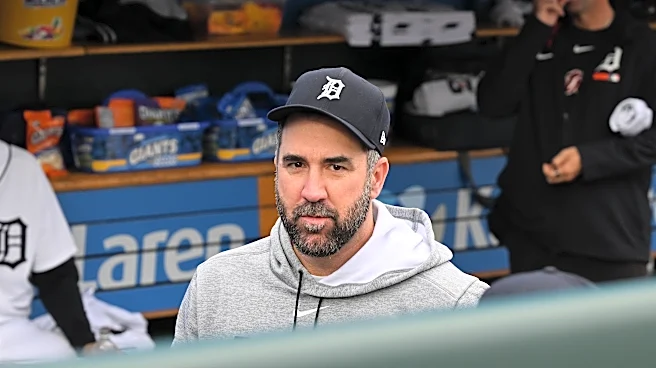




Detroit Tigers’ starter Justin Verlander is eligible to be activated from the 15-day injured list on April 16, but Verlander and the Tigers will take their time before talking about a date for a return. The long-time ace and future Hall of Famer was moved to the injured list on April 4 with left hip inflammation. However, the move was retroactive to April 1, meaning he could theoretically return on Thursday at Comerica Park against the Royals. Manager A.J. Hinch told reporters before the Tigers victory
over the Marlins on Saturday that a quick return isn’t in the cards.
Speaking to reporters after a Verlander bullpen session that reportedly went very well, Hinch said that it was still too soon to think about a timeline to activation. He also said that Verlander will at least need one rehab start or simulated game to stretch out fully before the Tigers consider taking him off the injured list. It’s possible that he could start a game for the Toledo Mud Hens sometime late this week or into next weekend, and then be on track to return during the Tigers’ home series against the Milwaukee Brewers from April 21-23.
Expect the timetable to be pushed back even a little further. If Verlander is going to rehab with the Mud Hens this week, he’d have to do so on the road in Louisville against the Bats. I suspect that the Tigers would consider that a sub-optimal spot for such an outing. Obviously a 43-year-old legend in the sport isn’t going to be taking the bus down to Louisville with Max Clark and the boys, but even on his own travel arrangements, the setting isn’t ideal.
The Tigers will want their own people with him to ensure everything in Verlander’s workouts and preparation go smoothly on start day. I’m not familiar enough with the Louisville Bats to evaluate their facilities, but the Cincinnati Reds affiliate is presumably somewhat less equipped than the Hens facilities after the Tigers and their affiliates put a lot of time and money into modernizing them over the past half decade. Much simpler to let Verlander stay in Detroit and simply drive down to Toledo on start day, prepare, pitch, and return immediately to Detroit for the usual post-start treatment and recovery protocols.
The Hens will return to Toledo on April 21 against the Omaha Storm Chasers, and that six-game set is probably more when we should expect a Verlander outing if they decide it’s worth giving him a Triple-A rehab start rather than just throwing bullpens and getting in a simulated game. Such an outing would no doubt be very well attended, and the Tigers would prefer their affiliates get a nice day at the box office rather than the Louisville Bats.
Of course, the crucial part of these considerations is the fact that Keider Montero has pitched well in two starts in Verlander’s stead. The 25-year-old right-hander has so far banished some of the control issues that plagued him in his first two seasons in the major leagues. After pitching for Team Venezuela in the WBC this spring, Montero never really got stretched out in the final weeks of spring training, and the Tigers kept his first outing for the Hens, as well as his two starts with the Tigers, on a short leash. Still, he’s thrown the ball well and shown maturity as in a pitcher in terms of course correcting when things start to go wrong in an outing.
Montero has allowed just two earned runs in 10 1/3 innings of work so far, and while it’s a very small sample, his walks are way down and his strikeouts are up. He’s looked very much in command of his game, and no doubt his performance has the Tigers wanting to see more before they’re faced with the tricky decision of how to proceed once Verlander is 100 percent. Montero’s success means there’s no rush to decide anything, but on the other hand, if he continues to pitch like this you can’t really send him down either, so the decisions do get tricker.
As I’ve said before, the reason for signing Verlander in the first place wasn’t nostalgia or overconfidence in his strong second half for the San Francisco Giants last year. Adding Verlander only cost the Tigers $2 million this season, allowing them to add starting depth without going over the luxury tax by deferring most of Verlander’s $13 million total. The penalties for going over and potentially losing revenue sharing funds would also hurt their draft pick compensation in 2027. This was just an opportunity to add depth into a pitching staff that doesn’t have much in the way of optionable members, knowing full wel that Verlander isn’t going to make 25-30 starts for them this season.
Adding Verlander gives them an additional usable starter without going over the threshold, but it also allows them a fair amount of flexibility. Plenty of teams make stashing an injury prone, but still effective veteran starter a regular feature of their offseason roster builds. A 43-year-old pitcher, no matter that he’s a freak and the greatest arm talent of the last quarter century in this case, is still 43 years old. Injuries aside, just to continue pitching at the game’s highest level takes a lot of work with the Tigers’ strength and conditioning staff, as well as with their physical therapists. It’s presumably rare that there’s literally nothing wrong physically, and that provides opportunities for the Tigers to give him stints on the injured list as needed, making sure that Verlander is only taking the mound when he really feels his best, while enabling them to use Montero or any other young starter who is pitching well.
In essence, you’re stashing an extra starting pitcher on the roster, knowing full well that you’ll never get 30 starts from them, and will instead have some flexibility in how that veteran starter and his replacement, Montero in this case, are deployed. That’s pretty useful depth, espcially early in the season when pitcher arm injuries are rampant. Later on in the season, the Tigers may have help coming in the form of Troy Melton or other young pitchers currently on the injured list. Right now, they need to succeed with what they’ve got. Of course, you can’t just hold a guy on the injured list forever with nothing wrong with them, and this is a lot simpler when the veteran starter isn’t a franchise legend. There may well come a point where some really difficult decisions have to be made. For now though, an issue is pretty easily massaged by stretching out Verlander’s rehab work.
So for now, stretching out Verlander’s timetable makes all the sense. If they have him throw bullpens this week, and then schedule a rehab start with the Hens somewhere in the 21-23rd of April, it allows Verlander to make such a start while still under the eye of the Tigers training staff, and pushes the decision on what to do when he returns off toward the end of the month.
Montero could then make another three starts while Verlander rehabs before the Tigers have to decide what to do with them both, and maybe two Verlander rehab starts are required, particularly if Montero is still pitching well. A lot can happen in a few weeks time during a baseball season that might make the longer term decisions simpler.