

The Green Bay Packers seem to be in a state of continual flux on the offensive line lately. Last season, the team appeared to be moving in the direction of a bigger, power-focused line, but the summer of 2026 suggests that the rubber band is snapping back a bit in favor of a more athletic group that is more typical of the lines the Packers have fielded in recent decades.
Dating back to Ted Thompson’s tenure as the team’s general manager, the Packers have generally prioritized agility and movement
skills in their linemen over pure bulk, size, and brute strength. Combined with running backs whose abilities were also more centered around agility and a more pass-focused attack, this made for a good approach.
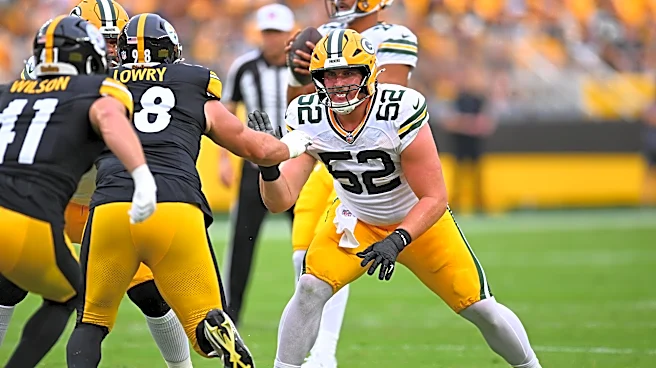
However, the signs were all there that the team was looking to change that approach in 2025. The first indicator was the signing of guard Aaron Banks as a free agent. The second was drafting Anthony Belton in the second round of the 2025 NFL Draft. Both players have body types that didn’t fit the typical mold of a Packers lineman; that mold had typically maxed out around 315 pounds and, again, focused on players who can move well in space. In contrast, Banks is 6-foot-5 and 325 pounds, while Belton goes 6-foot-6 and is listed at 336. While Banks started every game, Belton eventually moved into the starting lineup at right guard for the latter portion of the season.
With Sean Rhyan (6-5, 321) moving from right guard to center after Elgton Jenkins’ injury, that was a heck of a lot of beef in the middle of the line. However, in training camp, both Banks and Belton have been in and out of the lineup at guard, with rookie Jager Burton (6-4, 312) and Jacob Monk (6-3, 308) getting much of the work at left and right guard, respectively, in the last week and a half or so. Banks has yet to take a snap in team drills, while Belton has been playing right tackle almost exclusively amid Zach Bako-Bewele’s gradual return from his own injury.
The line that the Packers have been trotting out lately (with Bako-Bewele at tackle) would represent a substantial size difference compared to the unit that finished out last season. To that end, here’s a look at the average height/weight of the starting line in week one last year, the line that finished out the season in 2025, and the potential 2026 line (all numbers from Combine measurements):
If the Packers end up rolling with the youngsters on the interior, they would be down by 10 pounds and more than an inch in height on average compared to the starting line at the end of last season. Unsurprisingly, Burton and Monk tested out much better than Banks and Belton did, with exceptional speed and athleticism RAS scores for their positions compared to just moderate ones for last year’s starters.
This all comes back to the question in the headline of this piece: what do the Packers actually want their run game to be this season?
That decision might actually hinge on the status of starting running back Josh Jacobs. Fundamentally, Jacobs is a power runner who is not particularly suited to outside zone. Building a bigger, people-moving line in front of a back like Jacobs makes sense, but if the Packers aren’t likely to have him around for much longer (which they’re not, one way or another), it stands to reason that they would start to transition away from that approach. A back like MarShawn Lloyd, who is more athletic and has better acceleration than Jacobs, could be better suited for an outside zone-heavy running game, which would clearly be a fit for the more athletic players like Burton and Monk.
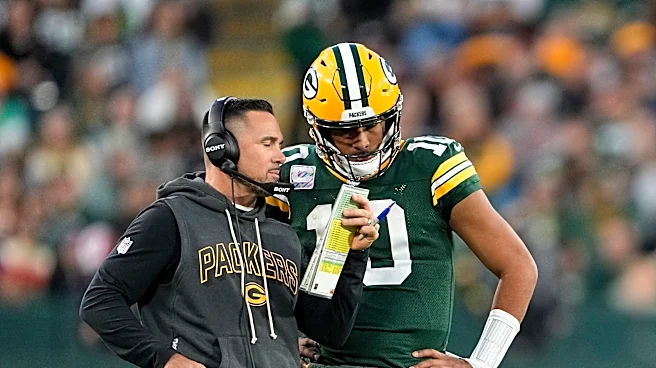
Belton has seemingly fallen out of favor with the coaches at guard. Matt LaFleur’s recent comments about Burton — saying that the rookie is making the coaching staff’s decisions “extremely difficult” — indicate that he’s very much in play for a starting spot. And Banks’ injury further complicates matters, preventing the team from getting a look at the interior group that finished out last season.
Are the Packers preparing for life post-Jacobs by moving back towards a more movement-based run game? Or is this simply a function of injuries forcing the coaching staff’s hand? Time will tell, but don’t be too surprised if the concepts the team uses in the run game and the distribution of carries between Jacobs and Lloyd both end up tracking closely with the lineup on the interior of the offensive line.