






There isn’t a more American holiday than Thanksgiving.
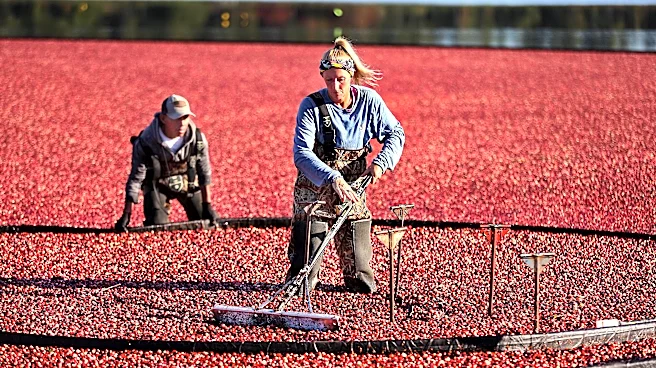
And regardless of where you’re celebrating or with whom, if you have cranberries in whatever form on the table, the likelihood is that Rutgers may have had a hand in getting them to you.
The top three cranberry producing states in the nation are – in order – Wisconsin, Massachusetts, and New Jersey. And if you want to boost the Big Ten, you can add Oregon at number four.
“The cranberry fever was when people realized the gold rush was over. You could
turn swampland into gold by growing cranberries,” said Peter Oudemans, a plant pathologist at Rutgers University–New Brunswick and director of the Philip E. Marucci Center for Blueberry and Cranberry Research and Extension. “So, cranberries really took off in the mid-1800s in the Pine Barrens.”
Thanks—in large part—to Rutgers.
Obligatory history lesson from Bob
So, you know Cook College at Rutgers? It was named for George Cook, a science professor who lobbied for Rutgers’ federal land-grant designation in 1864 and launched the New Jersey Agricultural Experiment Station (NJAES) in 1880. Through Cook’s and Rutgers’ efforts, local cranberry farmers transformed native wetlands into productive cranberry farms.
Historic sidebar to obligatory history lesson: Land Grant designation is a pretty big deal in the Big Ten; The Land Grant Trophy is awarded to the winner of the Michigan Stare-Penn State game. Ten of the conference’s schools are their state’s land grant college….including Rutgers. The list:
- Michigan State University
- Ohio State University
- Penn State University
- Purdue University
- Rutgers University
- University of Illinois Urbana-Champaign
- University of Maryland, College Park
- University of Minnesota
- University of Nebraska–Lincoln
- University of Wisconsin–Madison
By the way, and yes, another historical sidebar: Rutgers is the only school in the nation to be a colonial college, a land grant college, and the state university. You’re welcome.
Back to cranberries: collaborating with local farmers, Rutgers NJAES opened the Cranberry Research Station in 1918. Across more than a century, the field station has been true to its mission: using science to solve problems that matter to cranberry (and later blueberry) growers. So, if you don’t like cranberries, New Jersey ranks seventh in blueberry production, producing 48.5 million pounds in 2025. That’s a lot of pies.
But, Bob, this is a sports site!
I know, but that hasn’t stopped me before. However, in this case I have the connection.
Since the ag station’s early days, U.S. Department of Agriculture scientists have worked side-by-side with Rutgers experts, a collaboration that later expanded to include researchers from the Ocean Spray Cooperative, the world’s largest seller of cranberries.
False blossom is a disease that produces sterile flowers and severe crop loss, and it threatened to destroy New Jersey’s cranberry boom. Who comes to the rescue? Well, it wasn’t Sir Henry, but Rutgers and USDA researchers teamed up in south Jersey to combat the disease. For nearly two decades, researchers struggled to halt the outbreak before Rutgers alumnus and entomologist Philip E. Marucci returned to his alma mater. The same aforementioned Marucci for whom the research center is named. He became the center’s third director, and the center was renamed in his honor in 1999.
Ummm, sports, Bob? You said there was a connection?
Right! Marucci graduated from Rutgers in 1936, and while an undergraduate, he wrestled and played lightweight football. After graduating, he served in the U.S. Army during World War II, conducting malaria research in Panama and the Caribbean. Marucci brought the lessons he learned there on using DDT to control disease-carrying insects back to the cranberry station to battle false blossom. So, a Rutgers wrestler and lightweight football player saved Thanksgiving!
Sorry, I can be a bit dramatic and hyperbolic.
Back in October, University President William F. Tate IV visited with New Jersey cranberry farmers and researchers from Rutgers, USDA and Ocean Spray at the Marucci Center. “I’m here to learn more about the commodities of New Jersey,” Tate said. “Please know that I will lean into agricultural extension as the university president. We must ensure the resources are available for the extension experience. It’s why we have land-grant universities. It’s one of the primary aims of the land grant. I believe it’s the foundation. Perhaps some individuals have forgotten. I’m not going to.”
Land grant colleges and Rutgers and New Jersey and the Big Ten….perfect together!
From all of us at On the Banks, we hope your Thanksgiving is a peaceful, fulfilling, and enjoyable day.
Want more on Rutgers research on cranberries? This post was based on a Rutgers news release by Lisa Intrabartola; check out this link for more details.