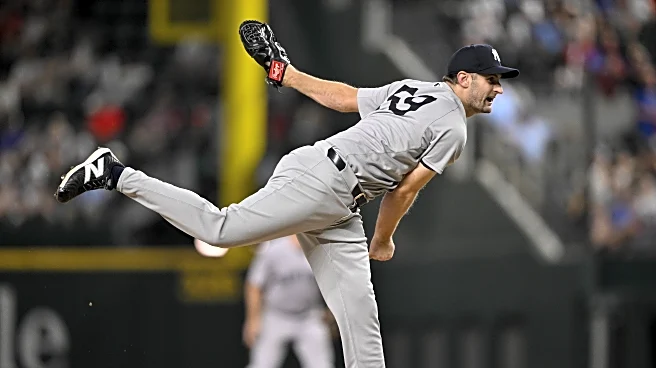




Last year, on July 31st, the New York Yankees traded prospects Roc Riggio and Ben Shields to the Colorado Rockies in exchange for right-handed reliever Jake Bird, who had a 3.49 FIP to that point, albeit with a 4.73 ERA, in 53.1 innings. Unfortunately, he imploded upon reaching the Bronx, and just three outings were enough to see him optioned to Scranton after surrendering seven runs (six earned) in just two innings of work.
His walk rate was a respectable 9.7 percent in the Rocky Mountains, but he just
couldn’t throw strikes and get himself in favorable counts in the Bronx. He paid the price with bases on balls and a couple of home runs, too, even if he did strike out four. Then in Scranton, Bird did a better job preventing the long ball, conceding just one in 15.2 frames, but control issues persisted as he put up a disappointing 16.7 percent walk rate. His 6.32 ERA in Triple-A didn’t paint a particularly encouraging picture about his prospects for 2026.
It appears, however, that the offseason has really come in handy for Bird, not just to perform a complete mental reset after a few rocky months upon landing in New York, but to actually attack his weaknesses. Speaking on the YES Network, Yankees pitching coach Matt Blake discussed some of the things Bird has been working on these last few months with his eye on winning a spot in the bullpen.
While David Bednar, Camilo Doval, Fernando Cruz, and others are exciting and talented, the Yanks’ bullpen just isn’t as powerful as it used to be, so having an in-form Bird would be a breath of fresh air.
“I think the biggest thing was trusting his stuff in the zone. (It) has really big shape: big sweeper, big breaking ball. The pitches are moving a lot. So, we got to get him in the zone at a higher rate and limit the walks,” Blake explained. With the Rockies, Bird’s Zone%, or the percentage of pitches throw in the zone, was 57. The number fell to 53 percent with the Yankees in MLB, and 50.5 percent in Triple-A.
It comes down to confidence and execution. In 2025 as a whole, Bird had success with his sweeper (33.8 percent whiff rate, .258 xwOBA) and curveball (38 percent, .158 xwOBA.) He had some bad luck with the former, which had a .338 wOBA in contrast to that solid xwOBA. But they are both good, usable pitches. Swing-and-miss pitches, even.
Luck aside, Bird can be a useful pitcher if he is throwing his breaking stuff for strikes. Since they have a lot of natural movement, trying to get creative with the corners and nibbling might be counterproductive and lead to a lot of balls. And balls lead to hitters’ counts. And, well, hitter counts lead to what we saw in pinstripes this year.
This is a glimpse of what the Yankees can have in Bird if he manages to find himself in favorable counts:
On the other hand, this is what could happen often if he can’t locate his breaking stuff and is forced to rely on his sinker to get back in the count:
Starting at-bats on the right foot is also crucial for Bird. In Colorado, he threw a first-pitch strike 60.6 percent of the time. That fell to 50 percent with the Yankees, and even though the sample size is tiny, the number was a horrible 44.4 percent in his short stint in Scranton, per Sports Info Solutions.
Blake talked about how Bird struggled to show his best version in his short Yankees stint, but warned that he has had a really good offseason. The pitching coach said the righty has also been working on some adjustments on his sinker to somewhat “limit some of the contact quality.”
Combining his stats with the Rockies and Yankees, it’s safe to say his sinker was inequivocally and unquestionably rocked last year, with a .420 wOBA and a .414 xwOBA. That’s definitely a problem when you throw the pitch a third of the time. Any improvements he can make regarding this particular offering, whether it comes in movement, velocity, or sequencing/usage, will immediately make his stat line look better.
While it’s safe to say that Bird’s 2025 with the Yankees was a disaster both in the majors and in Triple-A, there is a lot of room to improve and also a need for solid relievers who can miss bats. If he can show his Rockies version, the right-hander should have a chance to lock up a spot and slowly earn high-leverage work.