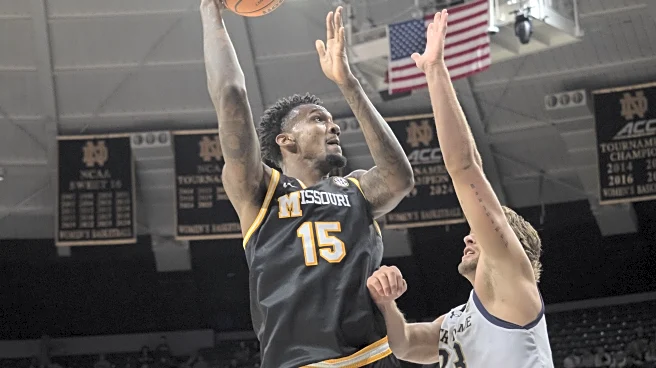




Back in April, Shawn Phillips’ pledge to Missouri filled a practical need for veteran depth at the post position.
Yet over the next 200 days, the notions of what the Arizona State transfer might offer grew increasingly ambitious. It wasn’t just slotting the senior in the starting five, either. Over the MU’s first three games, the Tigers made a concerted effort to funnel the ball through the post right after the opening tip.
At Howard, Jevon Porter hit Phillips on a delayed roll to the rim after the 7-footer
set a ball screen for Anthony Robinson II. Four days later, against Southeast Missouri State, MU dialed up a box set that set up a high-low play in which Mark Mitchell fed Phillips from the elbow. And when Minnesota came to town, a horns set tried to recreate the same scenario but was undercut by a misfired ball reversal.
And facing the nation’s No. 354 schedule certainly gave Phillips chances to feast against undersized frontlines that could offer scant resistance at the rim.
The story, though, has been quite different against stiffer competition. Phillips is averaging just 3.3 points and 2.3 rebounds in the Tigers’ three games against high-major opponents. And a deeper look at the metrics underlying his game suggests the experiment isn’t panning out.
What Phillips has run into isn’t just tougher competition — it’s a mismatch of fit. His presence shrinks the floor, slows the offense, and hasn’t delivered the developmental payoff MU expected. And so Missouri arrives at a crossroads it’s seen before: cling to the idea of a player they hoped to build around, or lean into the ones who make their offensive identity workable.
Coming out of the Border War, Phillips owns a minus-2.7 net rating, but more tellingly, the Tigers are 17.5 points per 100 possessions worse when he’s on the floor. The senior has also posted a 0.31 Bayesian Performance Rating, which estimates how much a player impacts team performance while adjusting for opponent strength.
In isolation, those data points might not mean much. So, let’s compare Phillips to other big men populating SEC rosters this season. Among 55 players, the median net rating is plus-26.2, per Synergy Sports data. Next, look at the median BPR. It’s 2.92. Put simply, the Arizona State transfer ranks among the bottom 10 for performance this season.
Those struggles hold up even when we zoom out and look at comparable players. Since the 2022–23 season, roughly 40 “rental” big men — one-year transfers — have suited up in the SEC. Right now, Phillips’ BPR would rank 34th in that group, nestled between Georgia’s Russel Tchewa and Auburn’s Ja’Heim Hudson.
And, to be fair, none of this should catch us entirely off guard.
During his time in Tempe, the former top-150 prospect occasionally flashed his potential, but foot injuries and inconsistency gave Danny Hurley pause in expanding his role. As a junior, Phillips’ most efficient work came as a roller or cutter. On the low block, he never quite rose above functional.
He arrived in Columbia with the frame and tools to be a legitimate anchor, but the defensive issues ($) he carried with him weren’t subtle. Last season, he landed in the 19th percentile in overall defensive efficiency, per Synergy Sports. Phillips could wall up and offer some deterrence, but anything that required him to guard in space — especially pick-and-roll actions — exposed the limitations.
A new system and fresh coaching voices created the possibility of a reset, but the early returns look familiar. Phillips is allowing 1.0 points per possession, per Synergy — almost identical to his output with the Sun Devils.
Those issues would be easier to tolerate if it were evident that Phillips boosts MU’s offense. As noted at the outset, MU’s made a concerted effort to play through him. Often, the tactics are blunt – quickly punching the ball inside with four-out spacing or having Phillips roll into a post-up from a ball screen.
Sometimes, Phillips inverts the floor before working his way to the paint. For example, he’ll set an away screen, receive the ball at the top of the key, set a high ball screen and slip to the block.
The Tigers also turn to Phillips to help crack zone defenses. A Tiger will flash to the nail for an entry pass while Phillips seals his man, setting up a high-low feed.
Part of MU’s rationale for importing Phillips was to give itself a source of straightforward offense around the rim – a commodity Josh Gray struggled to supply. Yet Phillips’ post-ups yield just 0.889 points, ranking in the 43rd percentile among Division-I players. Oh, it’s also identical to Gray’s performance. The difference? Phillips gets slightly more than three of those touches per game, almost six-fold more than Gray (0.6) a season ago.
Making Phillips a focal point has also demanded tradeoffs. The obvious example is rolling out a jumbo lineup that slides Mark Mitchell to the wing, uses Jevon Porter in the ‘boss’ role, and Phillips in the post. While that approach has bludgeoned some overmatched low-major opponents, it also gives defenses license to shrink the floor, clog up gaps, and make life harder for drivers like Sebastian Mack.
His presence also does more than reshape how Missouri organizes itself in the half-court. Off-ball details haven’t always been sharp. Screens rarely generate real contact. Rolls are slow or drift offline. And when a driver or post-up initiates, Phillips often shadows the action by floating toward the rim with his defender in tow. Some of this is simply habit, not intent, but the effect is the same: he tends to rotate around the lane as the ball moves, sliding into pockets of space that clog driving lanes and shrink the floor even further.
Early returns against Minnesota ($) and Notre Dame suggested the rationale for scaling up lineups was shaky. Then, it crumpled inside the Sprint Center ($) against Kansas. In a little more than nine minutes of action, the jumbo lineup posted a minus-17 scoring margin and allowed an 11-1 run that put MU in an 18-point hole early in the second half.
In three games against power-conference opponents, the jumbo group owns a minus-27 scoring margin in 25 minutes of action. That’s a problem. And by Tuesday night, Gates offered an implicit acknowledgment of the drawbacks during his weekly coach’s show.
“Jacob [Crews]’s, you know, a floor spacer. I have to make sure he’s getting on the court more with Mark Mitchell to cause some gravity to the sidelines, versus having guys in that paint. The other thing is being able to play Luke Northweather. Obviously, with Jayden Stone out, another three-point shooter that we are missing, and obviously Trent Pierce out, who has been able to stretch the floor a little bit. We’ve got to have guys on that court to be able to knock down open looks.”
That MU pursued the strategy at all might seem quizzical, but the explanation might be simple: It assumed Phillips had more developmental headroom – and the Tigers’ staff was just the group to pick the lock to access it. They’re not alone. The outlook drives the decisions of countless programs as they sift through the transfer portal each spring.
But in Phillips’ case, the optimism might have been slightly misplaced.
Sometimes you’ll hear talk about a player maximizing their skill curve, which is really just a way of asking how much potential remains to tap. Quantifying that is notoriously squishy, but BPR gives us a decent proxy.
So, here’s the approach. I pulled two groups: big men who ranked among the top 150 in On3’s transfer composite and the SEC’s rental bigs over the past four seasons. Then I averaged each group’s BPR by class year — freshman through senior — and plotted those trajectories alongside Phillips’.
The pattern is pretty clear. Most bigs make their largest gains as sophomores and juniors. By the time they’re seniors or grad transfers, the curve flattens. Now look at Phillips. His sophomore dip — his first season at ASU — might have hinted at untapped potential. But his BPR jumped by 2.63 as a junior, almost precisely in line with what we see from top transfers (3.04) and rentals (2.47) over that same span.
Put simply, Phillips’ great leap forward already happened.
We could also go one step further. Rental bigs typically see their BPR improve by 0.41 at their new home. If we apply that to Phillips, his BPR should settle at 0.42. In reality, it’s 0.31 – or basically what we’d expect. And even if he had an outlier-level jump, the resulting 1.95 BPR would again be eerily similar to what Gray (1.75) produced in black and gold.
Even then, Phillips’ BPR would still lag behind the median big man (2.92) in the SEC this season. Additionally, Porter (3.23) and Northweather (1.84) would still be comparable or better options. So, exploring lineups that deploy Crews, Mitchell and a stretch five is a logical pivot — if Gates follows through.
Merely looking at how members of the frontcourt have performed against high-majors backs it up. You can see a broad breakdown in the table below. But let’s zoom in on Northweather. When he’s on the floor with MU’s supposed figureheads, we see that Mitchell (+23), Robinson (+10), and Mack (+2) reap heady returns. But when he’s a spectator, the performance for Mitchell (-24), Robinson (-14) and Mack (-13) inverts.
What’s behind the stark shift? Northweather’s 10.7 percent usage rate is modest, but nearly 75 percent of his shots come from behind the arc. He pulls an extra defender out of the lane and opens up avenues for that trio to attack. His value is indirect but potentially critical.
Whether those adaptations work is unclear. The alternative, however, is to remain trapped by the sunk-cost fallacy of the NIL outlay for Phillips and to use up your bonanza of buy games to test the hypothesis.
It’s also jarring because, on balance, Gates and his staff have usually been sharp at identifying a primary driver and tilting the offense around that strength.
It was easy in his debut season: lean into delay and point sets to let Kobe Brown hunt mismatches. The following year, MU shifted its focus to empty-side ball screens and pistol actions, which gave Sean East room to probe for soft spots. And last season, the staff steadily layered in actions to amplify the gravity Caleb Grill created ($) as a floor spacer.
None of this means Phillips can’t help. But MU needs to halt its chase for the version of the big man it hoped would arrive. Instead, it can build around the strength that remains on this roster – spread the floor and use Mitchell, Mack and Robinson to apply unrelenting pressure on the rim.
Along the way, the Tigers might discover the identity that’s eluded them so far.