
Thanks to the nflFastR project, Pro Football Focus and NFL NextGen Stats for the timely sources of data.
For those of you new to this, I will publish key QB stats each week judging how well the Colts’ QB performed. Yes, O-Line, receivers, and play-calling impact these numbers but they are primarily QB measures. I will probably modify the charts throughout the season. Commentary will be brief but feel free to let me know in the comments that stats aren’t everything. (click charts for larger view)
Obviously,
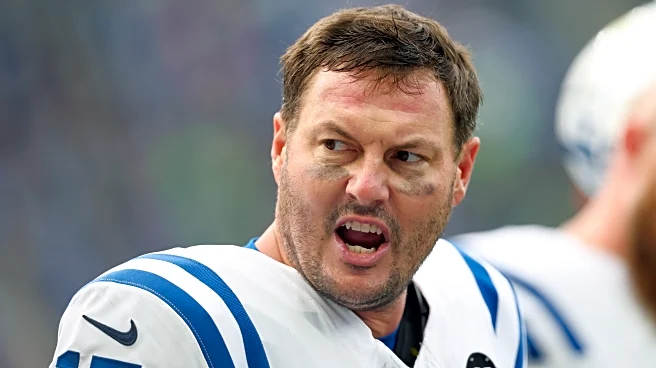
an out-of-shape 44-year-old with just four days to prepare for what is probably the 2nd toughest defense in the league provides context that shouldn’t be ignored. But ignore it, I will.
I measure QBs by how well they played and look for numbers that point to how well they may perform in the future. While I can certainly guess that Philip Rivers could improve with more time in the system, that is just that: a guess. I’m not interested in ifs and buts, so I will simply compare him to the 31 other QBs who played on Sunday.
HOW WELL?
Rivers produced a high volume of negative plays, leading to one of the worst success rates of the week and, in turn, a very poor EPA per play.

His biggest negative plays came on unconverted 3rd downs, and converting even a few of those would have gone a long way toward a win.
The next graphs show team-level comparisons, allowing you to see how he lined up against Daniel Jones. Rivers’ numbers are not good, but they also aren’t much worse than what the Colts saw in the previous few weeks.

HOW FAR?
He completed a high percentage of his passes, but that efficiency didn’t translate into first downs. With just 4.6 yards per attempt, sustaining drives was almost impossible.

Passing depth dropped off a cliff, as checkdowns and quick throws made up the bulk of the passing strategy. I guess I can’t call it a one-dimensional offense—maybe 1.5?

A game and a half without Jones and the offense suddenly became YAC-dependent, dropping five spots on the next graph.

TO WHO?
Warren had the most targets, which I expected, but Abdullah had the most yards, which I did not.

Pierce has snuck by both Warren and Pittman as yards leader.

Downs and Warren jump out at me on this chart. Both should have been higher value, and Downs should have had more depth on his targets.

Season numbers still look good, for what it’s worth.

HOW ACCURATE?
Although completion rate was high, accuracy was a problem—but not more so than in the previous three weeks.

HOW FAST?
Rivers is known for getting rid of the ball quickly and avoiding sacks, so it should be no surprise that he got rid of the ball quickly and avoided sacks.

TO WHERE?
This tells me his arm has a straight-line effective range of about 20 yards, which means you shouldn’t expect many successful passes beyond 10 air yards on the sidelines.

Again, on the season, all looks OK.

DASHBOARD
mouseover definitions: median EPA gain in similar game situation (down, distance, etc.)”>arsr, 3 yards to gain in game-neutral situations”>edp, sg%, oz%, pr%, tip, ttt, adot, ay/c, yac, yacoe, yd/c, ac%, cpoe, aypa, drp, scr%, ta%, sck%, aa%, ny/d, ny/p, 1st%, td%, to%, 0″>qbsr epa/p, adj/p
Here’s what happened in week 15:
- The run game struggled, which is unfortunate given that the Colts tied as the most run-first team of the week (29th ARSR, 30th EDP).
- Rivers faced very little pressure, primarily due to his ridiculously quick release time (32nd PR%, 30th TTT).
- Along with the quick throws came short targets and, unsurprisingly, shallow completion depth (29th ADOT, 31st AY/C).
- To compensate for short completion depth, you need a high completion rate and/or high YAC, and the Colts were just average in both, which led to poor yardage efficiency (18th AC%, 19th YAC, 31st AYPA).
- As expected, Rivers didn’t scramble, didn’t take sacks, and threw the ball away when he ran out of time (29th SCR%, 22nd SCK%, 8th TA%). That gave him one of the lowest abandon rates in the league—which, contrary to what some current NFL fans think, is a good thing (27th AA%). It didn’t really help overall yardage efficiency, though (30th NY/P).
- The low yards per play made it difficult to convert first downs and score touchdowns (25th 1st%, 21st TD%).
- The final-play interception was a desperation toss, so even though he technically finished with a high turnover rate, it had very little negative impact (9th TO%).
All of that combines to be the 30th ranked success rate and 28th ranked EPA efficiency. Not good. Not unexpected.
This is Rivers’ efficiency curve for the week and it tells the story.

The left side of the graph shows his very short passing target depth, and nothing occurred to lift the curve from that starting point. Typical ways to lift the curve are a high completion rate, high YAC, or frequent first-down conversions and touchdowns. None of that happened.
If he plays against the 49ers, I expect more of the same. Although their 24th-ranked defense may provide enough of a window for some of those close misses to become close hits and that could have a major impact on the outcome.