


With the basketball season now officially over for both Michigan’s men’s and women’s teams, many Wolverine fans are turning some of their attention — emphasis on some due to the hockey team’s run to the Frozen Four — to the football program for the 2026 season, set to kick off on Sept. 5 against Western Michigan at the Big House.
If you’ve turned your focus away from the team for the last few months, welcome back! With an almost entirely new coaching staff and a revamped roster, there’ve been plenty
of changes over the last few months, but also plenty to be excited for even though the team didn’t end its 2025 season on the highest of notes.
Today, let’s take a look at the three biggest reasons for optimism for the 2026 season.
Year 2 of Bryce Underwood
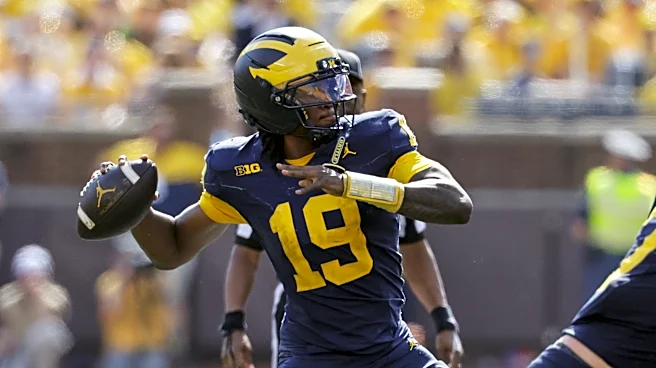
Consider this reason for optimism a holdover from last season. After a season of suboptimal quarterback play in 2024, Michigan brought in one of the most talented players in recent recruiting history to lead the position. And while Bryce Underwood showed some flashes of excellence and major dual-threat capabilities as a freshman, it’s safe to say he might have underwhelmed a bit given the lofty expectations that were placed on him.
Entering his sophomore season, Underwood seems poised to take a big step forward for a couple reasons. The first and simplest is experience. Now with a full season of college football under his belt, he’s more apt to take on the demands of a full season and will know what to expect in a Big Ten that’s loaded with great defenses.
Underwood will also be accompanied by a much better group of pass-catchers in 2026. Sophomore standout wide receiver Andrew Marsh is back after a big 2025 and has a chance to assert himself as one of the best receivers in the Big Ten. Michigan also brought in transfers J.J. Buchanan and Jaime Ffrench, as well as true freshman Salesi Moa. All three figure to get a healthy dose of targets in Jason Beck’s offense.
Speaking of Beck, he’ll be a big reason for any success Underwood has, as will new quarterbacks coach Koy Detmer Jr. Underwood didn’t have a dedicated quarterbacks coach last year, and it seems like that is something that undoubtedly stunted his development a bit last year. With even some semblance of guidance in 2026, there’s nowhere to go but up for Underwood.
Experience in the secondary
Michigan’s defense isn’t bringing back many starters from last season. Pretty much the entire front seven will consist of a new starting cast, with defensive tackles Trey Pierce and Enow Etta the lone holdovers from last season and set to take on the biggest workloads of their careers.
However, the secondary returns a handful of players that have shown some promise over the last few seasons, making it possible for the group to be one of the team’s greatest strengths.
Starting at corner, Zeke Berry, Jyaire Hill and Utah transfer Smith Snowden will likely be seeing the biggest shares of snaps. Snowden was a fixture in Utah’s defense the last two seasons, while Berry and Hill have been trending upward. At safety, Mason Curtis and Jordan Young are back alongside veteran Rod Moore and Memphis transfer Chris Bracy.
While it might be different from what fans have seen over the last two years, Jay Hill’s defensive scheme should cater to the secondary being ahead of the front seven. Using a 4-2-5 look more often than not, it’ll employ a bit of a bend-don’t-break style that seeks to limit big plays over the top. Furthermore, it sounds like there will be plenty of window dressing and disguised looks from a pre-snap positioning standpoint to keep quarterbacks guessing.
On the surface, it’s fair to wonder about Michigan’s defense as a whole thanks to all the attrition that occurred on that side of the ball this offseason, but there should be some confidence the secondary can hold its own early in the year while the front seven catches up.
Adults in the room
If there could only be one reason to be bullish on Michigan in 2026, it would have to be the fact the coaching staff and leadership structure is now head and shoulders above where it was the last two years.
In the days and weeks following Sherrone Moore’s firing, we came to know more about the level of dysfunction that had been bubbling beneath the surface of the program. The fact that team was still able to perform as well as it did during that time is impressive, and it’s encouraging to think about how much further this talented group could go without all the distractions holding them back. Furthermore, an inexperienced and largely unqualified coaching staff was replaced by some of the best and most respected coaches in the industry, which should only further raise the ceiling.
From an identity standpoint, Whittingham’s previous teams have been known for being fundamentally sound and highly disciplined, not unlike the teams we saw during the Jim Harbaugh era. It might be a stretch to think this year’s team will reach the same heights that Harbaugh’s final few teams did, but Michigan should be able to keep itself in any game, at the very least.