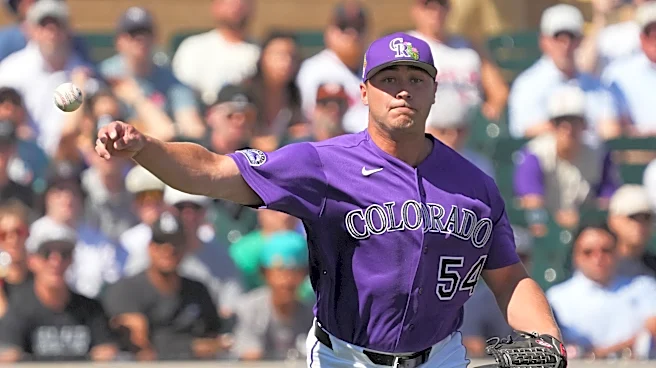







For nearly a month, the Rockies tried something you don’t see very often: They carried one left-handed reliever.
If you’ve followed bullpens for a while, that probably jumped out to you the same way it did to me. You get used to seeing two, three, sometimes four lefties when you scan a roster. Different looks, different roles, different ways to navigate a lineup. That’s just how it’s always been.
That’s why this stood out — and why it was worth watching.
Now, that setup has recently changed — Sammy
Peralta is here — and the Rockies have a second lefty. But that almost makes the original experiment more interesting.
Because the Rockies didn’t just end up with one lefty. For a stretch, they leaned into it. Brennan Bernardino was the only left-handed option in the bullpen, and the question wasn’t just whether it would work. It was what would it tell us.
So, what did the Rockies learn from trying it?
From LOOGY to the three-batter minimum
If you’re like me, you might tend to picture bullpen construction the old-school way.
You needed a LOOGY (Lefty One Out Guy) — a lefty who could come in, get one tough left-handed hitter out, and head back to the dugout like he just checked a box. That was a role. That was a roster spot.
That role is gone.
Since MLB introduced the three-batter minimum in 2020, relievers have to face at least three hitters or finish the inning. There are small loopholes — two outs, clean inning, you can sneak through — but the point is clear: You can’t just deploy a one-batter specialist anymore.
That didn’t eliminate left-handed relievers. It eliminated the reason to carry one who can’t get righties out.
So the job changed.
Now it’s not ‘do you have a lefty?’ It’s ‘can your lefty handle everyone?’
Why Bernardino made it work
That’s what made this viable at all. Because Bernardino isn’t a specialist.
So far this season, he’s handled both sides:
- Vs LHH: 5.0 IP, 5 H, 1 BB, 6 K, 1.20 WHIP
- Vs RHH: 5.2 IP, 4 H, 2 BB, 4 K, 1.06 WHIP

No dramatic platoon split. No obvious lane where he needs to be protected.
And when you watch him — and when you dig into the data — it makes sense.
He works with five main pitches (plus a rarely used slider), and none of them dominate the mix. Sinkers, curveballs, cutters, changeups, four-seamers — he’s constantly shifting shapes and speeds. The sinker/change combination helps him navigate right-handed hitters, while the breaking ball mix keeps lefties from getting comfortable.
He’s not overpowering anyone. He’s just not letting hitters get comfortable.
And the contact profile is what really drives it:
- 82.1 mph average exit velocity allowed
- 20% hard-hit rate
- 53.3% ground ball rate
At Coors Field, that’s not just useful — that’s survival.
Bernardino doesn’t blow hitters away. He just keeps them from doing damage. And in today’s game, that’s enough to let a lefty face anyone.

The other side of it: righties vs lefties
If you’re only carrying one lefty, though, the rest of your bullpen has to pick up the slack.
Right-handers have to get left-handed hitters out.
And to the Rockies’ credit, they’ve mostly held up there.
Jimmy Herget, Jaden Hill, and Antonio Senzatela have all been effective against lefties — limiting damage, keeping the ball on the ground, and giving the Rockies a way to survive without constantly chasing the left-on-left matchup. That’s part of why this didn’t unravel early.
But it hasn’t been universal.
Victor Vodnik and Juan Mejia, in particular, have been more vulnerable in those spots. And that’s where the lack of a second lefty starts to show.
When your righties can handle those matchups, you don’t notice the absence.
When they can’t, it becomes obvious pretty quickly.
Where it shows up in-game
You saw a glimpse of that recently.
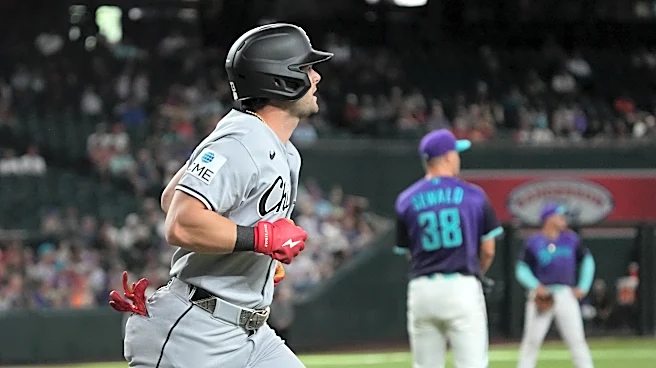
Vodnik ended up facing left-handed hitter Gavin Sheets in a big spot.
In a more traditional setup, that’s often where a lefty gets the call.
But that’s not what happened here — and that’s what made it interesting.
Instead, Vodnik stayed in to face Gavin Sheets and gave up the home run. With the damage done, he remained in to strike out the next batter — a righty — before the Rockies turned to Bernardino. The lefty was available, but he wasn’t used as a matchup lever in that moment.
But that might not be how the Rockies are thinking about it right now.
Part of the shift this season has been toward flexibility — leaning on pitchers who can cover innings, manage workload, and handle a mix of matchups rather than just one. In that context, leaving Vodnik in to face Sheets isn’t just a matchup decision. It’s a usage decision.
Would having another lefty — someone like Peralta — have changed the calculation?
Maybe. Maybe not.
But that’s the tradeoff.
When you only have one lefty, you don’t always get to chase the clean matchup. You trust your right-handers to navigate it — and live with the results.
Where Sammy Peralta fits
This brings us back to Peralta.
He’s different than Bernardino. He throws from a similar arm slot, but he’s still figuring out his pitch mix.
In 2025, Peralta leaned heavily on a slider-driven approach, throwing it nearly half the time, with a sinker and changeup behind it. That’s a more traditional relief profile — one often built to handle same-handed hitters first and figure out the rest second. So far at the major-league level, the results have been uneven. He’s shown flashes of dominance against left-handed hitters in small samples — but hasn’t found consistency — and hasn’t shown the same ability to suppress contact or flatten splits the way Bernardino has.
He isn’t replicating Bernardino’s role — he’s complementing it. Giving the Rockies a second look. A different option. A way to play the matchup when they actually want to, for now.
Strategy or shortage?
For a stretch, the Rockies showed something.
They showed that if your lefties are versatile enough — and your righties can hold their own — you can get by without multiple lefties.
That part worked.
But the roster move tells you something too.
Calling up Peralta suggests that one reliable lefty — and a handful of righties who can survive — still isn’t the same thing as having enough flexibility over a full season.
So what do you think?
Did the Rockies prove one-lefty bullpens can work? Is adding Peralta to the mix any indication of their thinking?
On the Farm
Triple-A: Albuquerque Isotopes 3, Sacramento River Cats 4
The Albuquerque Isotopes (13–11) lost a close one, falling 4–3 to the Sacramento River Cats (13–9) despite a late push. Albuquerque made it interesting with a three-run sixth to climb back into the game, but couldn’t find the tying run late. Cole Carrigg and Chad Stevens each went 2-for-3 with a walk, with Stevens driving in two runs. Patrick Weigel took the loss, while Welinton Herrera impressed out of the bullpen with 1.2 scoreless innings and three strikeouts.
Double-A: Hartford Yard Goats 5, Portland Sea Dogs 1
The Hartford Yard Goats (8–10) picked up a solid 5–1 win over the Portland Sea Dogs (9–9) at Delta Dental Park on a chilly 46-degree night. Andy Perez led the offense, going 2-for-4 with a home run, while Zach Kokoska added a 2-for-3 night with a long ball of his own. Blake Adams was the difference on the mound, earning the win with four innings of scoreless relief. Clean game, timely hits, and shutdown pitching — hard to draw it up much better than that.
High-A: Spokane Indians 1, Everett Aquasox 2
The Spokane Indians (6–13) dropped a tough one, falling 2–1 to the Everett AquaSox (11–8) on a walk-off in the bottom of the ninth. Alan Espinal led the offense with three hits, while Everett Catlett struck out seven over 4.2 innings, working around five walks and a solo homer. Justin Loer kept Spokane in it with 3.1 innings of scoreless relief to bridge the game late. Francis Rivera took the loss after allowing the winning run in the ninth.
Single-A: Rancho Cucamonga Quakes 3, Fresno Grizzlies 10
The Fresno Grizzlies (12–7) broke things open late and rolled to a 10–3 win over the Rancho Cucamonga Quakes (10–9), powered by a big night at the plate. Clayton Gray led the way, going 3-for-4, while Ethan Holliday and Tanner Thach each went deep — Thach’s fourth homer on the season was a towering moonshot that climbed high into the dark sky and felt like it was golfed out over the right-field fence. Jack O’Dowd added a long ball of his own as Fresno’s offense showed real punch. On the mound, three pitchers combined to keep things under control, backing up the breakout offensive performance.
Did we just become best friends? Rox hurlers bonding over boredom of injury rehab | MLB.com
In this MLB.com piece, Thomas Harding checks in on RJ Petit and Pierson Ohl as they grind through the long, often boring Tommy John rehab process, where it’s more about patience than payoff right now. Along the way, though, there’s a random noodle mishap and a worried mom sprinkled in that serve as a reminder there’s still a real human side to all of it.
Rockies Trade Nicky Lopez To Cubs | MLB Trade Rumors
The Rockies quietly flipped Nicky Lopez to the Cubs for cash. Lopez had been swinging it well in Albuquerque and represented a potential plug-and-play depth option if needed, but the Rox have chosen to move on. For the Cubs, it’s a low-risk reunion with a glove-first infielder they know well.
Barstool rounded up some clips of fans making some seriously impressive foul ball catches at Coors Field. It’s a fun mix of skill and chaos in the stands, and they’re definitely worth a quick watch.
Padres’ Mason Miller Loses One Streak in Win vs Rockies | SI.com
J.P. Hoornstra of Sport Illustrated breaks down Mason Miller’s absurd strikeout streak. The interesting part — somehow, of all teams, it’s the free-swinging, strikeout-prone Rockies that put it to an end. Of course it happens that way… baseball makes no sense.
Join the conversation!
Sign up for a user account and get:
- Fewer ads
- Create community posts
- Comment on articles, community posts
- Rec comments, community posts
- New, improved notifications system!
Please keep in mind our Purple Row Community Guidelines when you’re commenting. Thanks!