







The season was 1908/09. Two opening games away from home had left Sunderland pointless and manager Bob Kyle perplexed, as he attempted to manage a team in transition.
Five players had made their debuts in the opening-day defeat against Man City. One of these debutants, centre-forward Arthur ‘Boy’ Brown, cost a world-record fee of £1,600. Kyle had also spent an estimated £700 on a double transfer from Hearts, thirty-year-old centre-half and Scotland’s international captain Charlie B Thomson and a little-known
goalkeeper, Thomas Allan.
The unusual double signing had been a way around a Football League-enforced (short-lived) £350 transfer limit at the time. Thomson would go on to provide seven seasons of brilliant service, becoming something of a club legend. Allan spent two years as LR Roose’s understudy before being transferred back to Hearts for a nominal fee.
Bob Kyle had also bought full-back Albert Milton from Barnsley for £350 and winger John ‘Jackie’ Mordue for £750 from Arsenal. Mordue and Milton made their debuts in the third game of this season, a midweek fixture at Ayresome Park.
Milton came in for left-back Harry Forster and Mordue for Billy Hogg. Bob Kyle did not just shuffle players in and out of the team, he moved them about positionally. Arthur Bridgett moved to Hogg’s inside-left position and Mordue to left-wing, with George Holley moving to inside-right.
In a hard-fought derby, Jackie Mordue put Sunderland in front with a debut goal on twenty minutes. Ex-Sunderland forward Alf Common missed a penalty for Middlesbrough just before half-time. In the second half, Sunderland had the better of play but could not break stubborn Boro’ down. It was looking like a stalemate until the last two minutes, when first George Holley, then Arthur Bridgett scored to give Sunderland the points.
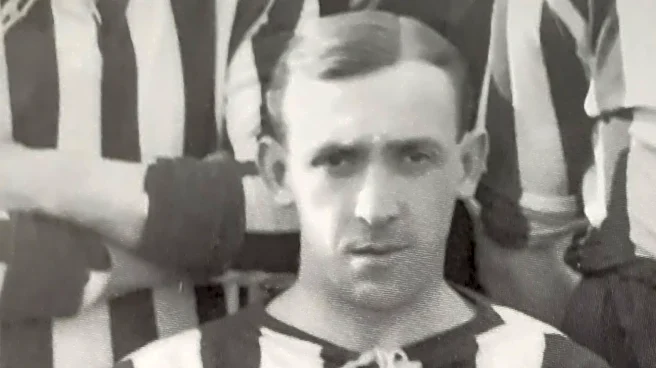
Jackie Mordue had acquitted himself well in his first game.
A County Durham boy, born in Edmondsley in 1886, he was the youngest of five siblings. At nine years old, his father, a coal miner, died and, in 1901, he was residing with his widowed mother in 358 Eighth Street in Witton Gilbert, playing football initially for Sacriston, then Spennymoor, whilst working down the pit, helping to keep bread on the table for his widowed mother and family.
In October 1906, he was signed by second-division Barnsley, Spennymoor being paid £50 for his services. He played twenty-six games, scoring twelve goals in the 1906/07 season before being sold to Woolwich Arsenal for £450.
Jackie linked up with his brother-in-law Jimmy Ashcroft (the Gunners goalkeeper) and played twenty-six games, scoring one goal in the 1907/08 campaign, before Bob Kyle came in and signed him for Sunderland.
Twenty-two years old when he made his debut for Sunderland, Mordue would go on to play thirty-eight games in the 1908/09 season, scoring eight goals. He operated on the left and right wings with good effect, quickly becoming an adaptable mainstay within the team.
He scored in the nine-goal-to-one rout of eventual league champions Newcastle in December 1908, helping Sunderland to third position in the table on the same points as second-placed Everton at the end of his first season with the Lads.
Jackie Mordue went on to play two hundred and ninety-nine games for Sunderland, scoring eighty-three goals in all competitions between 1908 – 1920. His best campaign for the Lads was the 1912/13 season, as he helped Sunderland win the league championship by four points from close rivals Aston Villa.
Mordue played in every game of that great season as Sunderland also played their way to the FA Cup final against Aston Villa, where they lost to a solitary goal in front of 120,081 fans at Crystal Palace.
Mordue scored fifteen goals in the league, including seven penalties. He also scored a crucial penalty in the semi-final replay against Burnley to help the Lads into the final.
His prowess from the spot earned him the nickname “the Prince of Penalty Takers”. He scored twenty-six consecutive penalties in total for Sunderland and did not miss a penalty in a competitive game until taking his thirty-fourth spot kick at the age of 34. In an era where goalkeepers could rush out from their line before the ball was kicked, this is a pretty remarkable record.
Added to the club’s success in 1912/13, Mordue made a winning England debut, playing alongside George Holley against Ireland, following this up just under a year later (also against Ireland). In his second and last international game, he played alongside Frank Cuggy and Charlie Buchan in the right-sided triangle that had become so effective for Sunderland and an essential ingredient to the success of the 1912/13 campaign.
Mordue also played for the Football League on three occasions.
Jackie belonged to a family with a grand football heritage in the North East. As well as football, he and his brother Michael (Tucker) were famed in the North-East community for their prowess at handball, more commonly known as “fives”.
Huge sums of money were won and lost on fives games, with illegal gambling extremely rife around the sport. There are many stories of Jackie and Tucker’s ability being so good that they would take on three opponents at once, or play with one hand tied behind their back. Tucker sadly was killed in action at Gallipoli in 1915.
The Great War saw league football curtailed until the 1919/20 season and impacted on many players’ careers. Without doubt, though, the loss of life, friends and family was the bigger impact. Albert Milton, who made his Sunderland debut with Jackie, was killed at Passchendaele in 1917.
Sunderland players Sam Hartnell, Jack Allan, Billy Lyon, Sandy McAllister, Thomas Rowlandson, Leigh Richmond Roose, Alexander Barrie and James Chalmers also lost their lives, as the overwhelming majority of the Sunderland squad enlisted or were called up to the conflict. Jackie joined the Royal Artillery Garrison and, like many of his fellow players, emerged from the war to a somewhat changed landscape.
Throughout Jackie’s time at Sunderland, Bob Kyle was the manager and Sunderland never finished lower than eighth in the top tier. The resumption of league football after the war would prove to be Mordue and Kyle’s last at Sunderland.
Jackie played thirty games, scoring seven goals in the 1919/20 season, as the Lads finished fifth in the table. He played his last game for Sunderland against Middlesbrough, the opposition against whom he debuted, on March 13th 1920 in a one-all draw at Roker Park in front of 30,000 fans.
Jackie transferred to Middlesbrough in 1920 and played thirty-five games over two seasons before going to Durham City (Div 3 North) in 1923 as player/manager, a post he held for twelve months.
The esteem in which Jackie Mordue was held at Sunderland was demonstrated at his funeral in March 1938. As the funeral procession left Pallion Working Men’s Club, many red & white wreaths were in evidence amongst the crowds, as well as the official party. Bobby Gurney, Raich Carter, Fred Hall and Bert Johnston were the pall bearers, and his playing colleagues Frank Cuggy and Warney Travers paid tribute.
Jackie Mordue scored 83 goals in 299 appearances in all competitions for Sunderland from his debut on this day in 1908.
As the story is told of a bygone era, when you could shout down a pit shaft in the North East and a cracking team of players would emerge, Jackie Mordue was undoubtedly one of those fine players.
Division One
Date – 09.09.1908
Venue – Ayresome Park
Attendance – 15,000
Middlesbrough 0 – 3 Sunderland
Goal Scorers – Mordue 20mins; Holley 88mins; Bridgett 89mins.
Middlesbrough – Williamson; Groves; Watson; Aitken S; Aitken A; Verril; Common; Bloomer; Hall; Wilcox; Thackeray.
Sunderland – Roose; Agnew; Milton; Tait; Thomson; Low; Clark; Holley; Brown; Bridgett; Mordue.