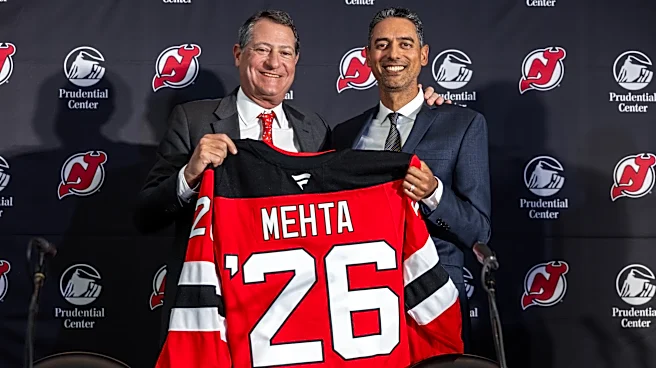




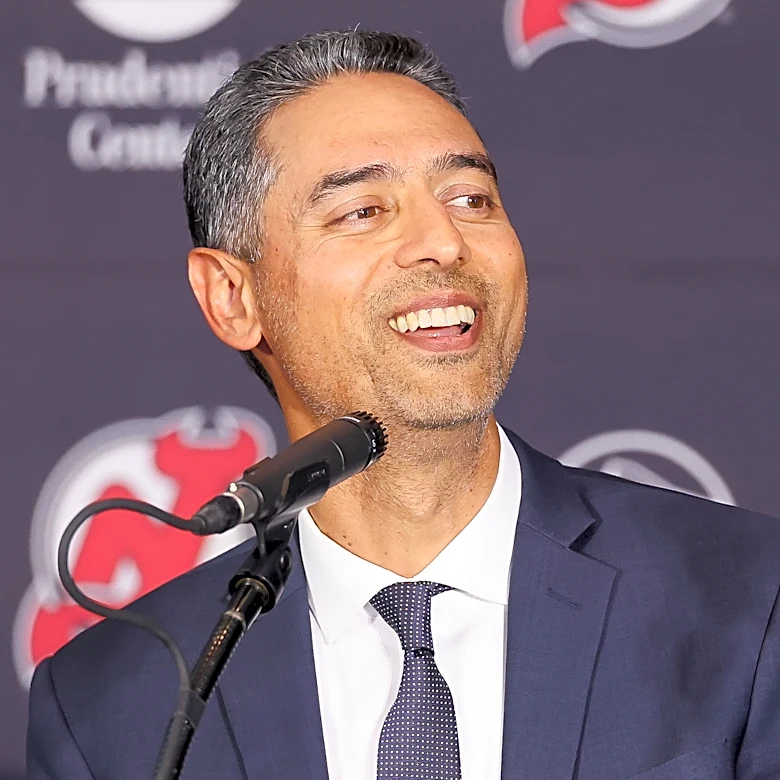
On Tuesday, the Devils introduced new general manager Sunny Mehta to the media, as well as the general public.
You can watch the press conference in its entirety here
.Judging from the comments here in previous articles as well as on social media, I think the reception to the Devils hiring of Mehta has generally been positive, but I was still curious to see his press conference as I don’t recall ever listening to him speak before. I’m familiar with Mehta’s background, but I’m not familiar with him as a person
outside of his backstory as a Devils fan who grew up in Wyckoff, NJ. I wanted to see how he’d handle himself in his first media session as general manager and the types of answers he would give to otherwise mundane (and sometimes, irrelevant) questions.
Needless to say, I came away impressed by how much thought he gave each answer and how he articulated his responses. He came across as someone who was comfortable addressing the media rather than treating it like a chore. He clearly was playing things close to the vest….perhaps because he genuinely hasn’t made decisions yet on who will stay and who will go yet, but he also avoided any cringeworthy soundbytes like his predecessor might’ve walked into by being too honest and direct. He didn’t publicly bury any players or anything like that. If anything, he went out of his way to show that he grew up a Devils fan and a New Jersey native.
I will say that if you were going into this press conference looking for specific questions on the futures of specific players, you likely came away disappointed. Mehta said early in the press conference that there will be a period of assessment on players, coaches, and staff, and that will presumably come in the subsequent weeks and months to come before the real offseason work begins.
That said, he came across clearly as a man with a plan, and he surely has one. Just because he’s not sharing the finer details of that plan with us in a public forum doesn’t mean he doesn’t have one. And after his press conference, I’m looking forward to seeing him execute on that plan.
With all of that out of the way, here are some of my key takeaways from the press conference and the day in general.
Players and Coaches in Attendance
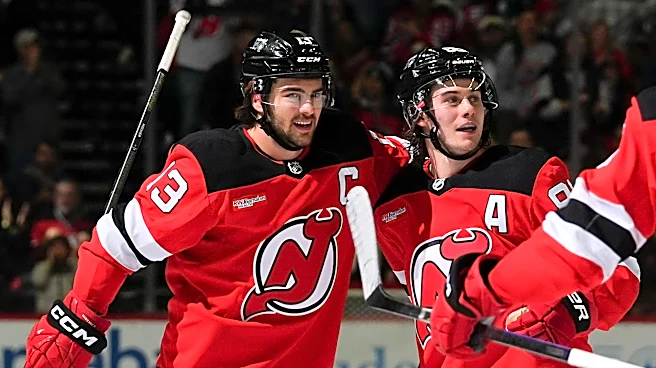
As Amanda Stein noted on Twitter, Nico Hischier, Jack Hughes, Connor Brown, Brenden Dillon, Jake Allen, Stefan Noesen, and Johnathan Kovacevic were among the players in attendance. Head coach Sheldon Keefe was also in attendance.
I don’t know how much I would read into in terms of players that weren’t there, but I do think its important for Hischier and Hughes, the leaders of the team, to be there as a show of public support. And I do think its notable in Hischier’s case seeing as he’s up for a contract this summer.
I wouldn’t say that Hischier being there today is a sign that he’s chomping at the bit to sign on the dotted line and cement himself as a Devil for life once he’s eligible to do so on July 1. But the alternative way of looking at it would be if he was that disgusted with the organization as a whole, it would’ve been really easy to stay away. It would’ve been really easy to cite a scheduling conflict while he’s sitting on a beach in the Caribbean sipping drinks. Hischier did not do that. He was there.
It’s something to keep in mind as we inch closer to July 1st and we see where the Devils and Hischier are in regards to a long-term commitment.
On Drafting and Development
Mehta mentioned the now famous Jesper Bratt story that you’ve probably heard ad nauseum by now. The one where Mehta’s model had Bratt #3 out of all of the players in the 2016 class on his draft board.
He also mentioned that “there’s probably other players I had in my Top 10 that are playing in Austria somewhere”.
I bring that up because drafting is hard. It’s really difficult to project what 18 year old young men are going to be years from now. Even the teams that we think are the best at drafting have more than their fair share of misses. If there was a simple answer as to why doesn’t this team draft better, more teams would be better at it and we’d have more than the “20 to 25 percent” of drafted players that Mehta referenced making it to the NHL.
Part of why I like the idea of hiring someone like Mehta as GM is the hope that he’ll be able to repeat that success with Bratt in the future. But the truth of the matter is that there isn’t a Bratt sitting there in the 6th round every year. We probably shouldn’t be expect Mehta to find the needle in the proverbial haystack year after year, especially if the needle might not even be there in the first place. But at a bare minimum, I think its fair to expect the Devils to take more players in rounds 1, 2, and 3 that have the right skillsets to make them reasonable bets to eventually make it to the NHL.
I would’ve liked to have heard more in regards to the Devils and their recent failures in drafting and development, particularly on the developmental side. Much has been written on this site in regards to poor draft selections, but its tougher to examine WHY draft picks fail. Is it because of the player? Did the organization fail them somewhere along the way? Or is it some combination of the two.
Mehta didn’t offer much in regards to the Devils situation, which makes sense as he just got here and isn’t ultimately responsible for any of their draft picks in the past. He did say (repeatedly) that one of Bill Zito’s greatest strengths was aggregating information from a variety of sources in-house. Not just scouts, but also the analytics department and sports science. Mehta wants to bring that approach to Newark.
Of course, if this sounds like the collaborative effort that we thought the Devils were operating with under Fitzgerald’s watch….well it certainly sounds like that from the outside looking in. This isn’t a knock on Fitzgerald, but I do think some of the moves he had made the last few years that haven’t worked have reverted back to the “200 Hockey Men” line of thinking. The type of thinking in regards to team building where you gotta “get pucks in deep” and be “tough to play against” and you subsequently start building your team in that manner because “it’s what works in the playoffs”. I think you saw some of that with some of the recent reaches (Chase Stillman) that haven’t worked out.
I don’t know if Greg Wyshynski’s report the Fitzgerald overrode the analytics department on the Ondrej Palat signing is accurate. But I do know that most of the scouting department is likely to be overhauled anyways as they’re going to be out of contract, and I’m fairly confident that over time, the Devils will get better players more frequently using Mehta’s approach….whatever it is….than they did the previous regime did.
If it were up to me, I’d overhaul everything on the pro and amateur scouting side. I think there’s enough examples in recent years of what hasn’t worked between poor selections, stalled development, and a stagnant AHL affiliate that has consistently been unable to provide any help. We’ll see what direction Mehta ultimately goes in though once he starts bringing “his guys” aboard.
Did Mehta Tip His Hand that Sheldon Keefe is Safe For Now?
Considering Mehta is a former poker player, he might want to do a better job with his tells because I think he tipped his hand here.
When answering a question about what he views the identity of the Devils to be as a team moving forward, Mehta said “I’ll talk with Sheldon about (it) in the upcoming offseason.”
Mehta said earlier in the press conference that “As for the short term, going forward, there’s going to be a period of assessment of all players, coaches and staff. No decisions are made on anything pertaining to that (right now).”
One would view those two quotes in isolation and note that they seem to be contradicting each other. And it would’ve been nice had somebody in the press corps had asked the obvious follow up question whether or not that means Sheldon Keefe is safe for now. But reading between the lines, I don’t know how one interprets that former statement other than operating under the assumption that Keefe will remain as the head coach of the Devils moving forward. Why would one talk with the head coach of the team about what they think the identity of the team going forward should be if you intend on hiring your own coach to replace him? If you didn’t want the coach around, wouldn’t you simply say that we thank him for his service, but are choosing to go in a different direction.
If I had to bet, I think Keefe is staying.
I don’t think that’s necessarily a bad thing either.
It’s important for the head coach and general manager to be lock step in their vision for the team. Mehta went as far as to call the relationship “paramount”. And the easiest way to accomplish that would be letting the general manager pick his head coach rather than inheriting one from the previous regime.
One can note that Keefe has historically been a coach that is open to listening to the analytics team to try to put the team in the best position he can. One can also note that Sheldon Keefe is a good head coach with success in this league, note the lack of quality alternatives out there at the moment, look at the adjustments the Devils made in their style of play post-Olympics where they looked significantly better than they did earlier in the season, and come to the conclusion that the smartest move for now is to simply not make a move.
For now, anyways.
That’s not to say that Mehta can’t change his mind a year or two from now as he continues to reshape the roster. Or if a better option becomes available.
Only Mehta (and maybe David Blitzer) knows what the Devils intend to do, but it would appear to me on the outside that Keefe is staying for the time being.
The Devils Identity and If They Are Still a “Win Now” Team
I don’t want to gloss over the identity question, as I think that’s an important one, so let’s circle back to that.
“For me, personally, I don’t really necessarily gravitate towards thinking that you have to play a certain style to win. Obviously, we played a somewhat idiosyncratic style with the Panthers, but I mean, the Lightning played a considerably different style than we did, and they won two Cups. And, so, I think we have to play to whatever it is our identity is and not do it the other way where we put the cart before the horse.”
I think one of the biggest issues with the NHL in general is that too many front office executives take the wrong lessons away from the successful teams.
It would be easy to point to what Florida did well in their Cup run and say “we need to recreate that”. After all, they’re big and physical and hit people. They get to the tough areas of the ice. They win along the boards. And most importantly, they won.
All of that might be true, but Florida also had a lot of really good hockey players. Just like how Tampa and Colorado and Vegas and other Stanley Cup champions before them also had a lot of really good hockey players. And like Mehta said, there’s more than one way to succeed in this league.
You might not be able to win on skill alone, but if the Devils of the last couple years are an example, you’re not going to win on sandpaper and grit alone either. You need the right balance. More importantly, you need to lean into the strengths of your best players and what they do well instead of trying to neuter them. The Devils had gotten away from being a team that comes after you wave after wave on the rush, and one would hope as they try to acquire more talent, they lean more towards what made them successful a few years ago.
When asked if he views the Devils as a contender more in the short-term or the long-term, Mehta said that he views them as both and his goal is to instill a process to help them win that is repeatable.
Of course, Mehta didn’t dive into any specifics, as he often referred to this only being “his second day on the job” and that there was an assessment period that needs to play out. But he certainly didn’t sound like someone who intends on doing a retool or rebuild of any sort.
Now, that doesn’t mean they’re just going to run it back with 90% of the same roster they had this past season either. I’m sure Mehta (and perhaps Keefe as well if he’s staying) has an idea already of which players they want to move on from and which ones they view as pieces moving forward. Not to mention that Mehta is inheriting a roster with a lot of players with some form of no-trade protection, bad contracts, or both. There might be instances where his hands are tied in the short-term because he can’t move on from the mistakes from the previous regime as quickly as he’d like to.
But I think we are looking at a roster that is due for a shakeup to some extent anyways. I don’t know what the future of Dougie Hamilton, Simon Nemec, or Dawson Mercer are, and it would’ve been nice had someone asked the next general manager what he thought of those players, but would I be surprised if Mehta took a sledgehammer to our blueline and bottom six to build a team that fits his vision better than the one he inherited? No, it would not.
If one is looking for something more tangible than that when it comes to the Devils and their intentions, David Blitzer did confirm when asked that he intends for the Devils to continue spending to the salary cap ceiling as it continues to increase over the next few years. So any concerns about the Devils operating with some sort of internal cap can be put to rest for now.
On Decision Making
Mehta was asked a lot about poker, which is understandable given his background. As a (bad) amateur poker player myself, I can certainly relate to a lot of the poker references he made.
Consider this quote for a moment.
“I think most long-term poker players are what, in the business, we call “tight and aggressive,” which means in some ways you’re more patient than other poker players in the sense that you don’t play garbage cards — have the discipline and the patience to wait for your moment. When you have that moment, you’re extremely aggressive — you have to have the guts to do what it takes when that moment is right to win the hand, and I’d say that’s exactly how I view this.”
I think this is the correct way to approach this. And I say this as someone who was very critical of Tom Fitzgerald and his tendency to sit on his hands for months on end while a season would spiral out of control and do nothing.
In poker, you might win occasionally playing hands like nine four offsuit. But more often than not, if you continually play those hands and play it like you have the nuts when you flop a pair of fours, you’re probably going to lose more often than you win. After all, its just a pair of fours at the end of the day.
Mehta made this point a few times but he mentioned that Bill Zito essentially was an aggregator of information before he made a decision and that that is what he wants to do as GM. Again, I’m not saying that Fitzgerald didn’t consult his braintrust before making decisions. I certainly didn’t love Blitzer’s answer about how there wasn’t a moment last season where he woke up one morning and declared that there needed to be a change when there were plenty of those mornings this season.
But I do think you need to be willing to pivot when what you’re seeing isn’t working either. Trusting what your eyes are indeed telling you and not being a slave to what your process or model says.
Conversely, when an opportunity presents itself to be “tight and aggressive” and make a move that will help you win, you want to see the GM be all in and aggressive in pursuing that.
I’m not saying Fitzgerald wasn’t “all in” when it came to, say, when Quinn Hughes became available. But one would have to believe coming away from that press conference that had Sunny Mehta been in charge of the Devils, they would’ve been in a better position to get him between having the right players to trade away, having the flexibility with the salary cap to make a move like that on a whim, and the gumption to seal the deal. And had they done that, they might still be playing hockey games this season.
All of that brings me to my next point.
Analytics
I think some people have painted Mehta with the broad brush of he’s the “analytics guy” and he’s not going to do anything that his model or Excel spreadsheet is going up against.
It’s probably a little premature to say that….the truth is we don’t know how he’ll react when he has to make a free agent signing or a waiver claim or a trade or fire a coach. We don’t know how he’s going to act when he has to look someone in the face and tell them why they’re being waived or traded. I assume because he came across eloquently in his press conference that he has some tact when it comes to the human element but will he be cutthroat when it comes to cleaning up some of the mess he has inherited? It remains to be seen.
That said, I thought his full answer about analytics was notable.
“To me, the reason that I ever even cared about analytics, statistics, probability, is ‘cause it helped me win.”
Mehta would go on to talk about how he learned analytics on the job as he never really set out to be the ‘analytics guy’ in the first place and how understanding the data helped him become a better poker player, a better trader, and ultimately, got his foot in the door with NHL franchises.
If nothing else, Mehta came across as an extremely competitive person. You have to be if you’re going to be a professional poker player, a stock trader, and work in an NHL front office.
Analytics can sometimes be overrated….I’ll go to my grave arguing against anyone who suggested Dougie Hamilton was playing well pre-benching when he had 10 points in 40 games or whatever it was because his advanced stats said so. When you’re being paid $9M a year, I don’t want to hear about your expected goals. I expect you to score real goals.
But I do think Mehta has had a model that has clearly worked for him in the past, which I think is why I’m intrigued by the idea of him finding players that other teams deem expendable.
Every team uses analytics. It’s naive to think that Colorado, Florida, or Tampa Bay haven’t en route to being perennial Cup contenders. It’s part of why Carolina has separated themselves from the rest of the pack in the Metropolitan.
I think its safe to assume the Devils will lean even harder into the analytics. And they’ll likely be better off as a result.
Taylor Ham vs. Pork Roll
He called it Taylor Ham, which is the correct choice.