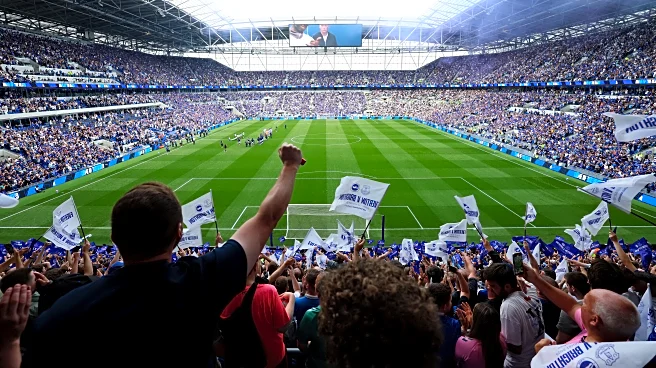




As anyone who has moved house will testify, it takes time for somewhere new to feel like home. The same applies to their new home at Hill Dickinson Stadium.
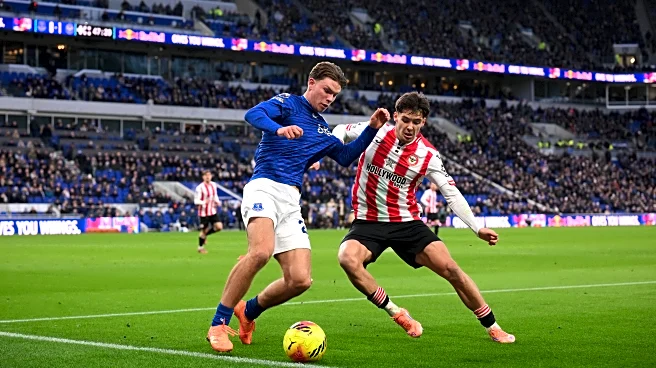
Everton have won just five of their 15 matches at their new ground, the last coming against Nottingham Forest more than two months ago. But the problems are not just restricted to on the pitch. Off the pitch, supporters have expressed their frustration at a range of issues including atmosphere, signage, food options, transport and stadium access.
So how serious are these issues? And can they be rectified? We take a look.
1) There’s no place like home
The issues seem to be threefold – performance on the pitch, atmosphere and stadium experience – though all three are interlinked.
The act of moving somewhere new has had an impact. Matchday rituals were so ingrained at Goodison – supporters old and young have never known anything else – there was always going to be a period of adjustment. That can have an unsettling effect, which can impact supporter mood.
That can also impact the players. Home advantage may have been negated slightly because they are all playing at an unfamiliar ground, though professional players are used to playing at different venues, so sympathy is limited in that respect. If anything, the improved facilities should bring the best out of the team.
2) Transport issues
Getting to and from a dockside site was never going to be straightforward, and so it has proved. Though close to town, it is still a 20–25 minute walk, further if you are travelling home via Lime Street station, and Regent Road can get very congested immediately after the game.
Walking is fine on a warm, sunny day if you have no mobility issues. But on a wet, cold Wednesday night, or if you cannot walk long distances, alternatives are needed. Public transport options have also had teething issues. There are shuttle buses and, by all accounts, improvements have been made to make them more efficient, but issues at Sandhills train station remain, with the site not yet in an ideal state to handle such high post-match demand.
Just getting out of the plaza can be a hassle, with only two exits cut into the dock walls. It is little surprise then that there seems to have been a visible increase in the number of fans leaving before the final whistle to try to mitigate against transport issues – especially after night, midweek or early evening games.
3) Season ticket seats
Another source of frustration has been the scattering of fans to new seats compared to where they sat at Goodison. Groups of supporters who sat together for years, particularly in the more vocal areas of the Gwladys Street, are now divided. That has certainly played a role in dulling the atmosphere, as those who want to sing are not necessarily together.
The club tried its hardest to be as fair as possible when it came to allocating season tickets at the new ground, giving priority to the most loyal supporters. But some scattering of fans was inevitable. Again, this may change over time. People will grow more familiar with those around them, while the club have confirmed supporters can request to move at the end of the season.
4) Layout flattening the atmosphere?
There have been suggestions the seating layout is contributing to the poor atmosphere. To comply with modern regulations, seats are slightly more spread out than the tightly packed stands at Goodison, with people therefore more dispersed.
The argument against this, though, is the steepness of the south stand, which includes rail seating. The stadium’s design also helps keep the sound in – anyone who has been on the stadium tour will know that the guides demonstrate how sound reverberates around the ground and seemingly rushes back at you.
Away fans have also spoken about how loud their section has been, suggesting it is not the seats but the fans sitting in them.

5) Terrible scheduling
This is where Everton have been unlucky. Some of the fixture scheduling this season has been awful, especially given Everton are not in Europe. They have only had three Saturday 3pm home matches this season and none since early December.
Matches against Leeds and West Ham were moved to Monday nights – as is the next game against Manchester United. Games against Wolves and Bournemouth were midweek matches in the middle of winter, with a Wednesday night fixture against Burnley to come next month.
Fans are less likely to get to the ground early and unlikely to hang around afterwards. All that combined does not produce conducive conditions for a lively night under the Hill Dickinson lights.
As the weather improves, fans may congregate in the fan plaza more before and after the game, avoiding the rush at full time. Big games against Manchester United (albeit on a Monday), Chelsea, Manchester City and Liverpool are all still to come too.
6) Misty-eyed nostalgia
Then there is the nostalgia of Goodison. Watching replays of James Tarkowski’s goal against Liverpool earlier this month stirred up all the emotions about leaving the Grand Old Lady. It is little surprise that fans compare a ground they held so dear with a new arena that – despite its modern wonder – does not yet hold the history and memories that made Goodison so special.
All that history cannot be replicated in just nine months. It will take time to build a new story at Bramley-Moore and, until then, we will always think longingly back to old times.

7) As good as we remember?
It is easy to get all misty-eyed about Goodison too. But let’s face it, the atmosphere was often poor, especially during the past few seasons when Everton were struggling. Yes, it came alive for certain games, but we have not had a really big game, moment or performance at BMD yet either.
8) Performances on the pitch
The old chicken-and-egg conundrum could be at play here – should the players get the fans going, or should the fans inspire the players? The truth, like most things, is somewhere in the middle.
Let’s face it, Everton have been pretty rotten at home this season, apart from their first few games in late summer and early autumn, so the fans have had little to shout about.
In the past, the supporters may have attempted to lift the players more than they have, but the myriad teething issues may have tempered enthusiasm, resulting in a negative cycle.
Given they are out of both cups and are firmly in mid-table, there is unlikely to be much to shout about over the next few months (though the fans would no doubt stand up to be counted if the team were in a relegation battle, for example). But with some of the bigger sides heading to Hill Dickinson in the run-in, things may change.
So what’s the answer?
Well, to put it simply: time. Time for the club to address teething issues within the stadium and for the authorities to improve infrastructure and transport outside. Time for fans to feel more familiar with their surroundings and those they are sitting next to. Time for the players to settle into their new home. And time for David Moyes and his recruitment team to strengthen the squad and build a team capable of challenging at the right end of the table.
Keep the faith, people.