
With the 2025 Texas Rangers season having come to an end, we shall be, over the course of the offseason, taking a look at every player who appeared in a major league game for the Texas Rangers in 2025.
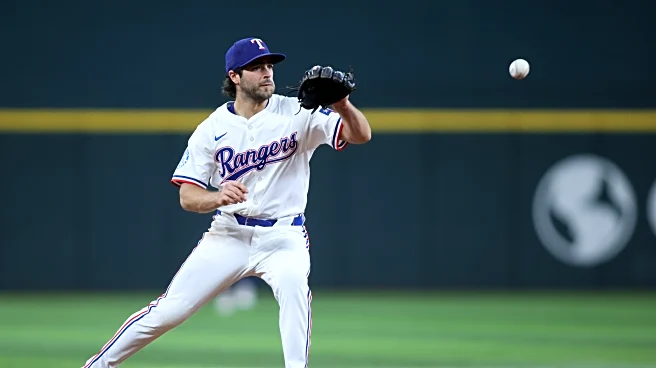
Today we are looking at infielder Josh Smith.
In 2024, Josh Smith played several defensive positions acceptably, hit quite well in the first half, and stopped hitting in the second half.
In 2025, Josh Smith played several defensive positions acceptably, hit quite well in the first half, and stopped hitting
in the second half.
Its like deja vu all over again.
This is part of an overall trend throughout Josh Smith’s career. In his major league career, Josh Smith has slashed .268/.365/.411 in the first half of the season, and .198/.280/.283 in the second half of the season. Of Smith’s 31 career home runs, 22 of them have been in the first half of the season.
His career OPS by month:
April — 794
May — 705
June — 844
July — 697
August — 538
September — 551
In 2025, Josh Smith put up a .277/.353/.416 slash line in the first half of the season and a .208/.306/.286 slash line in the second half of the season.
Smith’s OPS by month in 2025:
April — 794
May — 705
June — 844
July — 697
August — 538
September — 551
The obvious answer would seem to be that Smith is wearing down as the season goes on. The thing is, though, when we look at his career splits, we don’t see the sort of big changes from the first half of the season to the second half of the season that would explain such a dramatic split.
For Smith’s career, his walk rate in the first half is 10.0%, versus 8.7% in the second half.
His K rate is 19.3% in the first half, compared to 20.7% in the second half.
His hard hit rate is 28.7% in the first half, compared to 28.3% in the first half.
Smith’s ground ball rate goes up by about 3% in second half, with his line drive rate dropping by 2% and fly ball rate by 1%.
There’s clearly a difference in the underlying data between first half Josh Smith and second half Josh Smith, but the underlying data doesn’t indicate that it should be such a dramatic drop.
I went to Statcast and broke out Smith’s wOBA and xwOBA by month for his career, and what I saw was quite curious:
April — .355 wOBA, .343 xwOBA
May — .314 wOBA, .315 xwOBA
June — .369 wOBA, .312 xwOBA
July — .309 wOBA, .307 xwOBA
August — .246 wOBA, .287 xwOBA
September — .250 wOBA, .303 xwOBA
So as one would expect, Josh Smith’s xwOBA gets worse as the season. However, his actual wOBA in August and September trails his xwOBA by a significant margin, while his April and, especially, June splits show him way overperforming his xwOBA.
Here are the splits for 2025:
April — .360 wOBA, .322 xwOBA
May — .269 wOBA, .314 xwOBA
June — .374 wOBA, .318 xwOBA
July — .330 wOBA, .312 xwOBA
August — .258 wOBA, .300 xwOBA
September — .272 wOBA, .294 xwOBA
Again, we see a decline from month to month, but the drop in xwOBA is not nearly as precipitous as the drop in wOBA. If Josh Smith’s actual numbers were to be in line with his x-numbers, we’d be seeing someone whose bat gets worse as the season goes on, but not someone who completely falls off a cliff over the final two months of the season. His career 538 OPS in August and 551 OPS in September seem to overstate how significant the decline is, based on the underlying metrics.
I went into this exercise with the belief that Josh Smith may simply not be durable enough to be an everyday player — that he may need to be limited to 400 or so plate appearances to keep him from wearing down, rather than the 577 plate appearances he’s averaged the past two years.
And to be clear, I still have some concerns in that regard about Smith. He’s a small guy, listed at 5’9”, 172 lbs., and the conventional wisdom is that smaller guys tend to wear down more. That said, the underlying data suggesting that the downward slope is not as sharp as the surface numbers make it appear has me more bullish on him holding up as an everyday player long-term.
Smith has been effectively been an everyday player the past two seasons, and a good one, at though, putting up a 6.2 bWAR and 4.7 fWAR from 2024-25. He’s played primarily third base and shortstop in that time, though last year in particular he also got starts in all three outfield positions. He hasn’t had a ton of time at second base, the position he’ll be manning in 2026, primarily because the guy who has been the Rangers’ second baseman the past four years essentially played every day, limiting the opportunity for Smith to get innings there.
Smith is probably best suited defensively to second base, and I’m cautiously optimistic about what the Rangers will get from him in 2026. My hope is that a consistent position and outlying performances regressing to the mean will result in a much more solid and consistent 2026 campaign from Smith.
Previously: