



The first round is done. Here’s the full accounting:
Jordan Poole ran through Alen Smailagic 85% to 15% in the first matchup, and James Wiseman crushed Ryan Rollins 80% to 20% in the second. Jonathan Kuminga cruised past Patrick Baldwin Jr. 74% to 26%, followed by an upset when Trayce Jackson-Davis knocked off Eric Paschall 66% to 34%.
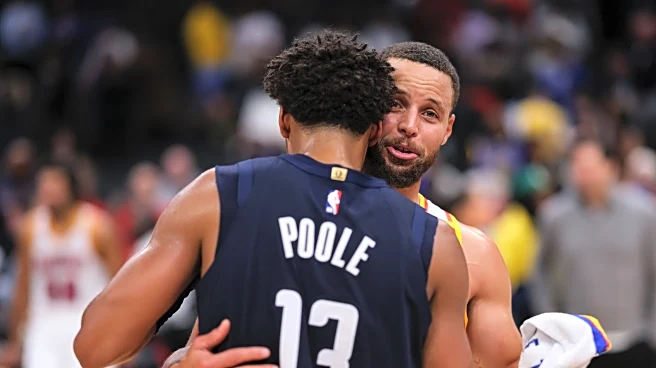
The bracket’s down to four, with Wiseman and Kuminga fans duking it out in the other poll. Today we’re talking Poole vs TJD.
Before we get into this one, a quick reset
on what this bracket actually is. This isn’t about who was better, or who disappointed you more. It’s about which version of belief stayed with you longer; the player you kept holding onto, even when it stopped being easy.
Jordan Poole — The Chosen Son
This isn’t a question about Jordan Poole’s career. You already know how it went. It’s whether you can put yourself back in the moment before all of it, back when the belief was clean and the ceiling felt limitless, and feel what that was like.The Poole era, before the complications set in, was one of the most alive things Dub Nation felt in the two-timelines stretch. He wasn’t a project you were squinting at through the fog of hope. You could already see it.
I was in Las Vegas for Summer League 2019 when he first suited up as a Warrior. KD had just left. The dynasty that everyone outside the Bay had been praying would end had finally started to wobble. And right in the middle of all that noise, this 19-year-old kid from Michigan was out there attacking closeouts, drawing fouls, playing like the moment owed him something.
The G League bubble in 2021 is where it clicked for everyone. Pre-bubble, he was averaging 5.5 points on 42.6% shooting in under 10 minutes a game. Post-bubble: 14.7 points on 43.3% in 23.5 minutes. Same player, just more rope. Give him space to operate and he’d make you look like a genius for believing in him.
Then 2022 happened. Four 20-point games off the bench in the playoffs at 22 years old, on a team that went on to win a championship. He was serving up Poole Parties on the biggest stages in the sport and doing it without hesitation. The shimmy was fully loaded. The free throw line had become a personal ATM. And Dub Nation didn’t just decide he was good, we saw him as the answer to the question nobody was ready to ask yet: what happens to all of this after Steph?
It wasn’t in the stat lines. It was in the feeling that the dynasty didn’t have to die when Steph’s career eventually wound down, because the kid right next to him could keep it breathing.
Then Draymond Green punched him in practice, and the whole thing started to shift.
The season that followed was genuinely complicated to watch and even harder to write about. He showed moments of Steph-like brilliance. And turnovers that made your eyes water and a 2023 playoff shot chart against the Lakers that looked like a crime scene. Steph threw his mouthguard in frustration at a Poole decision in a must-win game. That image said more than anything I could put in a season review.
That summer, he was traded to Washington for Chris Paul. He was 23 years old.
That’s the Poole story. The bracket seeded him first because the peak belief was the highest of anyone in this field, and the fall from that peak was the sharpest. It wasn’t that he failed. It was that we watched him arrive, watched him ascend, watched him win a ring, watched it come apart from the inside, and then watched him leave at 23 with the best basketball of his life allegedly still ahead of him somewhere else.
That unresolved feeling is why he’s still here.
Trayce Jackson-Davis — The Quiet Revelation
Trayce Jackson-Davis was the 57th pick in the 2023 NBA Draft. He was a four-year college big man whom the conventional wisdom had already written a clean, tidy obituary for: too slow, too limited, too old-school for the modern NBA.
He showed up to Chase Center and immediately looked like he’d been running pick-and-rolls with Stephen Curry his entire career.The screen timing was perfect. The roll angles were textbook. The finishing around the rim, with either hand, in traffic, on the short roll, was seamless. Warriors fans started falling for TJD without consciously deciding to. One game he was the guy you were cautiously pleased about. A few weeks later, you were actually upset when he didn’t play.
That’s the quieter version of basketball love. No single moment where the fanbase collectively lost its mind. Just a gradual accumulation of evidence until one day you realized you were already fully invested.
The fit wasn’t something you had to project forward or hope would develop. It was already functional. Already real. You could watch him in the second quarter of a random regular season game in January and feel good about things.
Then they traded him to Toronto.
No incident. No drama. No complicated feelings about turnovers or locker room dynamics or shot selection. Just a clean, sharp loss of something that was had legs, packaged into a deal and shipped out before it ever got to breathe. Warriors fans processed it mostly in silence because the grief was too specific to be loud. This wasn’t a projection that didn’t work out. This was a fit that did work, and they let it go anyway.
That’s the TJD story. Not heartbreak in the traditional sense. More like reaching for something on the shelf and realizing someone already moved it.
The Matchup
This one isn’t about who gave you more. They gave you different things entirely.
Poole made the post-KD era feel like it could be spectacular. The belief he generated wasn’t cautious or qualified, it was the full version, the kind where you’re already writing the next chapter in your head before the current one is finished. There’s something irreplaceable about that feeling, even knowing how it ended. Maybe especially knowing how it ended.
TJD made the present tense feel survivable. Not spectacular, not dynasty-level, but real and functioning and worth showing up for. The fit was so clean it hurt when it was gone. There was no what-could-have-been with him because you could already see exactly what it was. That clarity is its own kind of grief.
One version of believing in a player is screaming at the TV in 2022 because this kid is built different. Another version is quietly updating your expectations upward game by game until one day you realize you’d be pretty upset if he wasn’t here. Both are real and legitimate.
The question isn’t which player was better. Instead, it’s which version of hope you hold onto longer.